How to Use the RRSP Calculator
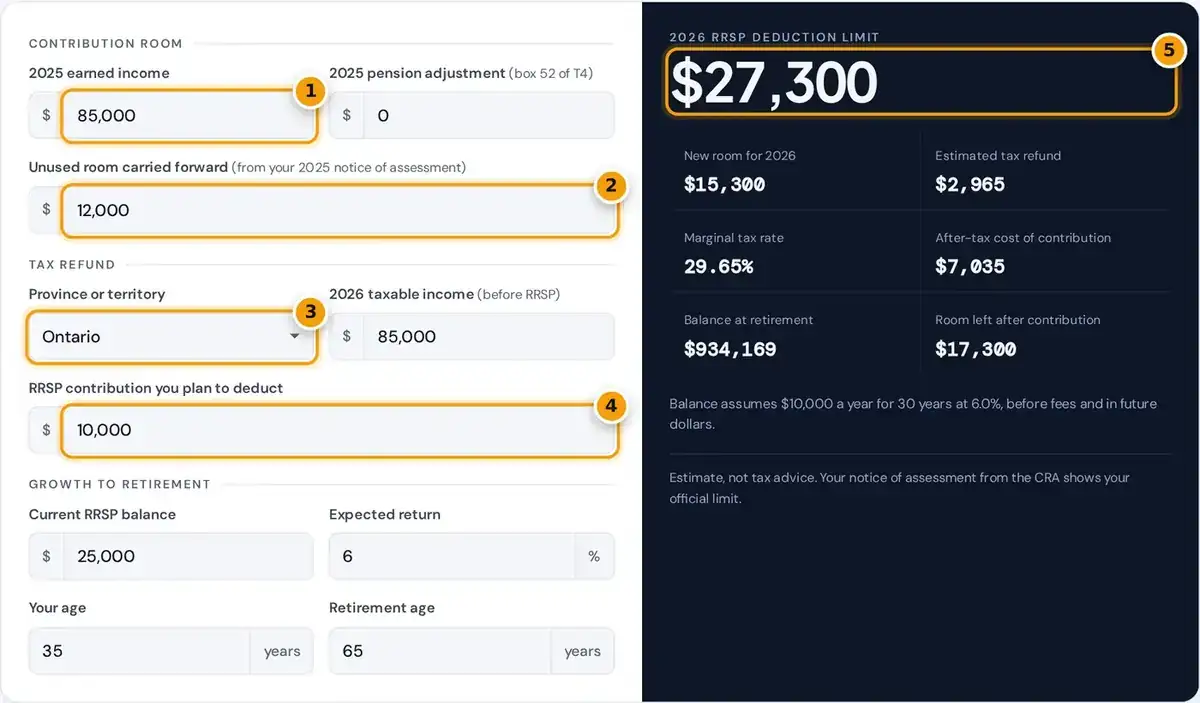
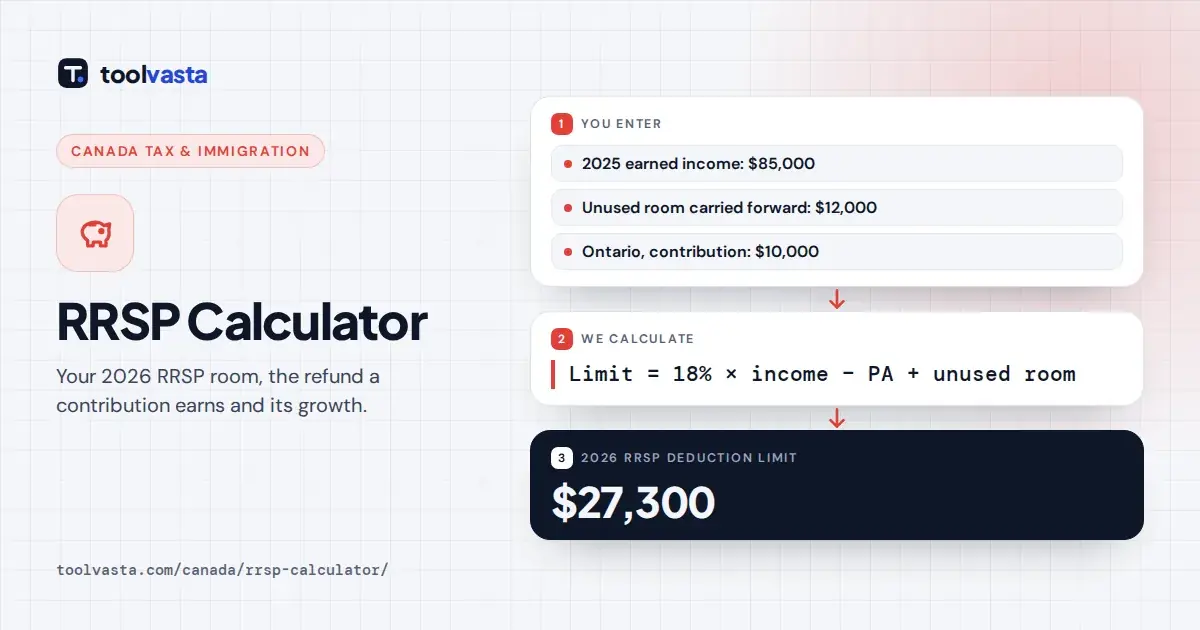
- Enter your 2025 earned income; 18% of it becomes new room, up to the 2026 maximum.
- Add unused room carried forward from your 2025 notice of assessment.
- Choose your province so the refund uses the right marginal tax rate.
- Enter the RRSP contribution you plan to deduct.
- Read your 2026 deduction limit, estimated tax refund and balance at retirement.
The calculator has three parts that update as you type. The first finds your 2026 deduction limit, the second estimates the tax refund from a contribution, and the third projects your RRSP balance at retirement.
For the limit, enter your 2025 earned income, the pension adjustment from box 52 of your T4 slip, and unused room. Your latest notice of assessment or CRA My Account shows the carried forward figure.
For the refund, choose your province or territory, then enter your 2026 taxable income and the contribution you plan to deduct. For growth, add your current balance, expected rate of return, age and retirement age.
How RRSP Contribution Room Is Calculated
Deduction limit = new room + unused room carried forward
Each year you earn new room equal to 18% of the previous year's earned income, capped at the dollar limit. Earned income mainly means employment and self-employment income, net rental income and certain support payments.
Investment income and pensions do not count. A pension adjustment reduces the new room if you belong to a workplace pension plan, because those benefits receive tax deferral inside the employer plan on your behalf.
The Canada Revenue Agency publishes the annual maximum in its table of RRSP dollar limits. The 2026 cap of $33,810 is reached with 2025 earned income of about $187,833, and the 2027 figure is set.
| Year | RRSP dollar limit |
|---|---|
| 2027 | $35,390 |
| 2026 | $33,810 |
| 2025 | $32,490 |
| 2024 | $31,560 |
| 2023 | $30,780 |
How the Tax Refund Is Estimated
An RRSP contribution is a deduction, so it lowers your taxable income rather than cutting your tax directly. The tax refund equals the tax on your income before the deduction minus the tax after it.
The calculator applies the 2026 federal and provincial tax brackets published by the CRA and Revenu Québec. It includes each basic personal amount, the Ontario surtax, the Ontario Health Premium and the 16.5% Quebec abatement.
A quick rule: your tax savings roughly equal the contribution times your combined marginal tax rate. When a large deduction crosses into a lower bracket, the saving per dollar drops, which the calculator captures automatically.
Worked Example: $10,000 in Ontario
An Ontario employee earned $85,000 in 2025 and has no workplace pension plan or pension adjustment. Eighteen percent of $85,000 is $15,300, well below the $33,810 cap, so the new room for 2026 is $15,300.
Adding $12,000 of unused room carried forward gives a deduction limit of $27,300. Deducting $10,000 from 2026 taxable income of $85,000 cuts total tax by about $2,965, which is the estimated tax refund for 2026.
Most of that deduction falls in the 20.5% federal and 9.15% Ontario brackets, a combined rate of 29.65%. The after-tax cost of the $10,000 contribution is therefore only about $7,035 for this employee in 2026.
Projecting RRSP Growth to Retirement
The growth section applies compound growth to your current balance and adds the same annual contribution at the end of every year. Investment income stays tax-deferred inside the plan until you withdraw it in retirement.
With the default inputs, a $25,000 balance, $10,000 a year and a 6% rate of return from age 35 to 65, the projection reaches about $934,169 in retirement savings before any income tax on withdrawal.
Returns are never guaranteed, so test a lower rate as well. The figure is in future dollars and ignores inflation and fees, so it helps to compare several scenarios, ideally with a qualified financial advisor.
RRSP vs TFSA
An RRSP gives you a deduction now and taxes withdrawals later. A TFSA gives no deduction, but growth and withdrawals are tax-free. Both shelter investment income, so the choice mainly depends on your tax rates.
The RRSP usually wins when your marginal rate today is higher than it will be in retirement, because withdrawals land in a lower tax bracket. The TFSA suits lower incomes and savings you need early.
You can contribute until December 31 of the year you turn age 71, when the plan must become a RRIF or annuity. A spousal RRSP can split retirement income between partners and reduce household tax.
Deadlines, Over-Contributions and Withdrawals
- Contributions made in the first 60 days of 2027 can be deducted on your 2026 return.
- The lifetime over-contribution buffer is $2,000. Excess amounts above it are taxed at 1% per month.
- Withdrawals count as income, and the bank holds back withholding tax at the time of withdrawal.
- The Home Buyers' Plan and Lifelong Learning Plan allow tax-free withdrawals that must be repaid.
The contribution deadline falls 60 days after the end of the year, so check the date each winter. You can contribute early and hold the deduction for a later year when your income is higher.
An over-contribution is easy to create when an employer group plan also deposits money. The calculator warns you when the planned amount goes over your limit, so you can adjust it before sending any money.
Withholding tax on an early withdrawal is only a prepayment. The full amount is added to your income for the year, and the final tax can be higher or lower once you file your return.
Assumptions and Limits
The refund is only an estimate. It ignores other tax credits and deductions, low-income tax reductions and the Quebec deduction for workers, so your actual refund can differ from the figure shown by the calculator.
Rates follow the CRA 2026 tax rates and brackets and the matching provincial and territorial tables. The growth projection assumes a steady return and an identical contribution every year, which real investment portfolios rarely deliver.
Always confirm your room on your notice of assessment before contributing. For complex situations, such as large pension adjustments, past-service adjustments or foreign income, a tax professional can check the numbers against your full return.
Frequently asked questions
What is the RRSP limit for 2026?
The RRSP dollar limit for 2026 is $33,810. Your personal limit is 18% of your 2025 earned income up to that amount, minus your pension adjustment, plus any unused room carried forward.
How much will I get back if I put $10,000 in an RRSP?
Roughly $10,000 times your combined marginal tax rate. An Ontario resident earning $85,000 saves about $2,965, because most of the deduction falls in brackets that add up to 29.65%.
Where can I find my RRSP contribution room?
Your RRSP deduction limit is printed on your latest notice of assessment and shown in CRA My Account. Unused room you carry forward from earlier years is already included.
What happens if I over-contribute to my RRSP?
The first $2,000 of over-contributions is allowed without penalty. Any excess above that is taxed at 1% per month until you withdraw it or new contribution room absorbs it.
When is the RRSP deadline for the 2026 tax year?
You can contribute until 60 days after the end of 2026 and still deduct the amount on your 2026 return. The CRA confirms the exact date each year.
Should I contribute to an RRSP or a TFSA?
An RRSP usually suits people whose tax rate today is higher than it will be in retirement. A TFSA suits lower incomes and money you may need before retirement, since withdrawals are tax-free.