How to Use the Severance Pay Calculator
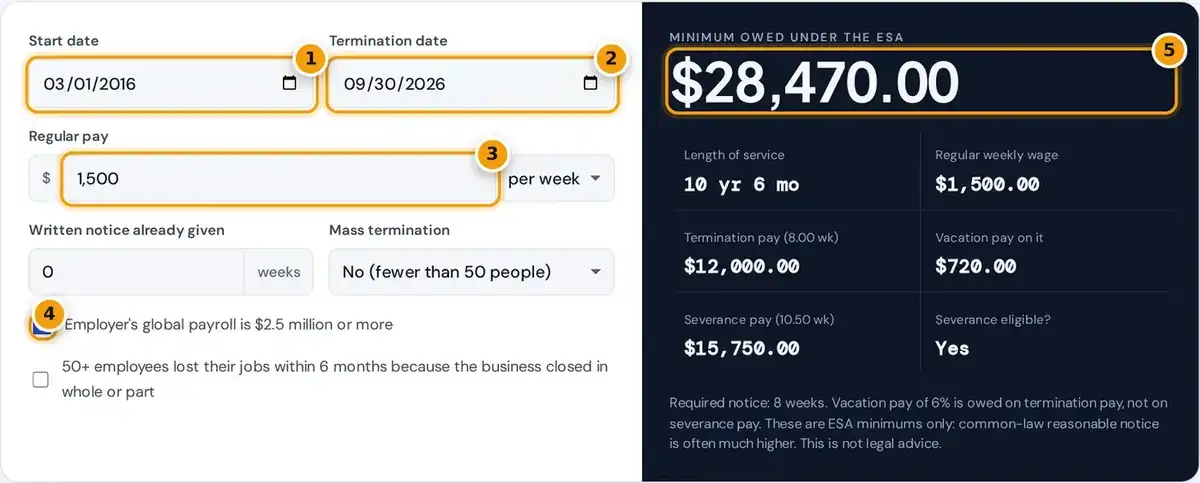
- Enter your start date with the employer.
- Enter your termination date.
- Enter your regular pay and choose weekly, yearly or hourly.
- Tick if your employer's payroll is $2.5 million or more.
- Read the minimum owed, split into termination pay, vacation pay and severance pay.
Enter your start date and your termination date, then your regular pay as a weekly amount, an annual salary or an hourly rate. For hourly pay, add your usual working hours per week as well.
If your employer gave you working notice before your last day, enter those weeks so they come off the total. Choose a mass termination size only if 50 or more people lost their jobs together.
Finally, tick whether the employer's payroll is $2.5 million or more, or whether a closure affected 50 or more employees. This severance calculator then shows termination pay, vacation pay on it and the severance pay.
Termination Pay: Notice by Length of Service
| Length of employment | Notice or termination pay |
|---|---|
| 3 months to less than 1 year | 1 week |
| 1 year to less than 3 years | 2 weeks |
| 3 years to less than 4 years | 3 weeks |
| 4 years to less than 5 years | 4 weeks |
| 5 years to less than 6 years | 5 weeks |
| 6 years to less than 7 years | 6 weeks |
| 7 years to less than 8 years | 7 weeks |
| 8 years or more | 8 weeks |
An employer that ends your job without cause must give written notice, pay in lieu of notice, or a mix, once you have worked at least 3 months. Termination pay covers the unworked notice weeks.
The notice period grows with length of service: 1 week under a year, 2 weeks from one to three years, then one extra week per year of service up to a maximum of 8 weeks.
Termination pay equals your regular weekly wage times the notice weeks you did not work. Any written notice already given reduces it week for week, which is exactly why the calculator asks for that number.
Mass Termination Notice
Longer notice applies when 50 or more employees are terminated at one location within four weeks. In that case the required notice depends on how many people lose their jobs, not on your individual service.
The ESA sets 8 weeks for 50 to 199 employees, 12 weeks for 200 to 499 and 16 weeks for 500 or more. The calculator applies these periods when you pick a mass termination size.
With the default profile above, choosing 500 or more employees raises the minimum owed to $41,190, because termination pay jumps from 8 weeks to 16 weeks while the severance pay portion stays exactly the same.
Severance Pay Under the ESA
Termination pay = regular weekly wage × (notice weeks − weeks of notice given)
Severance pay under Ontario's Employment Standards Act is paid separately, on top of termination pay. You need 5 or more years of service and an employer with a global payroll of at least $2.5 million.
A business closure can also trigger it: if 50 or more employees are severed within six months because all or part of the business permanently closes, eligible employees qualify even at a much smaller employer.
The amount is one week of regular wages per completed year of service, plus a fraction for completed months, capped at 26 weeks. The official ESA guide to severance pay sets out every condition clearly.
Worked Example
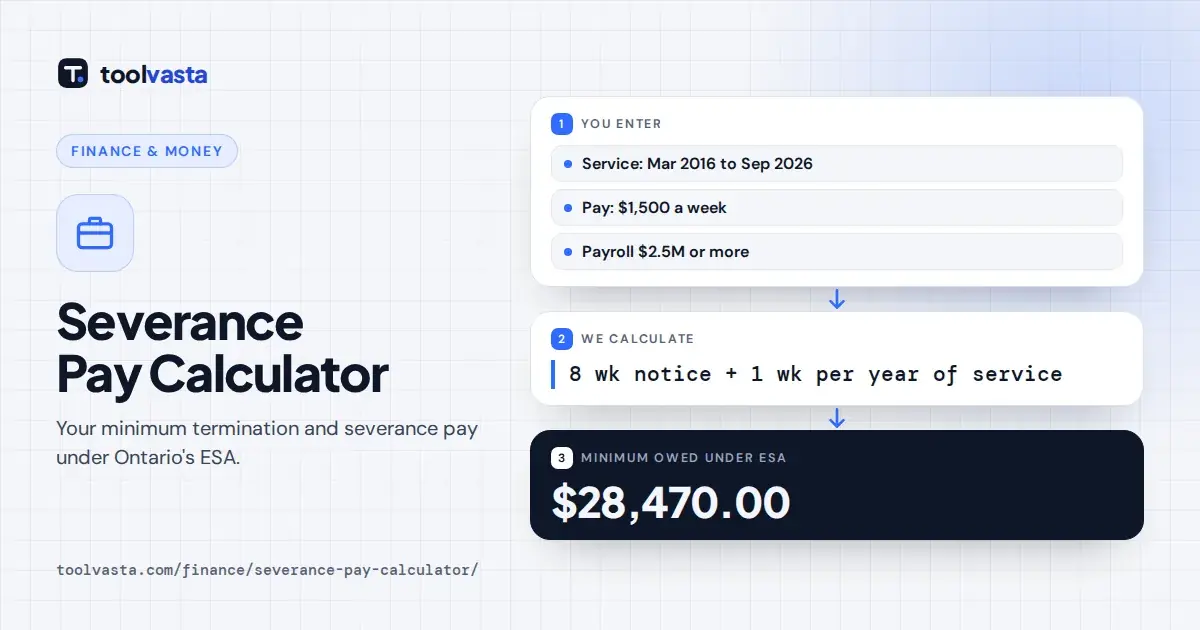
Take the defaults: an employee who started on March 1, 2016 and is terminated on September 30, 2026. That is 10 years and 6 completed months of service, at a regular weekly wage of $1,500.
Termination pay is 8 weeks times $1,500, or $12,000, plus 6% vacation pay of $720 because service is over five full years. Severance pay adds 10.5 weeks times the same $1,500, which comes to $15,750.
The minimum owed under the ESA is therefore $28,470. Untick the payroll box and severance pay disappears, leaving only $12,720 in total. With 2 weeks of working notice given instead, the total drops to $25,290.
Vacation Pay and Payment Timing
Vacation pay is owed on termination pay at 4% with under five years of service and 6% with five or more. It is not owed on severance, and the calculator applies the correct rate automatically.
Employers must usually pay termination and severance pay within seven days of the job ending or on the next pay day, whichever is later. Severance can sometimes be paid in installments with a written agreement.
Termination and severance pay can affect Employment Insurance, since separation payments may be allocated to weeks after your job ends and delay benefits. Apply for EI promptly anyway, so you do not lose any weeks.
Who Is Not Entitled
Some employees are not entitled to any termination or severance pay, including those guilty of wilful misconduct, disobedience or wilful neglect of duty that is not trivial and has not been condoned by the employer.
That ESA standard is narrower than common-law just cause, but both are hard for employers to prove. Being let go for poor performance alone does not usually remove your minimum statutory entitlement to termination pay.
Severance pay is also not owed to employees who refuse an offer of reasonable alternative employment, who retire on a full pension, or who work in certain construction roles. The ESA guide lists every exception.
Common-Law Reasonable Notice Can Be Much Higher
The ESA sets a floor, not a ceiling. Unless a valid employment contract limits you to ESA minimums, courts can award common-law reasonable notice, which is often many times larger than the ESA statutory amounts.
Courts weigh the Bardal factors: the character of employment, length of service, age, and the availability of similar work. Older, senior or long-serving employees usually receive the longest notice periods in wrongful dismissal court cases.
This tool does not estimate common-law notice, because courts decide each case on its facts. Before you sign a release or accept a package, speak with an employment lawyer about what your situation is worth.
Other Provinces
This calculator applies Ontario rules only. Alberta, Quebec, Manitoba, British Columbia and the other provinces set their own notice schedules, and most cap statutory notice at 8 weeks, although the service thresholds differ between them.
Ontario is quite unusual in adding a separate statutory severance payment. Federally regulated workplaces, such as banks and airlines, follow the Canada Labour Code instead, which has its own separate notice and severance pay rules.
For Ontario notice rules in full, read the government's guide to termination of employment, which also explains the mass termination rules. For other provinces, check the local employment standards office before relying on any figure.
Frequently asked questions
How is severance pay calculated in Ontario?
Multiply your regular weekly wage by your completed years of service plus completed months divided by 12, up to 26 weeks. You need 5 or more years of service and a $2.5 million payroll or a qualifying closure.
What is the difference between termination pay and severance pay?
Termination pay replaces the written notice your employer did not give, up to 8 weeks for individual terminations. Severance pay is an additional payment for long-service employees at larger employers, up to 26 weeks.
How much severance do I get after 10 years in Ontario?
If you qualify, 10 years of service gives 10 weeks of severance pay plus 8 weeks of termination pay under the ESA. Common-law notice for the same employee could be significantly higher than that.
Do I get vacation pay on termination pay?
Yes. Vacation pay is earned on termination pay, at 4% with less than 5 years of service or 6% with 5 or more years. It is not earned on severance pay, which is paid on top.
Does this apply in Alberta or Quebec?
No. This calculator uses Ontario's Employment Standards Act. Alberta, Quebec and the other provinces have different notice periods and generally no separate statutory severance payment, so check your own province's rules first.
What are the Bardal factors?
They are the factors courts use to set common-law reasonable notice: the character of employment, length of service, the employee's age and the availability of similar work. Together they often produce notice far above ESA minimums.