How to Use the Mortgage Calculator
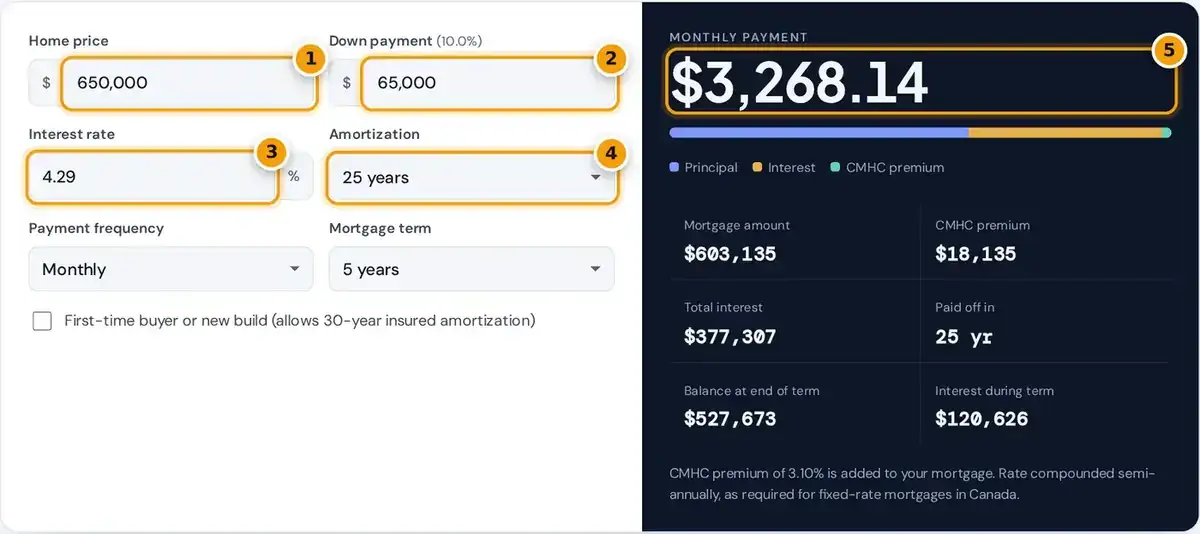
- Enter the home price you are looking at.
- Enter your down payment in dollars. The percentage and CMHC premium update automatically.
- Type the fixed or variable interest rate from your lender quote.
- Choose the amortization period, from 15 to 30 years.
- Read your payment, then check CMHC, total interest and the balance at the end of your term.
Type the home price and your down payment first. The mortgage calculator shows the down payment as a percentage beside its label, so you can see whether you are above or below the 20% line.
Next, enter the interest rate your lender quoted, choose an amortization period from 15 to 30 years, and pick a payment frequency. The mortgage term sets how long your current contract lasts, usually five years.
Tick the first-time buyer box if you qualify or are buying a new build. Every result, including the monthly payment, total interest and yearly amortization schedule, updates as you type, so comparing scenarios takes seconds.
The Mortgage Payment Formula Used in Canada
Canadian law requires a fixed-rate mortgage to be compounded semi-annually, not monthly. Semi-annual compounding gives a slightly lower effective rate than a typical US calculation, so the same quoted rate produces a smaller payment here.
Payment = M × i / (1 − (1 + i)−N)
The calculator turns the annual rate r into a periodic rate i for your frequency, where n is the number of payments per year. It then applies the annuity formula to the mortgage amount M.
N is the number of payments over the amortization. Early payments are mostly interest because the balance is large. As the principal falls, more of each payment repays the loan, as the yearly schedule shows.
Worked Example: A $650,000 Home With 10% Down
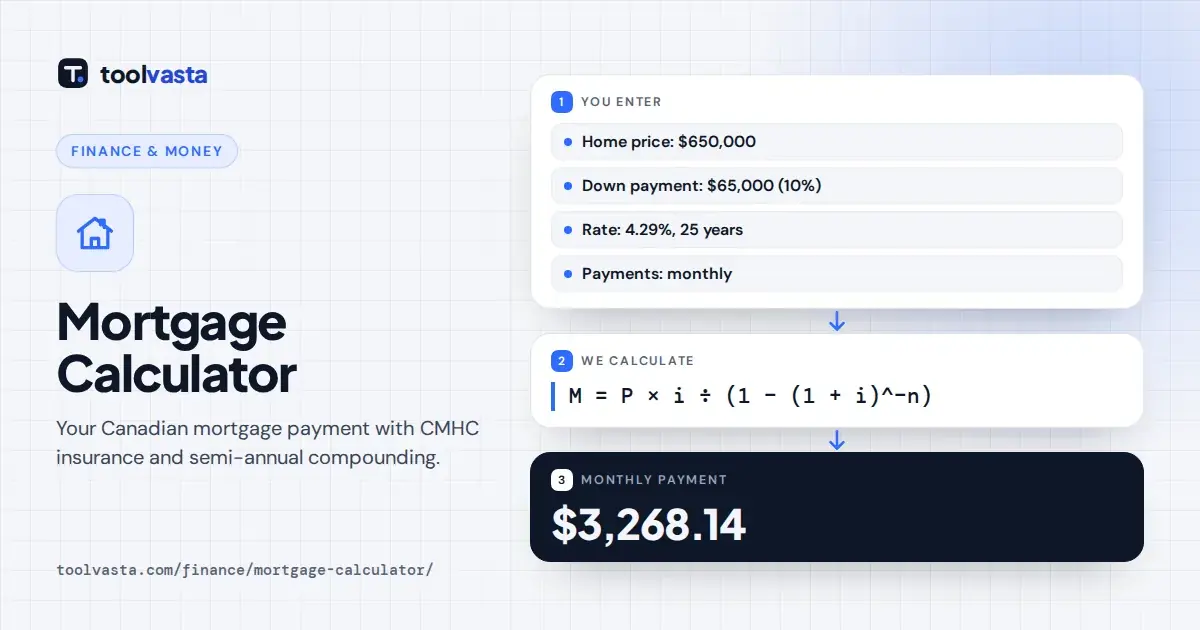
Take a $650,000 home purchase with $65,000 down, which is 10%. The loan is $585,000, giving a loan-to-value ratio of 90%. That band carries a CMHC premium of 3.10%, which works out to exactly $18,135.
The premium is added to the loan, so the mortgage amount becomes $603,135. At 4.29% with a 25-year amortization and monthly payments, the calculator returns a payment of $3,268.14 and total interest of about $377,307.
| Frequency | Payment | Total interest | Paid off in |
|---|---|---|---|
| Monthly | $3,268.14 | $377,307 | 25 years |
| Bi-weekly | $1,506.94 | $376,373 | 25 years |
| Accelerated bi-weekly | $1,634.07 | $321,712 | 21 years 9 months |
| Accelerated weekly | $817.03 | $321,092 | 21 years 9 months |
After the first five-year term you would still owe about $527,673, having already paid roughly $120,626 in interest. Open the amortization schedule under the result to see principal, interest and ending balance for every year.
Minimum Down Payment in Canada
The minimum down payment depends on the purchase price. Federal rules, summarized by the Financial Consumer Agency of Canada, set three clear tiers, and the calculator blocks any down payment below the required minimum amount.
| Purchase price | Minimum down payment |
|---|---|
| $500,000 or less | 5% of the price |
| $500,000 to $1,499,999 | 5% of the first $500,000 plus 10% of the rest |
| $1.5 million or more | 20% of the price |
For the $650,000 example, the minimum is $25,000 (5%) on the first $500,000 plus $15,000 (10%) on the remaining $150,000, a total of $40,000. The $65,000 in the default scenario comfortably clears that required minimum.
With 20% down or more you have an uninsured mortgage and pay no premium. Homes priced at $1.5 million or more always need 20% down, because default insurance is not available at that price level.
CMHC Mortgage Default Insurance Premiums
Mortgage default insurance is required when you put less than 20% down. It is provided by CMHC, Sagen or Canada Guaranty, protects the lender rather than you, and is normally added to the mortgage balance.
| Loan-to-value | Premium |
|---|---|
| Up to 65% | 0.60% |
| 65.01% to 75% | 1.70% |
| 75.01% to 80% | 2.40% |
| 80.01% to 85% | 2.80% |
| 85.01% to 90% | 3.10% |
| 90.01% to 95% | 4.00% |
An insured mortgage amortized beyond 25 years attracts an extra 0.20% premium surcharge. A 30-year amortization on an insured loan is limited to first-time buyers and purchases of a new build, which the checkbox controls.
In Ontario, Quebec and Saskatchewan, provincial sales tax applies to the premium. That tax cannot be rolled into the loan, so it must be paid in cash at closing. The calculator does not add it.
Which Payment Frequency Saves the Most?
Monthly, semi-monthly, bi-weekly and weekly payments all repay the loan over the same amortization. Paying more often trims total interest only slightly, by about $900 over 25 years for bi-weekly in the worked example above.
Accelerated bi-weekly and accelerated weekly payments are different. They take the monthly payment, divide it by two or four, and pay it 26 or 52 times a year. That adds roughly one extra payment annually.
In the worked example, switching from monthly to accelerated bi-weekly saves about $55,595 in interest and clears the loan in 21 years 9 months. A federal guide explains other practical ways to pay off faster.
Mortgage Term Versus Amortization
The amortization is the time needed to repay the loan. The term is the length of your contract, commonly from one to ten years. At each term's end you face renewal at the going rate.
That is why the calculator reports the balance at end of term and the interest during term. Those two figures show how much debt you carry into renewal and what the first contract costs you.
A closed mortgage usually has a lower rate but limits prepayment privileges, such as a yearly lump-sum payment. An open mortgage lets you repay anytime without a penalty, typically at a higher rate. Compare both.
What the Calculator Does Not Include
Results are estimates only. The payment covers principal and interest only. Closing costs, land transfer tax, legal fees, property taxes, home insurance and condo fees are extra, and they belong in your monthly housing budget.
Lenders also test affordability. They compare housing costs with gross income, a ratio called gross debt service, and apply a federal stress test at a qualifying rate that is higher than your actual contract rate.
Some lenders compound a variable-rate mortgage differently from the semi-annual method used here, so variable payments can differ. Confirm final figures with your lender or a licensed mortgage broker before you commit to any offer.
Frequently asked questions
How is a mortgage payment calculated in Canada?
Lenders convert the quoted annual rate into a rate per payment using semi-annual compounding, then apply the annuity formula to the mortgage amount and the number of payments. The calculator above does this automatically for every payment frequency.
How much down payment do I need for a house in Canada?
You need 5% on the first $500,000 of the price and 10% on the portion from $500,000 up to $1.5 million. Homes priced at $1.5 million or more need at least 20% down.
When do I have to pay CMHC insurance?
Mortgage default insurance is required when your down payment is less than 20% of the purchase price. Premiums range from 0.60% to 4.00% of the loan depending on loan-to-value, and the premium is normally added to your mortgage.
Is accelerated bi-weekly better than monthly?
Regular bi-weekly payments cost almost the same as monthly. Accelerated bi-weekly payments add about one extra monthly payment each year, so a 25-year mortgage is usually repaid several years sooner with far less total interest.
Can I get a 30-year mortgage in Canada?
Yes. Uninsured mortgages with 20% or more down can be amortized over 30 years. Insured mortgages can use 30 years if you are a first-time buyer or buying a new build, with a 0.20% premium surcharge.
Is there a grace period for a missed mortgage payment?
Most Canadian lenders do not offer a formal grace period, and a missed payment can trigger fees and affect your credit. Contact your lender early if you expect trouble, since relief options are easier to arrange before arrears build.