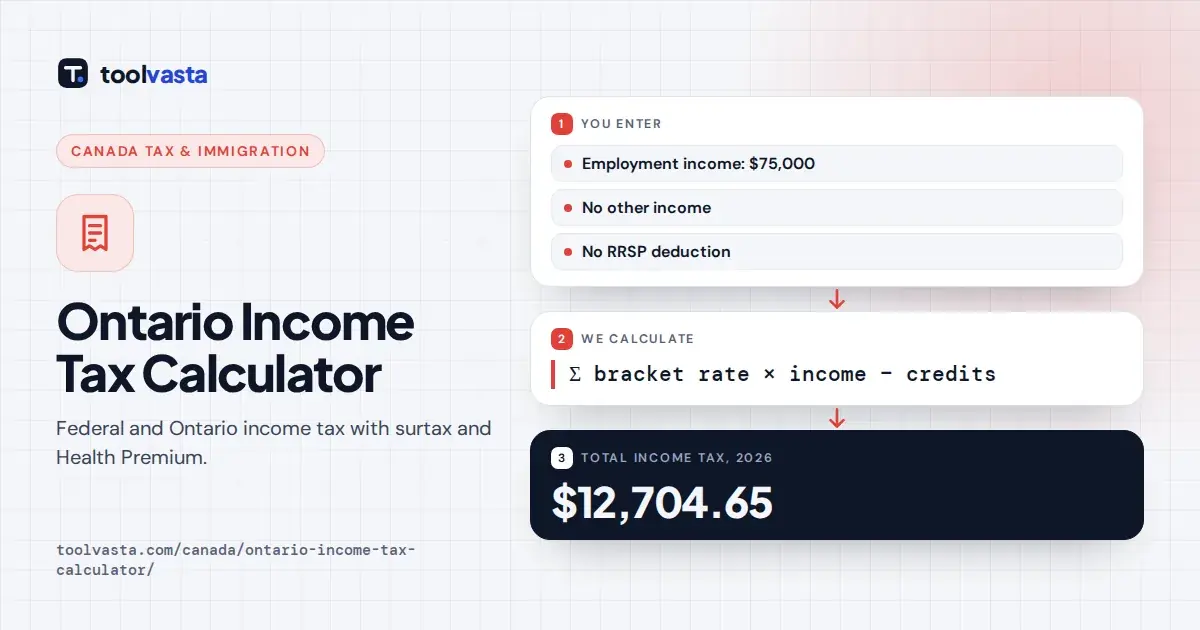
How to Use the Ontario Income Tax Calculator
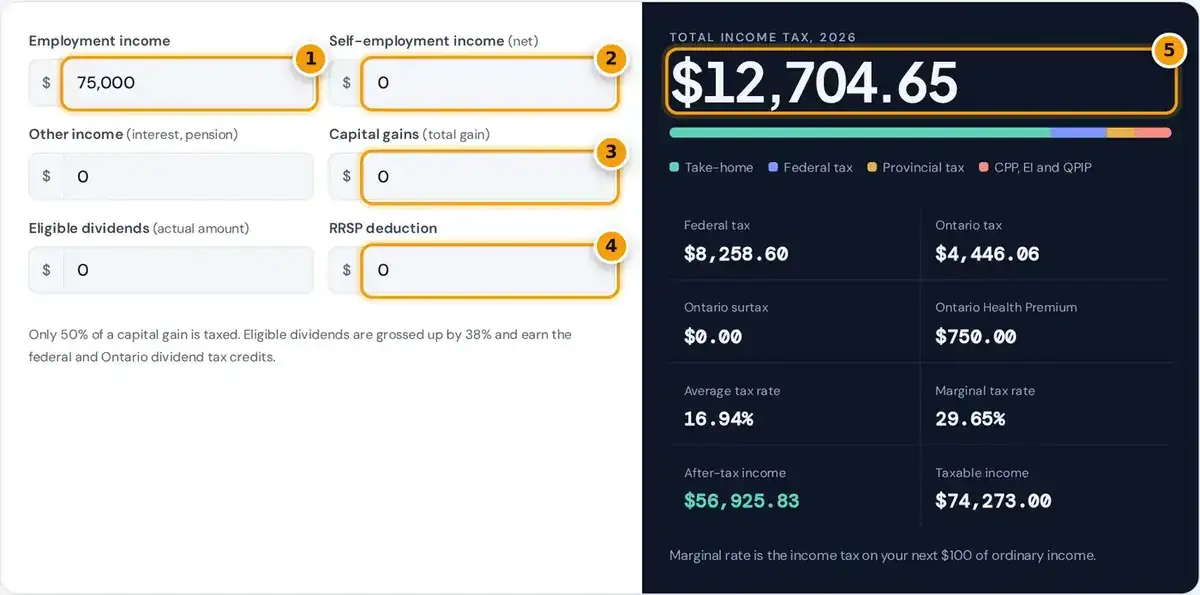
- Enter your 2026 employment income.
- Add net self-employment income, if any.
- Enter capital gains; only 50% of the gain is taxed.
- Enter your RRSP deduction to see how it lowers the tax.
- Read total tax, federal and Ontario parts, average and marginal rates.
Enter your expected 2026 income by type. Most people only need employment income. Add self-employment income, other income such as interest or pension, capital gains, eligible dividends and any RRSP deduction you plan to claim.
The Ontario income tax calculator then shows total income tax, the federal and Ontario parts, the Ontario surtax and Health Premium, your taxable income and your after-tax income once CPP and EI are taken off.
Two rates sit beside those figures. The average tax rate is total tax divided by income, while the marginal tax rate is the share of your next dollar that goes to tax. Tables follow below.
2026 Federal and Ontario Tax Brackets
Canada uses progressive tax brackets, so each rate applies only to the income inside its band. Moving into a higher bracket never raises the tax on income below that threshold, a common and costly misunderstanding.
| Ontario taxable income | Ontario rate |
|---|---|
| $0 to $53,891 | 5.05% |
| $53,891 to $107,785 | 9.15% |
| $107,785 to $150,000 | 11.16% |
| $150,000 to $220,000 | 12.16% |
| Over $220,000 | 13.16% |
For the 2026 tax year, federal tax is 14% up to $58,523, 20.5% to $117,045, 26% to $181,440, 29% to $258,482 and 33% beyond that point, as officially published by the federal Canada Revenue Agency.
The Ontario basic personal amount is $12,989 and the federal amount is $16,452, reduced for high incomes. Most thresholds are indexed to inflation each year, so they rise slightly every January to protect purchasing power.
How Ontario Income Tax Is Calculated
Federal tax and Ontario tax are calculated separately on taxable income, then simply added together. Each one starts with bracket tax and subtracts non-refundable credits at the lowest rate: 14% federally and 5.05% in Ontario.
Surtax = 20% × (basic tax − $5,818) + 36% × (basic tax − $7,446)
Ontario tax = basic tax + surtax − tax reduction − LIFT + Health Premium
Credits include the basic personal amount, the base part of CPP contributions and EI premiums, plus the federal Canada employment amount. The Ontario surtax adds 20% and 36% of basic Ontario tax above two thresholds.
The Ontario tax reduction removes tax for very low incomes, with a $300 basic amount. The LIFT credit is 5.05% of employment income up to $875, and the Ontario Health Premium adds up to $900.
CPP, CPP2 and EI Deductions
Employees pay CPP contributions of 5.95% on earnings between $3,500 and $74,600, for a maximum contribution of $4,230.45 in 2026. CPP2 then adds 4% on earnings from $74,600 to $85,000, up to $416 each year.
EI premiums are 1.63% of earnings up to the maximum insurable earnings of $68,900, for a maximum of $1,123.07. Self-employment income pays both halves of CPP but no EI unless you choose to opt in.
The enhanced CPP portion and CPP2 are deducted from income, while the base CPP amount and EI earn credits. The calculator subtracts all of these before showing take-home pay, so it matches a real paycheck.
Worked Example: A $75,000 Salary in Ontario
Here is a worked example for a single $75,000 salary in 2026. CPP is $4,230.45, CPP2 is $16 and EI is $1,123.07. The enhanced CPP portion of $727 is deductible, so taxable income is $74,273.
Federal tax is $11,421.97 before credits, minus 14% of $22,595.52 in credits, leaving $8,258.60 federally. Ontario tax is $4,586.45 before credits, minus 5.05% of $17,631.52 in credits, which gives $3,696.06 of basic Ontario tax payable.
| Line | Amount |
|---|---|
| Federal tax | $8,258.60 |
| Ontario tax, including $750 Health Premium | $4,446.06 |
| Total income tax | $12,704.65 |
| Average tax rate | 16.94% |
| Marginal tax rate | 29.65% |
| After-tax income | $56,925.83 |
No surtax applies at this income, but the $750 Health Premium brings Ontario tax to $4,446.06, so total income tax is $12,704.65. After CPP and EI, take-home pay is $56,925.83, with a 29.65% combined rate.
Ontario Marginal Tax Rates in 2026
Your combined marginal rate is the federal and Ontario rate on the next dollar of ordinary income. It decides what a raise, a bonus or an RRSP deduction is worth, so it matters a lot.
| Taxable income | Combined marginal rate |
|---|---|
| $58,523 to $94,907 | 29.65% |
| $94,907 to $107,785 | 31.48% (20% surtax starts) |
| $117,045 to $150,000 | 43.41% |
| $181,440 to $220,000 | 48.26% |
| Over $258,482 | 53.53% |
The top marginal rate is 53.53% above $258,482, once the surtax is included. A $120,000 salary pays $26,887.71 in total income tax at a 43.41% marginal rate, while a $40,000 salary pays just $3,844.46 overall.
The table assumes only basic credits and ignores the Health Premium where it is phasing in. The calculator includes the premium, so its marginal figure can be a little higher in those narrow income ranges.
Capital Gains, Dividends and Interest Income
Only half of a capital gain is taxable in 2026, because the capital gains inclusion rate stays at 50%. Adding a $20,000 gain to the same $75,000 salary raises total tax from $12,704.65 to $15,669.65.
Eligible dividends receive a 38% gross-up, and the federal and Ontario dividend tax credit then largely offsets much of that tax. A $60,000 salary plus $5,000 of eligible dividends pays $8,639.98 in total income tax.
Interest income is fully taxable at your marginal rate, with no credit at all. That is why holding interest-paying investments inside an RRSP or TFSA often saves more tax than holding stocks paying eligible dividends.
What the Calculator Assumes and When to File
This is an estimate. It assumes you are single, lived in Ontario on December 31, 2026, and claim basic credits. Medical expenses, donations, tuition, pension splitting and non-eligible dividends are not included in the result.
A tax deduction lowers taxable income, while a tax credit lowers the tax itself. Benefits such as the Ontario Trillium Benefit and the Canada Workers Benefit are separate, and the Ontario tax provisions explain LIFT.
Your 2026 return is due by April 30, 2027, or June 15 if you or your spouse are self-employed, though any balance owing is due April 30. Withholding decides whether you receive a tax refund.
Frequently asked questions
How much income tax do I pay on $75,000 in Ontario?
In 2026, a $75,000 salary pays about $8,258.60 in federal tax and $4,446.06 in Ontario tax, including a $750 Health Premium. After CPP and EI, take-home pay is about $56,925.83.
What is the Ontario surtax?
The surtax is extra provincial tax: 20% of basic Ontario tax above $5,818 plus 36% of basic Ontario tax above $7,446 in 2026. With only basic credits, it starts at about $94,907 of taxable income.
How much is the Ontario Health Premium?
It is $0 up to $20,000 of taxable income and rises in steps to $300, $450, $600, $750 and a maximum of $900 for income above $200,000. It is collected through payroll and on your tax return.
What is the top marginal tax rate in Ontario?
For 2026 the top combined federal and Ontario rate is 53.53% on taxable income above $258,482. Because only half of a capital gain is taxable, gains at that level are taxed at about 26.76%.
Are capital gains taxed at 50% in 2026?
Yes. The proposed increase to a two-thirds inclusion rate was cancelled in March 2025, so only half of a capital gain is added to taxable income in 2026 and taxed at your marginal rate.
How do RRSP contributions reduce my Ontario tax?
An RRSP deduction lowers taxable income dollar for dollar, so it saves tax at your combined marginal rate. At a $75,000 salary, each $1,000 deducted saves close to $296.50 in federal and Ontario tax.