How to Use the Protein Intake Calculator
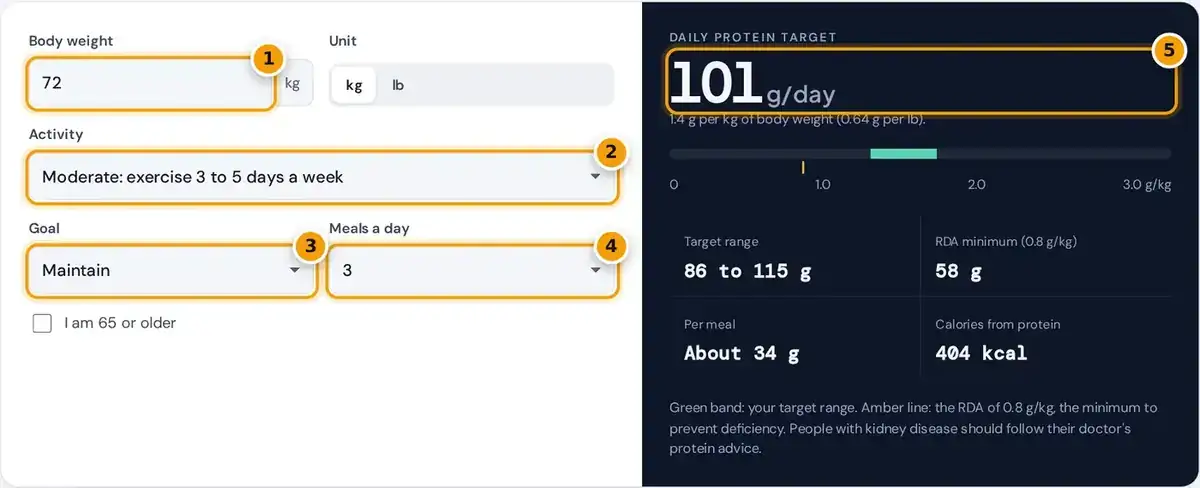
- Enter your body weight in kg or lb.
- Choose your activity level.
- Pick your goal: maintain, build muscle or lose fat while keeping muscle.
- Choose how many meals you eat to see protein per meal.
- Read your daily protein target, the range and how it compares with the RDA.
Enter your body weight in kilograms or pounds, choose your activity level and pick a goal: maintain, build muscle or lose fat while keeping muscle. Then set how many meals you usually eat each day.
Tick the box if you are 65 or older, because protein needs rise with older age. The result updates instantly, with no extra button to press, and the weight converts automatically when you switch units.
You get a daily target in grams, a target range, RDA minimum for comparison, protein per meal and calories from protein. The green band on the scale shows your range against the amber RDA line.
How Your Protein Target Is Set
Target = middle of the range for your activity and goal
Per meal = daily target ÷ number of meals
| Situation | Protein per kg |
|---|---|
| RDA, healthy adults (minimum) | 0.8 g/kg |
| Sedentary | 0.8 to 1.0 g/kg |
| Lightly active | 1.0 to 1.2 g/kg |
| Moderately active | 1.2 to 1.6 g/kg |
| Very active or athletes | 1.4 to 2.0 g/kg |
| Building muscle with strength training | 1.6 to 2.2 g/kg |
| Losing fat while keeping muscle | Range above plus 0.4 g/kg, up to 2.2 |
| Adults 65 and older | At least 1.0 to 1.2 g/kg |
Your target is body weight multiplied by a protein factor in grams per kilogram, or g/kg. It picks a range for your activity and goal, then uses the middle of that range as the target.
The floor is the Recommended Dietary Allowance, or RDA, of 0.8 g/kg from the Dietary Reference Intakes used by Health Canada. It covers nearly all healthy adults but is only a minimum, not an ideal.
Active people need more. Sports nutrition groups, including Dietitians of Canada, recommend 1.2 to 2.0 g/kg for athletes, and the ranges in the table above step up with training volume from sedentary to very active.
Protein for Muscle Gain
To build muscle, the calculator uses 1.6 to 2.2 g/kg, combined with regular strength training or other resistance training. Protein supplies the amino acids that drive muscle protein synthesis after each workout and during recovery.
A 2018 meta-analysis by Morton and colleagues found that extra protein boosted strength training gains up to about 1.6 g/kg a day, with 2.2 g/kg covering almost everyone. That neatly explains the range used here.
Training is what builds muscle; protein only supports it. For muscle gain, eating more than 2.2 g/kg brings very little extra benefit, so spend those extra calories on carbohydrates that fuel harder training sessions instead.
Protein for Weight Loss
When you lose fat, the calculator adds 0.4 g/kg to your activity range, up to 2.2 g/kg. A higher intake helps preserve muscle during a calorie deficit, so more of the lost weight is fat.
Protein also improves satiety, or fullness. Meals built around lean protein tend to keep you fuller for longer than meals of refined carbohydrates, which makes a lower calorie intake easier to stick with over weeks.
For a sedentary 72 kg adult who wants to lose fat, the range becomes 1.2 to 1.4 g/kg, or 86 to 101 g a day, with a daily target of 94 g, the middle point.
Worked Example
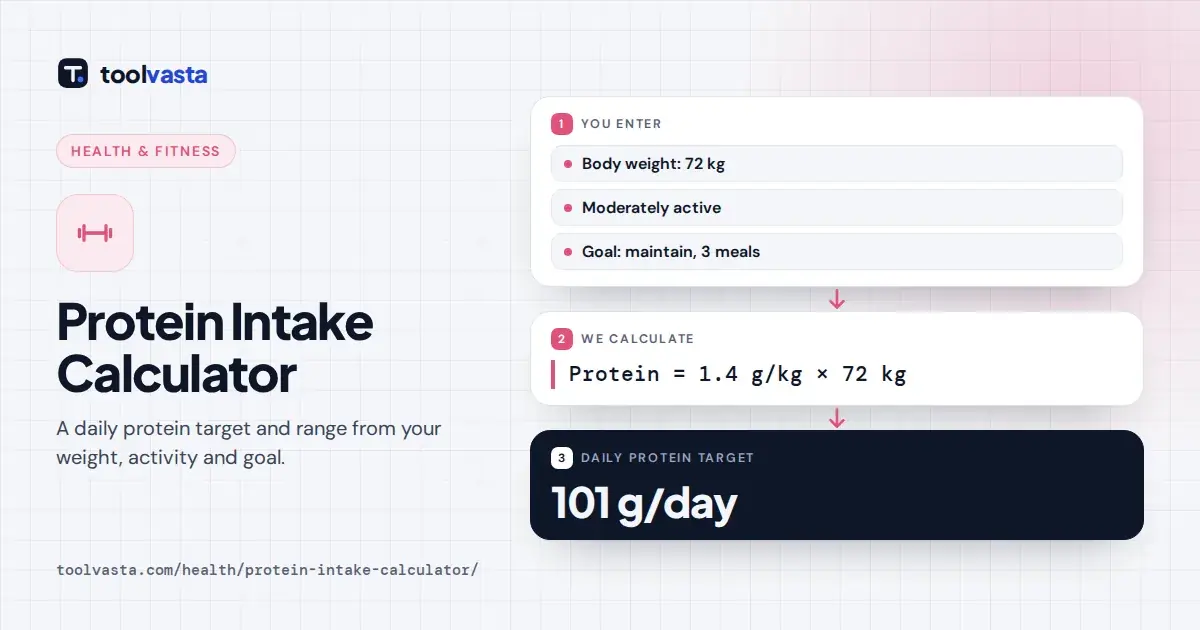
Take the defaults: a 72 kg adult who exercises 3 to 5 days a week and wants to maintain weight. The moderate range is 1.2 to 1.6 g/kg, which is 86 to 115 g daily.
The target is the middle, 1.4 g/kg, or 101 g a day. Across three meals that is about 34 g per meal, and calories from protein come to 404 kcal at 4 kcal per gram.
The RDA minimum for the same person is 72 times 0.8, or 58 g. Switch the goal to build muscle and the range becomes 115 to 158 g, with a daily target of 137 g.
Protein per Meal and Food Sources
Spreading protein across the day works better for muscle than eating most of it at dinner. Reviews suggest about 0.4 g/kg per meal over at least four meals, which is roughly 20 to 40 g.
Good sources include eggs, Greek yogurt, cottage cheese, milk, fish, chicken, lean meat, tofu, lentils and beans. Animal foods and soy contain all the essential amino acids, so they all count as complete protein sources.
Plant-based protein works well too when you mix sources through the day, such as beans with grains. Vegans may aim toward the top of their range, because some plant proteins are digested slightly less efficiently.
Older Adults and Pregnancy
Older adults lose muscle more easily, a process called sarcopenia. Expert groups such as the PROT-AGE study group recommend at least 1.0 to 1.2 g/kg, which the calculator applies when you tick 65 or older.
For a 72 kg sedentary adult aged 65 or older, the range moves from 58 to 72 g to 72 to 86 g daily. Pairing protein with resistance exercise gives the best protection for muscle.
Needs also rise during pregnancy and breastfeeding. The Dietary Reference Intake for pregnancy is 1.1 g/kg a day, so pregnant and breastfeeding readers should ask a doctor or registered dietitian for a personal target instead.
Safety and Limits
For healthy adults, intakes up to about 2 g/kg appear safe. Too much protein is mainly a concern for people with kidney disease, who should follow the protein advice of their own doctor or dietitian.
Targets based on total body weight can be too high for people carrying a lot of body fat. In that case, use your goal weight instead, for a more realistic figure that still protects muscle.
Food should supply most daily protein, with supplements or protein powder filling gaps. Targets are daily averages, so a lower day balanced by a higher day is fine. This is an estimate, not medical advice.
Frequently asked questions
How much protein do I need per day?
The RDA for healthy adults is 0.8 g per kg of body weight. Active people usually benefit from 1.2 to 2.0 g/kg, and people building muscle from about 1.6 to 2.2 g/kg of body weight.
How much protein do I need to build muscle?
Aim for about 1.6 to 2.2 g of protein per kg of body weight a day, combined with regular strength training. Most people see little extra benefit above 1.6 g/kg, according to a large 2018 meta-analysis.
How much protein should I eat per meal?
Around 0.4 g per kg of body weight per meal, which is about 20 to 40 g for most adults, spread over three to five meals. The calculator divides your daily target by your chosen meals.
How much protein should I eat to lose weight?
During a calorie deficit, many adults do well with about 1.2 to 1.6 g/kg or more. This calculator adds 0.4 g/kg to your activity range, up to 2.2 g/kg, to help preserve muscle.
Is too much protein harmful?
For healthy adults, intakes up to about 2 g/kg appear safe. People with kidney disease should follow their doctor's advice on protein, and anyone with a medical condition should check before a big change.
Should I calculate protein from my current or goal weight?
If you carry a lot of extra body fat, use your goal weight. It gives a more realistic target that still supports muscle, while leaner people can use their current body weight.