How to Use the Rucking Calorie Calculator
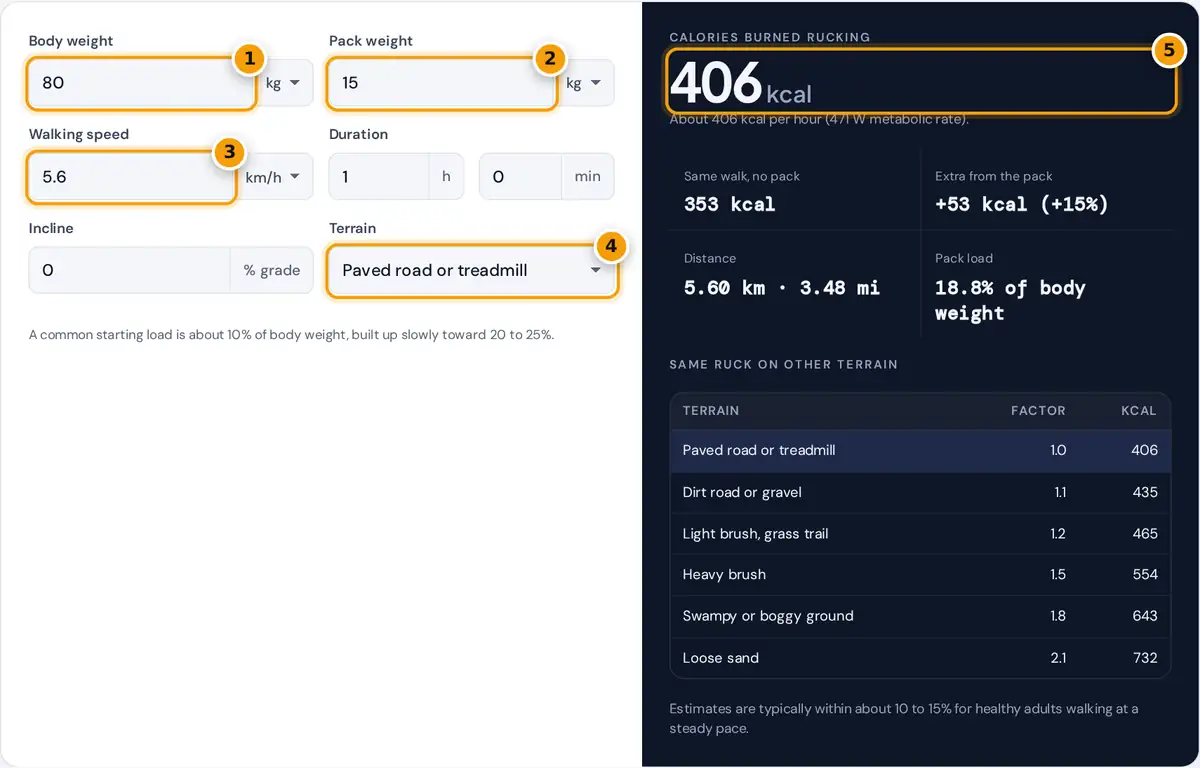
- Enter your body weight in kg or lb.
- Enter the weight of your pack or weighted vest.
- Enter your walking speed and how long you rucked.
- Set the incline and choose the terrain, from pavement to loose sand.
- Read calories burned, then compare with the same walk without a pack.
Enter your body weight and the weight of your pack, in kilograms or pounds. Add your average walking speed, how long you rucked, the incline as a percentage grade and the type of ground. A treadmill or road counts as the easiest terrain. Soft surfaces such as sand take far more effort for the same speed.
The result shows total calories burned, calories per hour, the calories you would burn on the same walk without a pack, and the extra energy the pack adds. A table repeats the same ruck on six terrain types so you can see how much a trail or a beach changes the cost.
The Pandolf Load Carriage Equation
kcal = M (watts) × seconds ÷ 4,184
Here W is body mass in kg, L is the load in kg, V is speed in meters per second, G is the grade in percent and η is the terrain factor. The equation was published by Pandolf, Givoni and Goldman in 1977 from US Army research on soldiers carrying packs, and it is still the standard way to estimate the energy cost of load carriage.
Worked Example
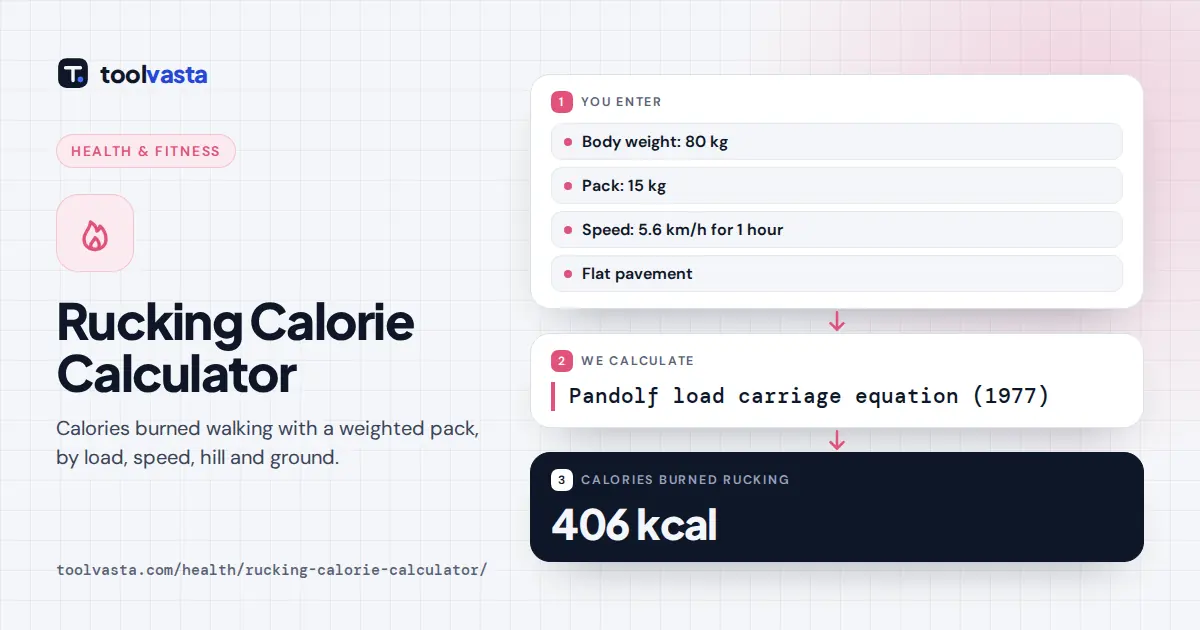
An 80 kg person carries a 15 kg pack on a paved road at 5.6 km/h (1.556 m/s) for one hour on flat ground:
- 1.5 × 80 = 120 W for standing with a body mass of 80 kg
- 2.0 × 95 × (15 ÷ 80)² = 6.7 W for holding the load
- 1.0 × 95 × 1.5 × 1.556² = 344.9 W for walking
That totals 471.5 W, or 471.5 × 3,600 ÷ 4,184 = 406 kcal in an hour. The same walk without a pack works out to about 353 kcal, so the pack adds roughly 53 kcal, or 15%.
Terrain Factors
| Terrain | Factor η |
|---|---|
| Paved road, treadmill | 1.0 |
| Dirt road | 1.1 |
| Light brush | 1.2 |
| Heavy brush | 1.5 |
| Swampy bog | 1.8 |
| Loose sand | 2.1 |
The terrain factor multiplies only the walking part of the equation. Loose sand roughly doubles the cost of moving compared with pavement, which matches how much harder a beach walk feels.
Calories per Hour by Pack Weight
| Pack weight | Flat road | 5% incline |
|---|---|---|
| No pack | 353 kcal | 540 kcal |
| 10 kg (22 lb) | 387 kcal | 598 kcal |
| 15 kg (33 lb) | 406 kcal | 628 kcal |
| 20 kg (44 lb) | 426 kcal | 661 kcal |
| 25 kg (55 lb) | 449 kcal | 695 kcal |
Figures are for an 80 kg person walking at 5.6 km/h (3.5 mph) on pavement, calculated with the same equation as the tool. Going from no pack to 25 kg adds about 96 kcal an hour on flat ground, while a 5% incline adds about 187 kcal even without a pack.
Rucking Tips
- Start light. About 10% of body weight is a sensible first load. Increase pack weight or distance, not both at once.
- Keep the weight high and tight. A plate carried high against the back is easier on the shoulders than a loose load.
- Walk, do not run. Running with a heavy pack raises impact on joints. The Pandolf equation also applies to walking only.
- Use hills. A 5% grade raises the calorie burn more than adding several kilograms to the pack.
Limits
The equation does not cover downhill walking, which needs a separate correction. It can underestimate energy use at very slow speeds and was developed with fit young adults, so individual results vary. Treat the number as an estimate for planning and comparing workouts.
Results are estimates for general information, not medical advice. Talk with a doctor or registered dietitian before big changes to diet, exercise or sleep, especially if you are pregnant, under 18 or managing a health condition.
Frequently asked questions
How many calories does rucking burn?
An 80 kg person carrying 15 kg at 5.6 km/h on flat pavement burns about 406 kcal an hour. Heavier packs, hills and soft ground raise that number.
How much more do you burn rucking than walking?
It depends on the load. A 15 kg pack adds about 15% for an 80 kg person on flat ground. Adding a 5% incline raises the burn far more than extra pack weight.
What is the Pandolf equation?
It is a load carriage formula from US Army research published in 1977. It estimates energy use in watts from body mass, load, walking speed, grade and a terrain factor.
How heavy should my rucksack be?
Many people start with about 10% of body weight and build toward 20 to 25% over weeks. Loads above about 30% of body weight are heavy and need careful progression.
Does a weighted vest count as rucking?
Yes. The equation only cares about the total load you carry. A vest spreads the weight around the torso, which some people find more comfortable than a backpack.
Is rucking good for weight loss?
Rucking burns more calories than plain walking at the same pace and is low impact. Weight loss still depends on your total diet and activity over time, not one type of exercise.