How to Use the Step Calorie Calculator
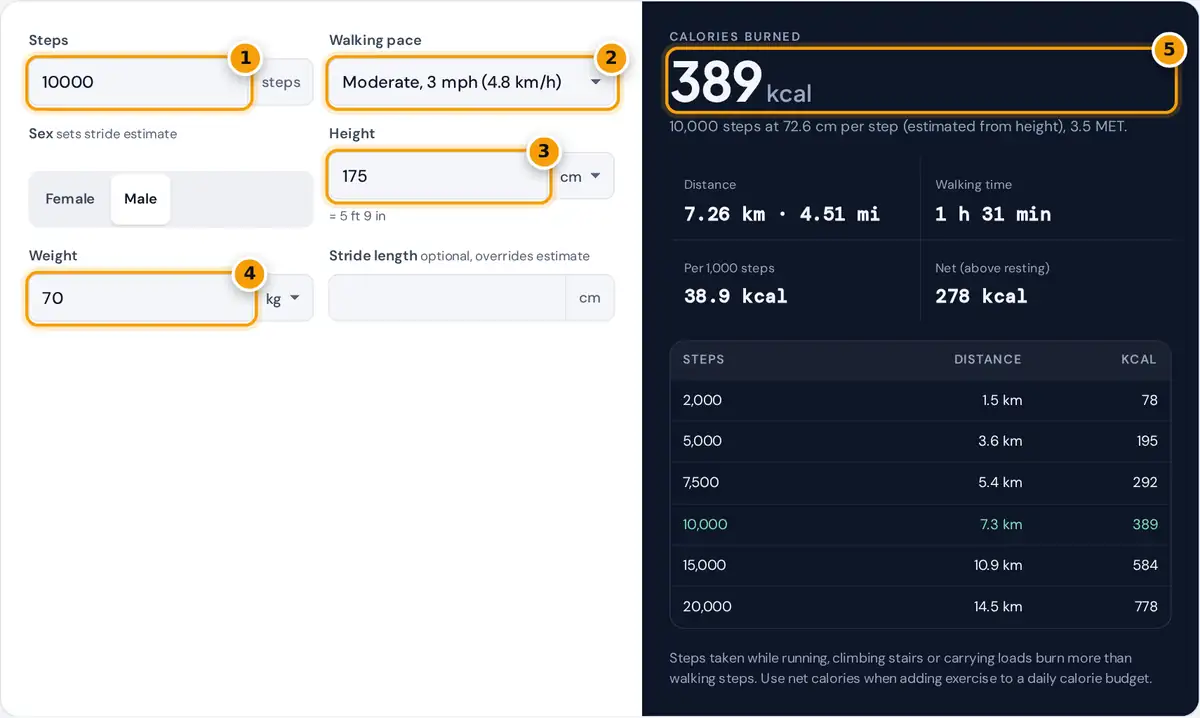
- Enter your step count.
- Choose your usual walking pace.
- Enter height to estimate stride length, or type your own stride.
- Enter your weight in kg or lb.
- Read calories burned, distance, walking time and kcal per 1,000 steps.
Type the number of steps from your phone, watch or pedometer. Choose the pace that best describes how you walked: most everyday walking is moderate, while purposeful exercise walking is often brisk. Enter your height and weight in metric or imperial units and select your sex, which fine tunes the stride estimate.
If you have measured your stride, enter it in centimeters to replace the estimate. The result shows calories burned, distance in kilometers and miles, the walking time those steps take, calories per 1,000 steps and net calories, which exclude what you would burn at rest. The table shows the same pace and body size at common step goals.
How Steps Become Calories
distance = steps × stride
time = distance ÷ walking speed
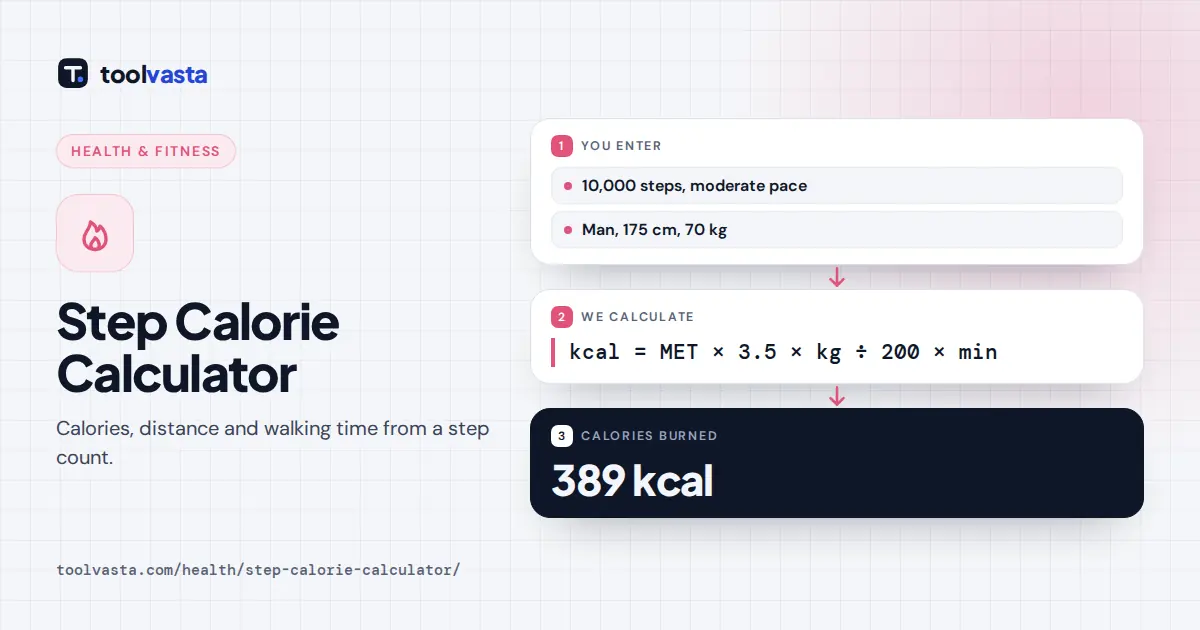
kcal = MET × 3.5 × kg ÷ 200 × minutes
The stride factors are a widely used rule of thumb for walking step length. MET values come from the Compendium of Physical Activities: 2.8 for slow walking at 3.2 km/h, 3.5 for moderate at 4.8 km/h, 4.3 for brisk at 5.6 km/h and 5.0 for very brisk at 6.4 km/h.
Worked Example
A 175 cm, 70 kg man walks 10,000 steps at a moderate pace. His stride is about 175 × 0.415 = 72.6 cm, so he covers 7.26 km (4.51 mi). At 4.8 km/h that takes about 91 minutes. Calories per minute are 3.5 × 3.5 × 70 ÷ 200 = 4.29, so the walk burns about 389 kcal, or 38.9 kcal per 1,000 steps. Net of resting burn, it adds about 278 kcal.
Calories for 10,000 Steps by Weight
| Body weight | Moderate pace | Brisk pace |
|---|---|---|
| 55 kg (121 lb) | 306 kcal | 322 kcal |
| 70 kg (154 lb) | 389 kcal | 410 kcal |
| 85 kg (187 lb) | 473 kcal | 498 kcal |
| 100 kg (220 lb) | 556 kcal | 586 kcal |
The table assumes a 175 cm man's stride of 72.6 cm. A brisk pace burns more per minute but covers the steps faster, so the total for a fixed number of steps rises only modestly.
Step Goals and Walking Time
A daily target of 10,000 steps is popular, but any increase from your current level counts. At a moderate pace, 1,000 steps takes most adults around 9 to 10 minutes, so adding 3,000 steps is roughly a 30 minute walk. Splitting steps into several short walks gives about the same calorie total as one long walk at the same pace. If you want more calories from the same time, walk briskly or add hills rather than only adding steps.
Steps also add up outside planned walks. Housework, shopping and climbing stairs all count on a step counter, though stairs burn more per step than level walking. For the best estimate, choose the pace that matches most of your day, and remember that slow shuffling steps around the house are shorter than walking strides.
How to Measure Your Stride
- Walk 20 normal steps on a flat surface and mark where you start and stop.
- Measure the distance in centimeters and divide by 20.
- Repeat once and average the two results. Enter the figure in the stride field.
Tips and Limits
Step counters miss or add steps, especially when you push a stroller or move your arms little. Terrain, hills and carrying a bag all increase energy use. MET values are averages, so individual burn can differ by 10 to 20%. Use the estimate to compare days and set goals rather than as an exact count. For overall activity guidance, see the World Health Organization, and for converting steps to distance only, use our steps to miles calculator.
Results are estimates for general information, not medical advice. Talk with a doctor or registered dietitian before big changes to diet, exercise or sleep, especially if you are pregnant, under 18 or managing a health condition.
Frequently asked questions
How many calories do 10,000 steps burn?
For a 70 kg person walking at a moderate pace, 10,000 steps burn about 389 kcal. Heavier people burn more, and the exact number also depends on stride length, pace and terrain.
How many calories does 1,000 steps burn?
Roughly 30 to 55 kcal for most adults at a walking pace. A 70 kg person with an average stride burns about 39 kcal per 1,000 steps at a moderate pace.
How is stride length estimated?
A common rule of thumb multiplies height by 0.415 for men and 0.413 for women. A 175 cm man therefore has an estimated stride of about 72.6 cm. Measuring your own stride is more accurate.
Does walking faster burn more calories per step?
A little. Faster walking has a higher MET value but you also cover the steps in less time, so calories for the same step count rise only modestly compared with the jump in intensity.
What are net calories?
Net calories subtract the energy you would have burned sitting still during the same time. Use net calories, not total, when you add walking to a daily calorie budget.
Are fitness tracker step calories accurate?
Trackers make similar estimates and can be off by a wide margin. Use any calorie figure as a guide and focus on consistent daily steps and the weekly trend of your weight.