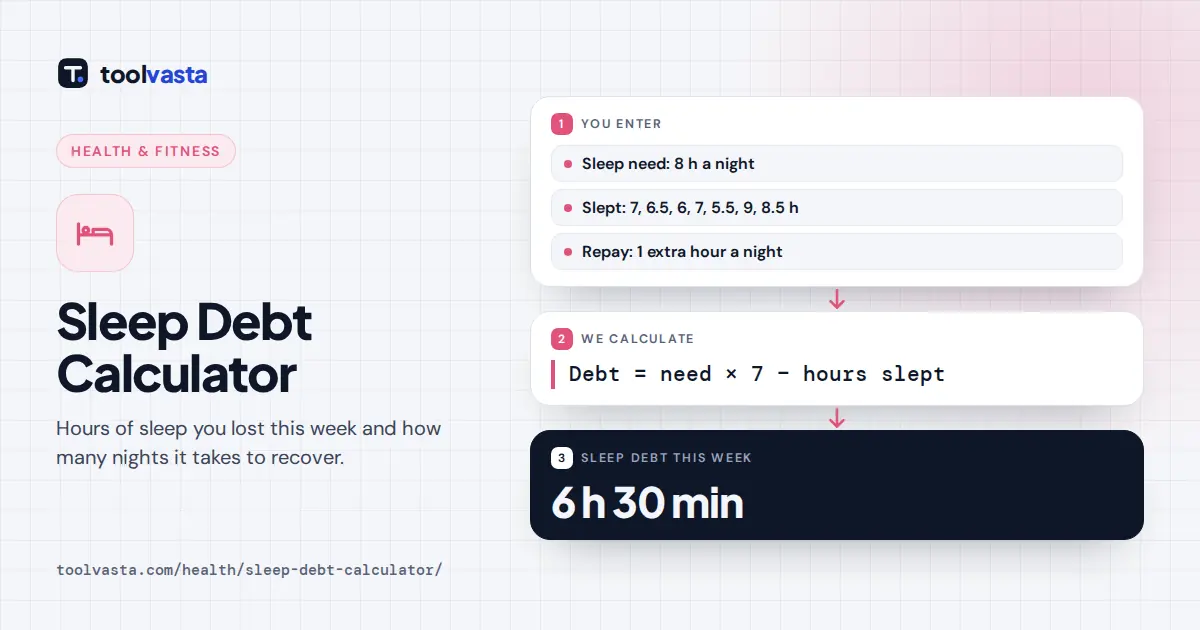
How to Use the Sleep Debt Calculator
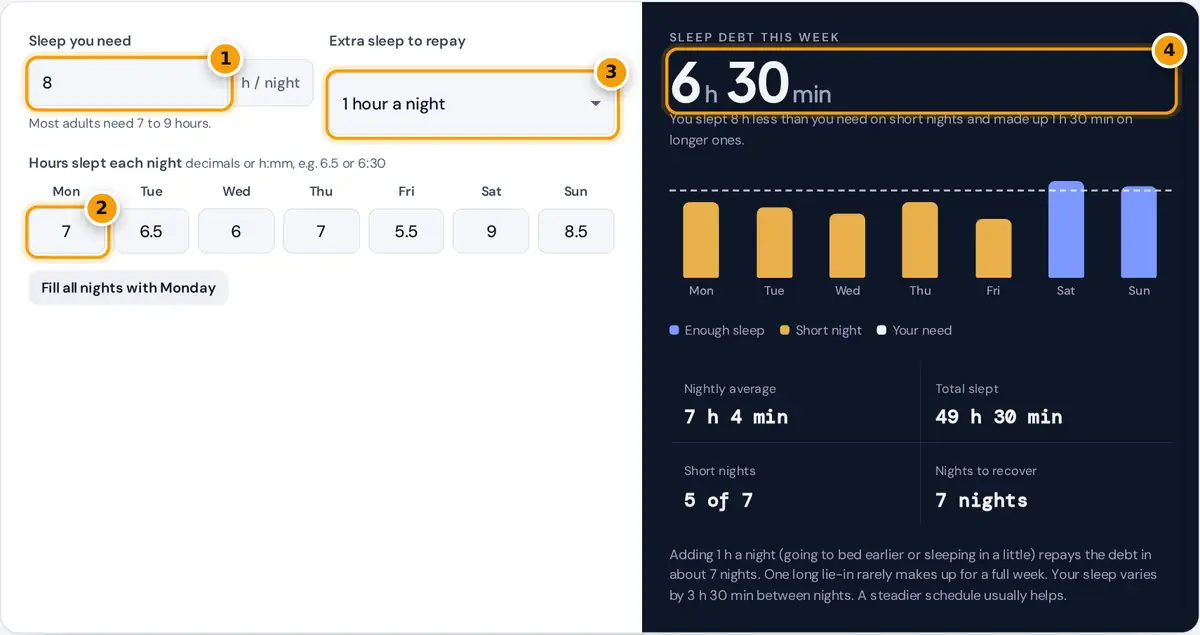
- Enter how many hours of sleep you need. Most adults need 7 to 9.
- Type the hours you slept each night, as decimals like 6.5 or clock style like 6:30.
- Choose how much extra sleep you can add each night to repay the debt.
- Read your weekly sleep debt, then check your average, short nights and nights to recover.
Enter how many hours of sleep you need each night. If you are not sure, start with 8 hours: most adults need between 7 and 9. Then type the hours you actually slept on each of the last seven nights. You can write decimals such as 6.5 or clock style such as 6:30. If every night was about the same, type Monday and press Fill all nights with Monday.
The result shows your total sleep debt for the week, a chart of each night against your need, your nightly average, the number of short nights and how many nights it takes to repay the debt at the extra sleep you choose.
How Sleep Debt Is Calculated
nightly average = total hours slept ÷ 7
nights to recover = sleep debt ÷ extra sleep per night (rounded up)
Longer nights count against shorter ones, so a 9 hour Saturday reduces the debt from a 6 hour Wednesday. The note below the result also shows the shortfall from short nights alone, so you can see how much the weekend helped.
Worked Example
With a need of 8 hours and nights of 7, 6.5, 6, 7, 5.5, 9 and 8.5 hours, the week totals 49.5 hours against a need of 56. The sleep debt is 6 h 30 min. Five nights were short by a total of 8 hours, and the weekend made up 1.5 hours. The nightly average is 7 h 4 min. Sleeping 1 extra hour a night repays the debt in 7 nights.
How Much Sleep Do Adults Need?
| Age group | Recommended sleep |
|---|---|
| Teenagers, 13 to 18 years | 8 to 10 hours |
| Adults, 18 to 64 years | 7 to 9 hours |
| Adults, 65 years and older | 7 to 8 hours |
These ranges follow guidance from sleep medicine bodies such as the American Academy of Sleep Medicine and the Canadian 24-Hour Movement Guidelines. Your own need sits somewhere inside the range. A good test is how much you sleep on a relaxed holiday after the first few days, once any backlog is gone.
Common Signs of Sleep Debt
- You need an alarm to wake up on almost every workday.
- You fall asleep within a few minutes of lying down.
- You sleep much longer on days off than on workdays.
- You feel drowsy in meetings, in class or while driving, especially in the afternoon.
- You rely on caffeine to get through the morning.
Drowsy driving is dangerous. If you notice yourself drifting while driving, pull over somewhere safe and rest.
How to Pay Back Sleep Debt
- Go to bed earlier. Moving bedtime 30 to 60 minutes earlier for a week or two is the most reliable way to recover.
- Keep the wake time steady. Sleeping in for hours on the weekend shifts your body clock and can make Monday night harder.
- Use short naps carefully. A 20 minute nap before mid-afternoon can help without hurting night sleep.
- Protect the basics. A dark, cool room, less caffeine after noon and less screen time before bed make the extra sleep easier to get.
Limits
This calculator counts hours only. It cannot measure sleep quality, which depends on things like breathing problems, pain, noise or shift work. Recovery is also not a simple bank account: research shows that a few long nights help, but they may not fully reverse the effects of weeks of short sleep on attention and mood. If you are tired despite enough hours, or snore loudly and wake unrefreshed, talk to a doctor.
Results are estimates for general information, not medical advice. Talk with a doctor or registered dietitian before big changes to diet, exercise or sleep, especially if you are pregnant, under 18 or managing a health condition.
Frequently asked questions
How do you calculate sleep debt?
Multiply your nightly sleep need by 7 and subtract the total hours you slept that week. Needing 8 hours but sleeping 49.5 hours in a week leaves a sleep debt of 6.5 hours.
Can you catch up on lost sleep?
Partly. Extra sleep over the following nights repays short-term debt, and you will feel more alert. A single long weekend lie-in usually is not enough, and it can shift your body clock.
How long does it take to recover from sleep debt?
At 1 extra hour a night, a 6.5 hour debt takes about 7 nights. Larger debts built up over months can take several weeks of consistent, adequate sleep.
How much sleep do I need?
Most adults aged 18 to 64 need 7 to 9 hours a night, and adults over 65 need 7 to 8. Teenagers need 8 to 10. Your personal need sits within that range.
Do naps reduce sleep debt?
Yes, nap time counts toward total sleep. Keep naps short, around 20 minutes, and before mid-afternoon so they do not make it harder to fall asleep at night.
Is 6 hours of sleep enough?
For most adults, regularly sleeping 6 hours builds sleep debt. A need of 8 hours with 6 hours a night adds 14 hours of debt every week.