How to Use the VO2 Max Calculator
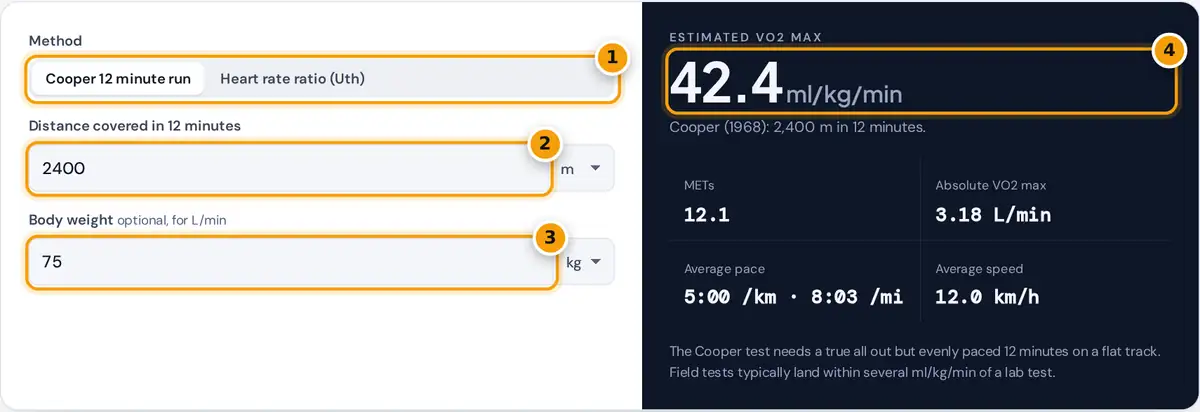
- Choose the Cooper 12 minute run or the heart rate ratio method.
- Enter the distance you covered in 12 minutes, in m, km or miles.
- Add body weight for absolute VO2 max in L/min.
- Read your estimated VO2 max, METs and test pace.
Choose a method. For the Cooper 12 minute run, run or walk as far as you can in exactly 12 minutes on a flat track, then enter the distance in meters, kilometers or miles. For the heart rate ratio method, enter your resting heart rate, measured lying down soon after waking, and your maximum heart rate. If you do not know your maximum, tick the box to estimate it from age.
Add your body weight if you want absolute VO2 max in liters per minute. The result shows VO2 max in ml/kg/min, the same value in METs, and either your test pace and speed or your heart rate ratio and reserve.
VO2 Max Formulas
Uth: VO2 max = 15.3 × HRmax ÷ HRrest
Tanaka: HRmax ≈ 208 − 0.7 × age
METs = VO2 max ÷ 3.5
absolute VO2 (L/min) = VO2 max × kg ÷ 1,000
Kenneth Cooper published the 12 minute field test in 1968 after testing US Air Force personnel. The heart rate ratio method was published by Niels Uth and colleagues in 2004 from tests of trained men. One MET is 3.5 ml of oxygen per kg per minute, the standard resting value.
Worked Example
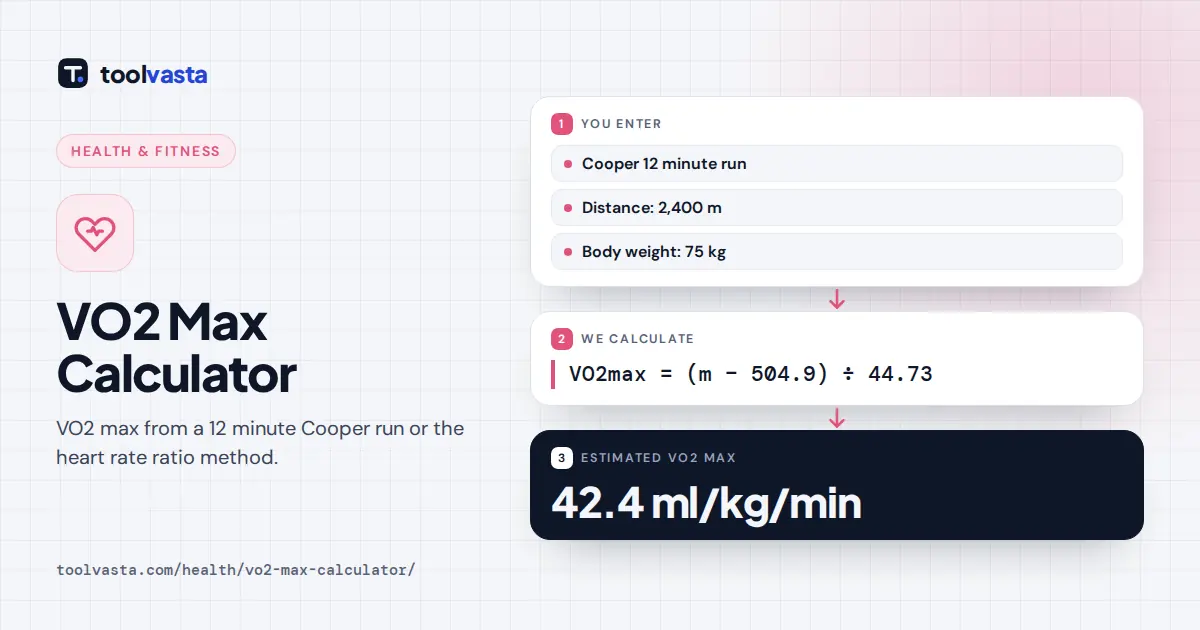
A runner covers 2,400 m in 12 minutes. VO2 max = (2,400 − 504.9) ÷ 44.73 = 42.4 ml/kg/min, which is 12.1 METs. At 75 kg that is 3.18 L of oxygen per minute. The test pace was 5:00 per km, or 12.0 km/h. Using the heart rate method instead, a resting heart rate of 60 and a maximum of 185 give 15.3 × 185 ÷ 60 = 47.2 ml/kg/min.
Cooper Distance to VO2 Max
| 12 minute distance | Miles | VO2 max |
|---|---|---|
| 1,600 m | 0.99 | 24.5 |
| 2,000 m | 1.24 | 33.4 |
| 2,400 m | 1.49 | 42.4 |
| 2,800 m | 1.74 | 51.3 |
| 3,200 m | 1.99 | 60.3 |
How to Run the Cooper Test
Use a 400 m track so you can count laps, and warm up with 10 minutes of easy jogging and a few short strides. Start the timer and run at the fastest pace you can hold for the full 12 minutes. Note the lap count and the extra distance when the time ends. Even pacing matters: runners who start too fast usually slow sharply after six minutes and cover less ground. Walking breaks are allowed if needed. Test on a calm, mild day and compare later results only with tests run under similar conditions.
For the heart rate method, measure resting heart rate on three mornings before getting out of bed and use the average. A maximum heart rate from a hard race finish or a supervised test is far better than an age formula.
How to Improve VO2 Max
VO2 max responds to consistent aerobic training. Most programs combine plenty of easy running, cycling or swimming with one or two harder sessions a week, such as intervals of three to five minutes at a hard effort. Untrained people usually see the largest gains in the first few months. Retest every six to eight weeks under the same conditions to see progress.
Limits and Safety
- Field tests estimate VO2 max. A lab test with gas analysis is the only direct measurement.
- The Cooper test depends on pacing and motivation. Starting too fast lowers the distance.
- The Uth method was developed in trained men and is less tested in other groups. Medicines such as beta blockers change heart rate and make it unreliable.
- A maximal effort test is hard work. If you have heart disease, symptoms or have been inactive, talk with a doctor before an all out test.
General physical activity guidance is available from the World Health Organization.
Results are estimates for general information, not medical advice. Talk with a doctor or registered dietitian before big changes to diet, exercise or sleep, especially if you are pregnant, under 18 or managing a health condition.
Frequently asked questions
How do I calculate VO2 max from the Cooper test?
Subtract 504.9 from the distance in meters you covered in 12 minutes, then divide by 44.73. For example, 2,400 m gives (2,400 − 504.9) ÷ 44.73 = 42.4 ml/kg/min.
Can I estimate VO2 max from heart rate?
Yes. The Uth method multiplies 15.3 by your maximum heart rate divided by your resting heart rate. A resting rate of 60 and a maximum of 185 give an estimate of about 47.2 ml/kg/min.
What is a good VO2 max?
It depends heavily on age and sex. Higher values mean better aerobic fitness. Compare your result with your own previous tests rather than general charts, and retest under the same conditions.
How accurate are VO2 max calculators?
Field equations usually land within several ml/kg/min of a lab measurement, and errors can be larger for some people. They are best for tracking your own changes over time rather than as an exact number.
What is the difference between relative and absolute VO2 max?
Relative VO2 max is per kilogram of body weight, in ml/kg/min, and suits running comparisons. Absolute VO2 max is total oxygen use in liters per minute, which matters more in rowing and cycling.
How often should I retest VO2 max?
Every six to eight weeks is enough to see training changes. Use the same method, course, time of day and similar weather so that differences reflect fitness rather than conditions.