How to Use the Vertical Jump Calculator
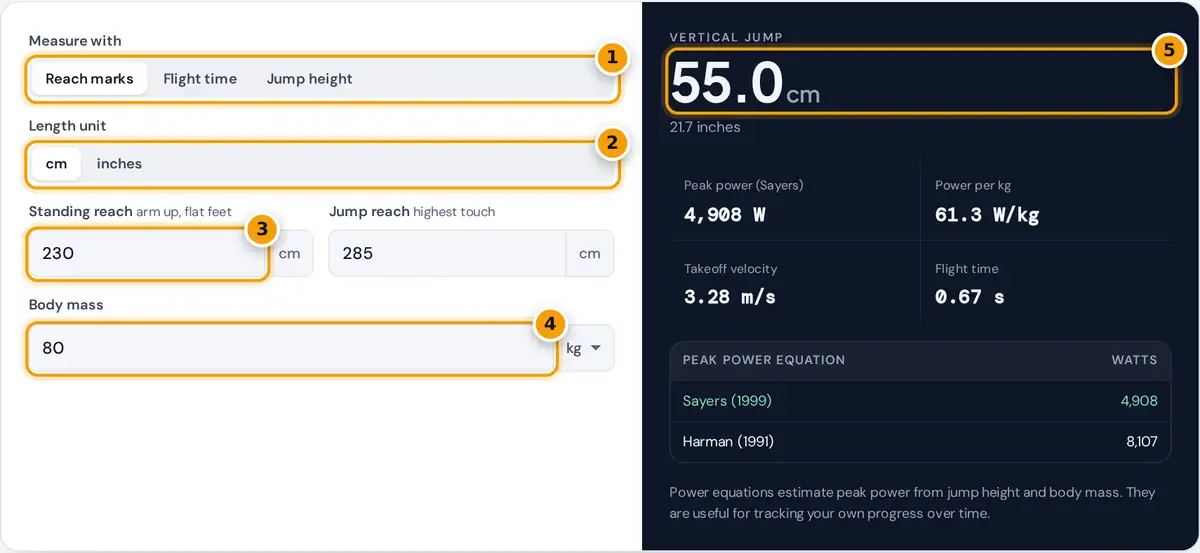
- Pick how you measured: reach marks, flight time or a known jump height.
- Choose centimeters or inches.
- Enter standing reach and jump reach.
- Enter body mass in kg or lb.
- Read jump height, then check peak power, W per kg and takeoff speed.
Pick how you measured the jump. Reach marks uses the classic wall or vane test: stand side on, reach as high as you can with flat feet, then jump and touch as high as possible. Flight time uses the time in the air from a contact mat or a slow motion phone app. Jump height takes a value you already know.
Choose centimeters or inches, then enter your body mass in kilograms or pounds. The result shows jump height in both units, estimated peak power, power per kilogram, takeoff velocity and flight time. Test the same way each time and take the best of three attempts after a warm-up.
Jump Height and Sayers Power Formulas
flight method: jump height = g × t² ÷ 8 (g = 9.80665 m/s²)
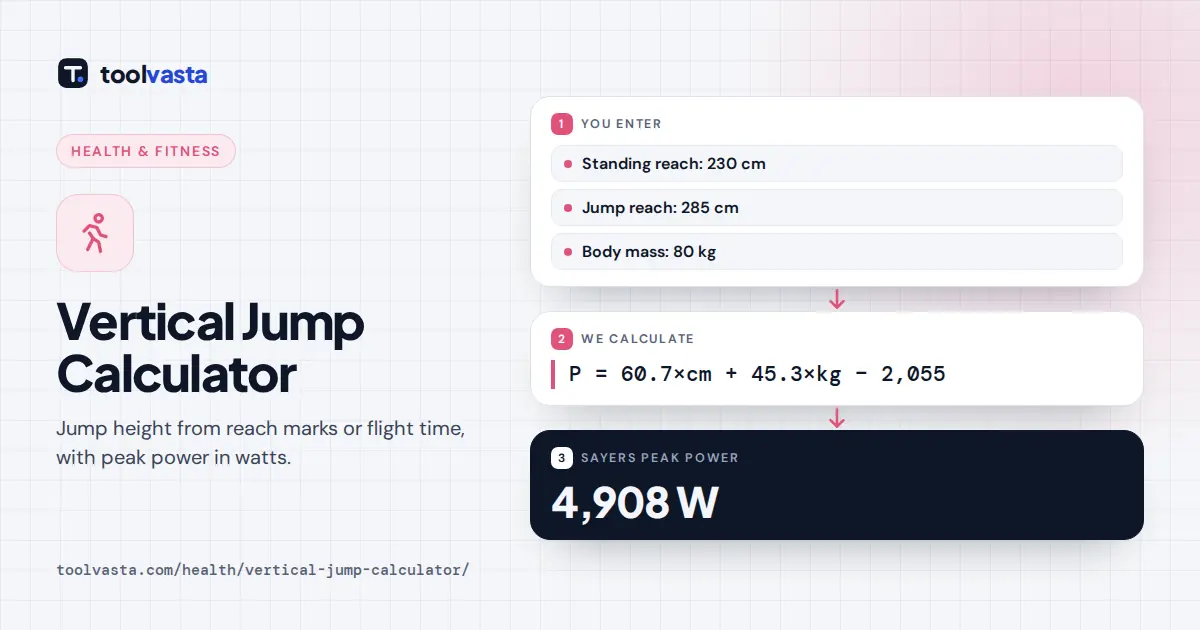
Sayers peak power (W) = 60.7 × jump (cm) + 45.3 × mass (kg) − 2,055
takeoff velocity = √(2 × g × height)
The flight time formula assumes you land in the same position you took off from, so tucking the legs before landing makes it read high. The Sayers equation was published in 1999 from force plate measurements of squat and countermovement jumps. The older Harman equation is shown for comparison; it tends to give higher numbers, so compare results only within one equation.
Worked Example
An 80 kg athlete has a standing reach of 230 cm and touches 285 cm. The jump is 285 − 230 = 55.0 cm, or 21.7 in. Sayers peak power is 60.7 × 55 + 45.3 × 80 − 2,055 = 3,338.5 + 3,624 − 2,055 = 4,908 W, which is 61.3 W per kg. Takeoff velocity is 3.28 m/s and the flight time is 0.67 s. A flight time of exactly 0.6 s gives 9.80665 × 0.36 ÷ 8 = 44.1 cm.
Reach Test or Flight Time
The reach test is simple and needs only a wall and chalk, but it rewards shoulder flexibility and a good reach at the top of the jump. Flight time methods measure the body's center of mass indirectly and suit jump mats and phone apps that count video frames. Both are useful if you stick with one. Results from the two methods are not directly comparable, because a reach test usually allows an arm swing and a reach, while flight time tests often use hands on hips.
Flight Time to Jump Height
| Flight time | Jump height | Inches |
|---|---|---|
| 0.40 s | 19.6 cm | 7.7 in |
| 0.50 s | 30.6 cm | 12.1 in |
| 0.60 s | 44.1 cm | 17.4 in |
| 0.70 s | 60.1 cm | 23.6 in |
| 0.80 s | 78.5 cm | 30.9 in |
Small timing errors matter: because height depends on time squared, a 0.02 s error at 0.6 s changes the result by about 3 cm.
How to Test and Track Progress
- Warm up for 5 to 10 minutes, then do two or three practice jumps before measuring.
- Decide whether you allow an arm swing and a countermovement, and keep that the same each time.
- Record the best of three attempts with about a minute of rest between them.
- Retest every four to six weeks. Power per kilogram is the fairest number for comparing yourself over time as your weight changes.
Limits
Reach tests depend on how accurately you mark standing reach. Flight time apps depend on frame rate and on choosing the exact takeoff and landing frames. Power equations are regression estimates for groups of athletes and can be off for an individual, especially at very low or very high body mass. They are best used to compare your own results over time.
Results are estimates for general information, not medical advice. Talk with a doctor or registered dietitian before big changes to diet, exercise or sleep, especially if you are pregnant, under 18 or managing a health condition.
Frequently asked questions
How do I measure my vertical jump?
Stand side on to a wall and mark your highest reach with flat feet. Then jump from a standstill and mark the highest touch. The difference between the two marks is your vertical jump.
What is the Sayers equation?
It estimates peak leg power from jump height and body mass: watts = 60.7 × jump height in cm + 45.3 × body mass in kg − 2,055. It was published by Sayers and colleagues in 1999.
How do you calculate jump height from flight time?
Multiply gravity, 9.81 m/s², by the flight time squared and divide by 8. A flight time of 0.6 seconds gives about 0.441 m, or 44.1 cm of jump height.
Why is power per kilogram useful?
Heavier athletes produce more total power for the same jump, so watts alone favor bigger people. Dividing by body mass gives a fairer number for comparing your own progress or athletes of different sizes.
Should I use an arm swing for the test?
Either is fine if you stay consistent. An arm swing usually adds several centimeters. Many coaches test both, but compare results only with jumps done the same way.
Why do Sayers and Harman give different power numbers?
They were fitted to different athletes and jump types, so their constants differ. Harman usually reports higher values. Pick one equation and use it every time you retest.