How to Use the Intermittent Fasting Calculator
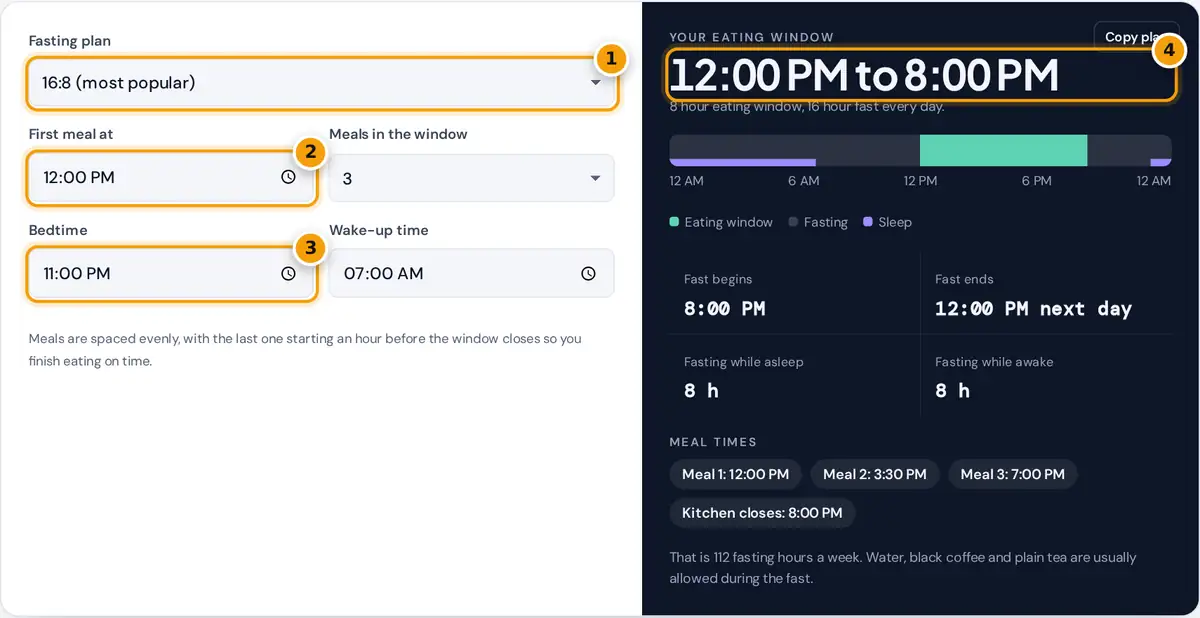
- Choose a fasting plan such as 16:8, 18:6, 20:4 or OMAD, or pick Custom to type your own fasting hours.
- Enter the time of your first meal. The eating window starts here.
- Add your usual bedtime and wake-up time to see how many fasting hours you sleep through.
- Read your daily eating window, then check fast start and end times and your meal times.
Pick a fasting plan from the list. The first number is the hours you fast and the second is the hours you can eat, so 16:8 means a 16 hour fast and an 8 hour eating window. Choose Custom to type any fast from 10 to 23.5 hours. Then enter when you want your first meal, how many meals you plan to eat, and your usual bedtime and wake-up time.
The result shows your daily eating window, a 24 hour timeline, the exact time your fast begins and ends, and evenly spaced meal times. It also splits the fast into hours spent asleep and hours spent awake, which is the part most people find hard. Press Copy plan to paste the schedule into a note or calendar.
How the Fasting Schedule Is Calculated
window closes = first meal + eating window
fast ends = first meal the next day
meal gap = (eating window − 1 h) ÷ (meals − 1)
The last meal starts one hour before the window closes, so you have time to finish eating. The calculator then compares the fasting period with your sleep period, including sleep that crosses midnight, to count the fasting hours you sleep through.
Worked Example
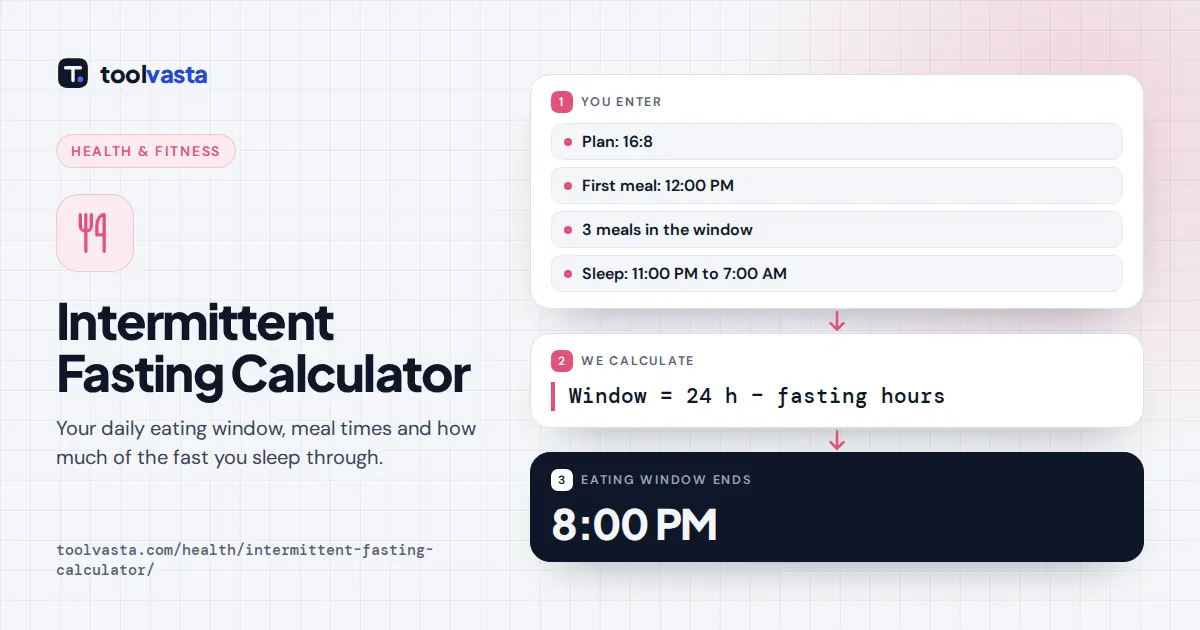
On a 16:8 plan with the first meal at 12:00 PM, the eating window runs from 12:00 PM to 8:00 PM. With three meals, the gap is (8 − 1) ÷ 2 = 3.5 hours, so meals fall at 12:00 PM, 3:30 PM and 7:00 PM. The fast runs from 8:00 PM to 12:00 PM the next day. If you sleep from 11:00 PM to 7:00 AM, all 8 hours of sleep fall inside the fast, so only 8 of the 16 fasting hours are spent awake.
Common Intermittent Fasting Plans
| Plan | Fast | Eating window | Example window |
|---|---|---|---|
| 12:12 | 12 h | 12 h | 7:00 AM to 7:00 PM |
| 14:10 | 14 h | 10 h | 9:00 AM to 7:00 PM |
| 16:8 | 16 h | 8 h | 12:00 PM to 8:00 PM |
| 18:6 | 18 h | 6 h | 12:00 PM to 6:00 PM |
| 20:4 | 20 h | 4 h | 2:00 PM to 6:00 PM |
| OMAD 23:1 | 23 h | 1 h | 6:00 PM to 7:00 PM |
Many people start at 12:12 or 14:10 and move to 16:8 once the evening cutoff feels normal. Weekly plans such as 5:2, where you eat less on two days rather than skipping hours, are not daily time windows and are not covered by this calculator.
Choosing the Best Eating Window
- Fit it around sleep. Ending the window two or three hours before bed lets more of the fast happen overnight.
- Match your social life. If you eat dinner with family at 6:30 PM, choose a window that includes it, such as 11:00 AM to 7:00 PM.
- Keep it consistent. The same window every day is easier to follow than a window that moves.
- Plan the first meal. Breaking the fast with a meal that has protein and fiber makes it easier to avoid snacking until the window closes.
Limits and Safety
This tool builds a timetable. It does not estimate weight loss, because results depend on what and how much you eat during the window. Fasting is not recommended for people who are pregnant or breastfeeding, under 18, have a history of eating disorders, or take medicines such as insulin that need regular meals. If that applies to you, or you feel unwell while fasting, speak with a doctor first.
Results are estimates for general information, not medical advice. Talk with a doctor or registered dietitian before big changes to diet, exercise or sleep, especially if you are pregnant, under 18 or managing a health condition.
Frequently asked questions
How do I calculate my 16:8 fasting window?
Add 8 hours to the time of your first meal. If you eat first at 12:00 PM, your window closes at 8:00 PM and your fast runs from 8:00 PM until 12:00 PM the next day, which is 16 hours.
What is the best time window for intermittent fasting?
There is no single best window. Many people choose 12:00 PM to 8:00 PM because it skips breakfast and keeps dinner. Ending earlier in the evening puts more of the fast overnight while you sleep.
Does sleep count as fasting?
Yes. Any time you are not eating or drinking calories counts, including sleep. That is why the calculator shows how many fasting hours fall inside your sleep, often half or more of the fast.
Can I drink coffee while fasting?
Black coffee, plain tea and water have almost no calories, so most fasting plans allow them. Milk, sugar, cream and flavoured coffee drinks add calories and break a strict fast.
How many meals should I eat in a 16:8 window?
Two or three meals is common. Two meals 7 hours apart, or three meals about 3.5 hours apart, both fit an 8 hour window and leave the last hour free to finish eating.
Is intermittent fasting safe for everyone?
No. It is not advised for pregnant or breastfeeding people, anyone under 18, people with a history of eating disorders, or people on diabetes medicines. Speak with a doctor if any of these applies to you.