How to Use the Calories Burned Calculator
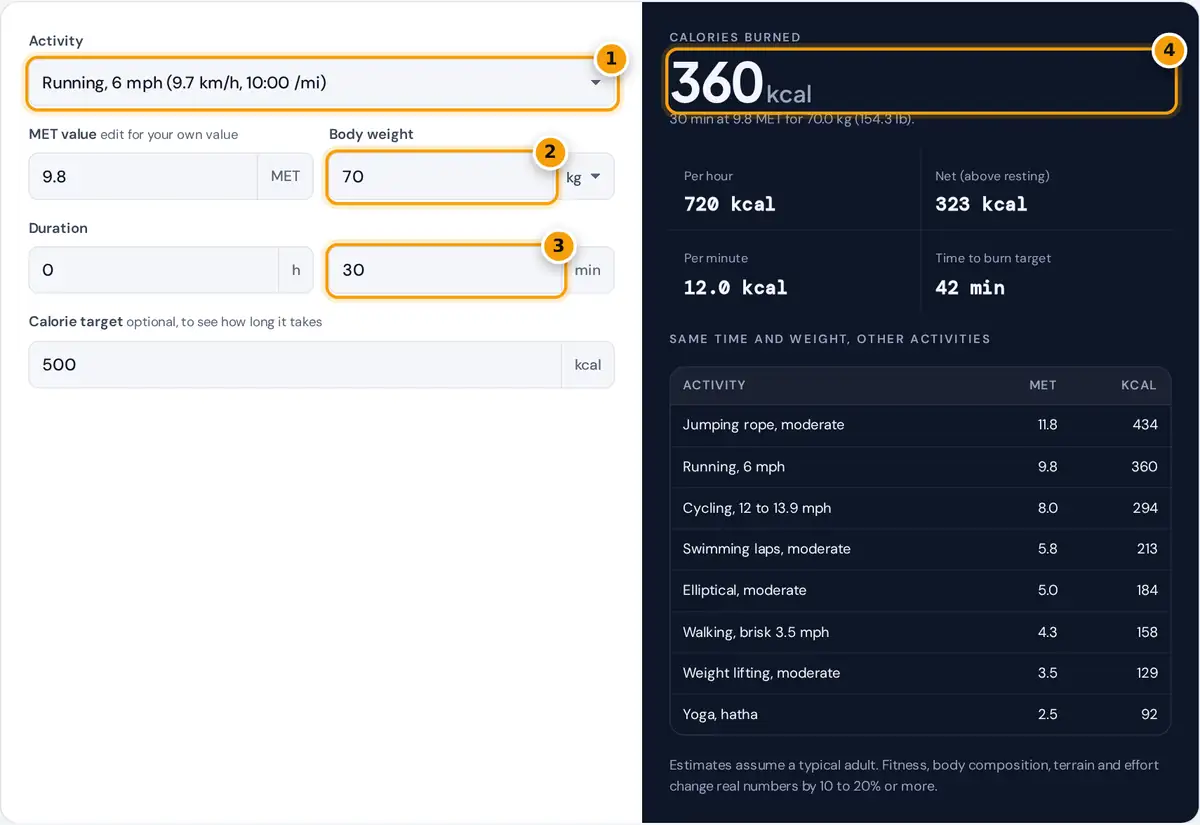
- Choose your activity. Its MET value from the Compendium of Physical Activities fills in automatically.
- Enter your body weight in kg or lb.
- Enter how long you did the activity in hours and minutes.
- Read total calories burned, then check calories per hour, net calories and time to reach your target.
Choose the activity that best matches what you did. Each one fills in a MET value from the Compendium of Physical Activities, the reference list used in exercise research. If your watch, a coach or a study gives a better MET figure, type it into the MET field. Enter your body weight in kg or lb and how long you were active.
The result shows total calories burned, calories per hour and per minute, and net calories, which leave out what your body would have burned anyway at rest. Add a calorie target to see how long the activity takes to burn it, and use the comparison table to see other common workouts for the same time and weight.
MET Formula for Calories Burned
total kcal = kcal per minute × minutes
net kcal = (MET − 1) × 3.5 × kg ÷ 200 × minutes
A MET (metabolic equivalent of task) compares an activity with sitting quietly. One MET is defined as 3.5 ml of oxygen per kg of body weight per minute, and burning 1 liter of oxygen releases about 5 kcal. That is where the 3.5 and the 200 in the formula come from.
Worked Example
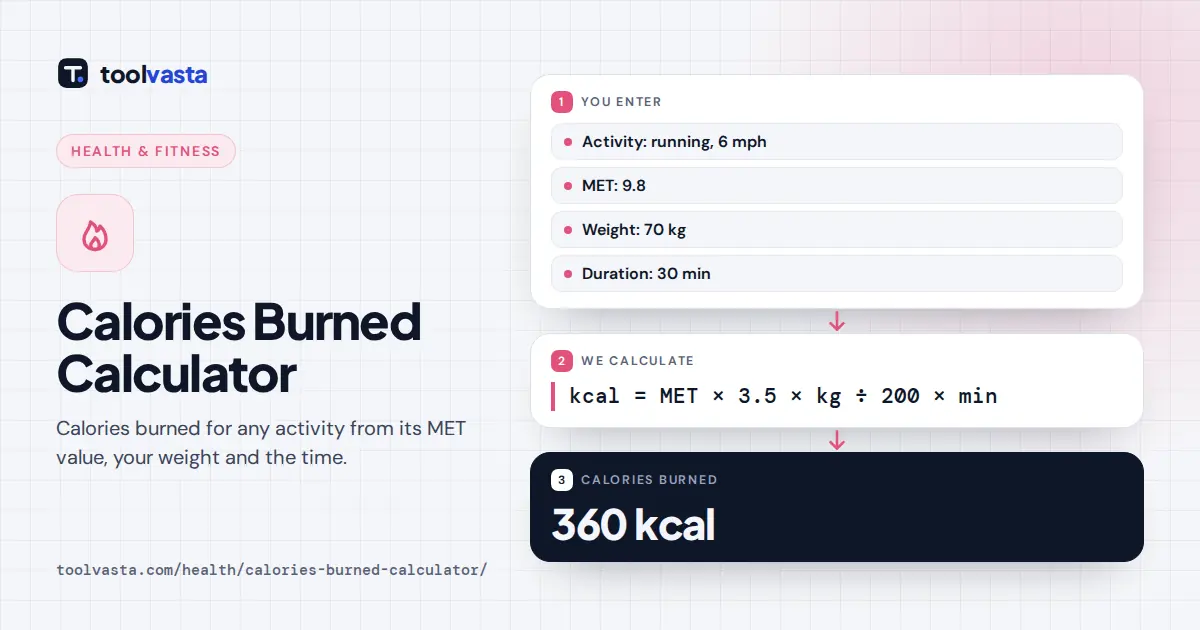
A 70 kg person runs at 6 mph (MET 9.8) for 30 minutes. Calories per minute are 9.8 × 3.5 × 70 ÷ 200 = 12.0 kcal, so the run burns about 360 kcal, or 720 kcal per hour. Subtracting the 1 MET resting rate gives a net burn of about 323 kcal. A 90 kg person walking at 3 mph (MET 3.5) for 45 minutes burns about 248 kcal, or 177 kcal net.
MET Values for Common Activities
| Activity | MET | kcal per hour, 70 kg |
|---|---|---|
| Yoga, hatha | 2.5 | 184 |
| Walking, 3 mph | 3.5 | 257 |
| Weight lifting, moderate | 3.5 | 257 |
| Walking, 3.5 mph | 4.3 | 316 |
| Elliptical, moderate | 5.0 | 368 |
| Swimming laps, moderate | 5.8 | 426 |
| Cycling, 12 to 13.9 mph | 8.0 | 588 |
| Running, 6 mph | 9.8 | 720 |
| Jumping rope, moderate | 11.8 | 867 |
Values follow the 2011 Compendium of Physical Activities (Ainsworth and colleagues). Heavier people burn more calories for the same activity because they move more mass, which is why weight is part of the formula.
Using Exercise Calories in a Daily Budget
If you track food against a daily calorie target, add net calories, not total calories. Your target already includes the energy you burn at rest, so counting the full total would count that resting energy twice. In the example above, the 30 minute run adds about 323 kcal to the day, not 360. Many people also find their appetite rises after long or hard sessions, so watch your weight trend over a few weeks rather than eating back every logged calorie.
How Accurate Are Calorie Estimates?
MET values are averages measured in groups of adults. Your own burn can differ because of fitness, body composition, age, terrain, wind, technique and how hard you really worked. Treat the result as a reasonable estimate, typically within 10 to 20%, rather than an exact count. Fitness trackers make similar assumptions and also vary.
- Use net calories when you add exercise to a daily calorie budget, because your resting burn is already counted in your TDEE.
- Pick the effort level honestly. A casual bike ride is closer to 4 MET than 8.
- For walking or running on a treadmill with incline, the ACSM equations in our treadmill calorie calculator use speed and grade directly.
Results are estimates for general information, not medical advice. Talk with a doctor or registered dietitian before big changes to diet, exercise or sleep, especially if you are pregnant, under 18 or managing a health condition.
Frequently asked questions
How do I calculate calories burned during exercise?
Multiply the activity's MET value by 3.5 and by your weight in kg, divide by 200, then multiply by the minutes. A 70 kg person running at 9.8 MET for 30 minutes burns about 360 kcal.
What is a MET value?
A MET compares an activity's energy cost with sitting quietly, which is 1 MET. Running at 6 mph is 9.8 MET, so it burns about 9.8 times as much energy per minute as rest.
What is the difference between total and net calories burned?
Total calories include the energy you would burn at rest anyway. Net calories subtract that 1 MET baseline, so they show the extra energy the activity adds. Use net calories with a daily calorie budget.
Why do heavier people burn more calories?
Moving a larger body takes more energy, so the MET formula scales with body weight. At the same MET and duration, a 90 kg person burns about 29% more calories than a 70 kg person.
How many calories does walking for an hour burn?
At a moderate 3 mph (3.5 MET), a 70 kg person burns about 257 kcal per hour. At a brisk 3.5 mph (4.3 MET) the same person burns about 316 kcal.
Are fitness tracker calorie numbers more accurate?
Trackers add heart rate data, which can help, but they still rely on estimates and can be off by a wide margin. Use either number as a guide and watch your weight trend over weeks.