How to Use the Lean Bulk Calculator
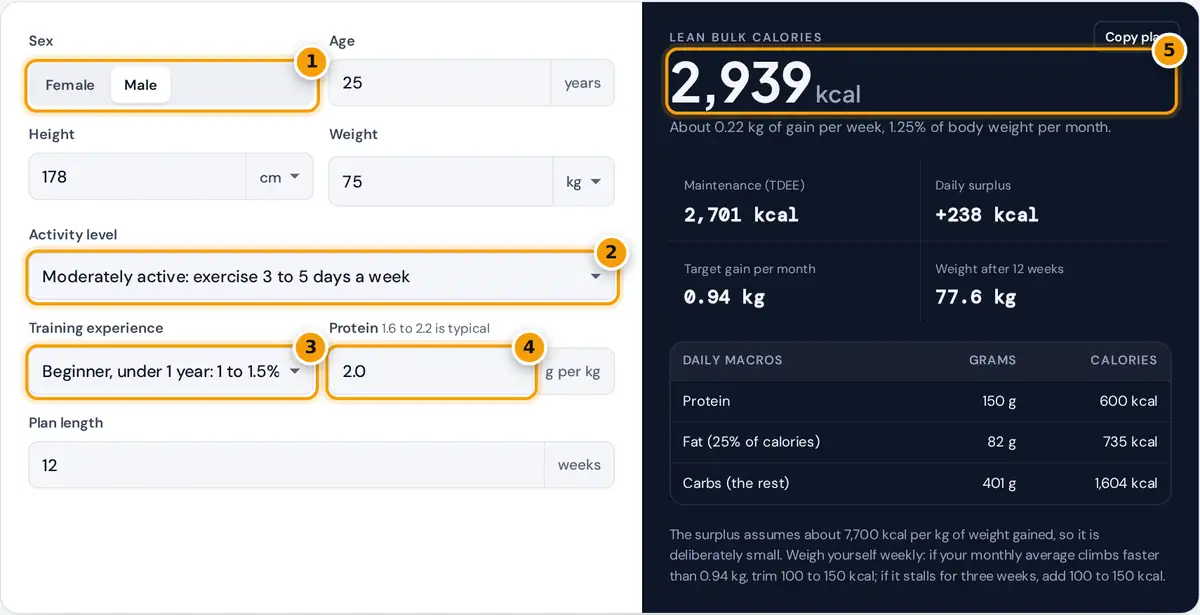
- Enter sex, age, height and weight.
- Pick your activity level including training.
- Choose your lifting experience to set a realistic monthly gain rate.
- Adjust protein per kg and the plan length if needed.
- Read your lean bulk calories, surplus, macros and projected weight.
Enter your sex, age, height and weight, and choose the activity level that matches your normal week including training. Then pick your lifting experience. Experience sets the target gain rate, because beginners can add muscle much faster than people who have trained for years. Adjust protein if you follow a different target, and set how many weeks the bulk will last.
The result shows the daily calories for a lean bulk, the surplus above maintenance, the target gain per month and your projected weight at the end of the plan. The macro table splits calories into protein, fat and carbs, and you can copy the plan into your notes or tracking app.
How Lean Bulk Calories Are Calculated
monthly gain = body weight × gain rate %
weekly gain = monthly gain × 12 ÷ 52
daily surplus = weekly gain × 7,700 ÷ 7
lean bulk calories = TDEE + daily surplus
The gain rates are the commonly used guideline popularized by researcher and coach Alan Aragon: about 1 to 1.5% of body weight per month for beginners, 0.5 to 1% for intermediates and 0.25 to 0.5% for advanced lifters. The calculator uses the middle of each range. Protein is set per kilogram of body weight, fat is 25% of calories and carbs fill the rest.
Worked Example
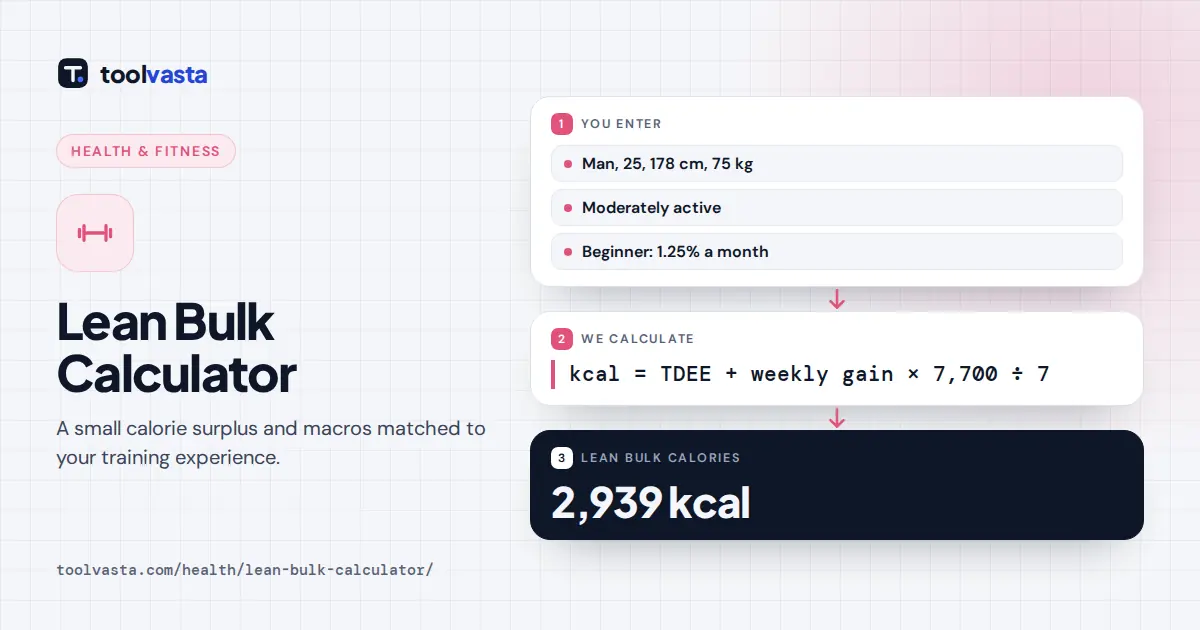
A 25 year old man, 178 cm and 75 kg, moderately active, has an RMR of 1,743 kcal and a maintenance of 2,701 kcal. As a beginner his target is 1.25% of 75 kg, which is 0.94 kg per month or 0.22 kg per week. That needs a surplus of 0.2163 × 7,700 ÷ 7 = 238 kcal, so his lean bulk target is 2,939 kcal a day. Protein at 2.0 g per kg is 150 g, fat is 82 g and carbs are 401 g. After 12 weeks he would weigh about 77.6 kg.
Lean Bulk Gain Rates by Experience
| Experience | Gain per month | 75 kg lifter | Typical surplus |
|---|---|---|---|
| Beginner | 1 to 1.5% of body weight | 0.75 to 1.1 kg | About 200 to 300 kcal |
| Intermediate | 0.5 to 1% | 0.4 to 0.75 kg | About 100 to 200 kcal |
| Advanced | 0.25 to 0.5% | 0.2 to 0.4 kg | About 50 to 100 kcal |
Lean Bulk Versus Dirty Bulk
A dirty bulk eats far above maintenance and accepts a lot of fat gain for faster scale progress. A lean bulk keeps the surplus small so most of the added weight is muscle and less time is needed to diet afterwards. The price is patience: progress on the scale is slow, and the surplus is small enough that daily food choices matter. Most people who train for strength and looks prefer the lean approach.
Adjusting the Plan Over Time
As you gain weight your maintenance calories rise slowly, so recalculate every four to six weeks with your new weight. Compare the monthly change in your average weight with the target shown here. Gaining faster usually means more fat, so trim calories slightly. Gaining slower is fine for a few weeks, but a long stall means the surplus has disappeared.
Tips and Limits
- Follow a progressive strength program. Without a training stimulus, extra calories mostly become fat.
- Track the weekly average of your morning weight. Daily readings swing with water, salt and food in the gut.
- The 7,700 kcal per kg figure is a rule of thumb. Muscle tissue costs less energy to store than fat, so adjust by your actual trend after three to four weeks.
- Sleep of seven hours or more and steady protein across meals support muscle gain as much as the calorie number does.
For general nutrition research, see the National Institutes of Health.
Results are estimates for general information, not medical advice. Talk with a doctor or registered dietitian before big changes to diet, exercise or sleep, especially if you are pregnant, under 18 or managing a health condition.
Frequently asked questions
How many calories should I eat for a lean bulk?
Eat a small surplus above maintenance, usually about 100 to 300 kcal a day depending on training experience. Beginners can use the larger end because they gain muscle faster than experienced lifters.
How fast should I gain weight on a lean bulk?
A common guideline is about 1 to 1.5% of body weight per month for beginners, 0.5 to 1% for intermediates and 0.25 to 0.5% for advanced lifters. Faster gain usually adds more fat.
How much protein do I need when bulking?
Most sports nutrition reviews suggest about 1.6 to 2.2 g of protein per kg of body weight a day. The calculator defaults to 2.0 g per kg, and you can change it.
What is the difference between a lean bulk and a dirty bulk?
A lean bulk uses a small surplus to limit fat gain, while a dirty bulk eats far above maintenance for faster weight gain. Lean bulking needs more patience but less dieting afterwards.
How long should a lean bulk last?
Many lifters run a lean bulk for 3 to 6 months, then reassess body fat and strength. Because gain is slow, short bulks of a few weeks rarely show meaningful muscle change.
What if I am not gaining weight on my lean bulk?
Check your weekly average weight for three weeks. If it is flat, add about 100 to 150 kcal a day and recheck. Underestimating activity is a common reason for stalled progress.