How to Use the Heart Rate Zone Calculator
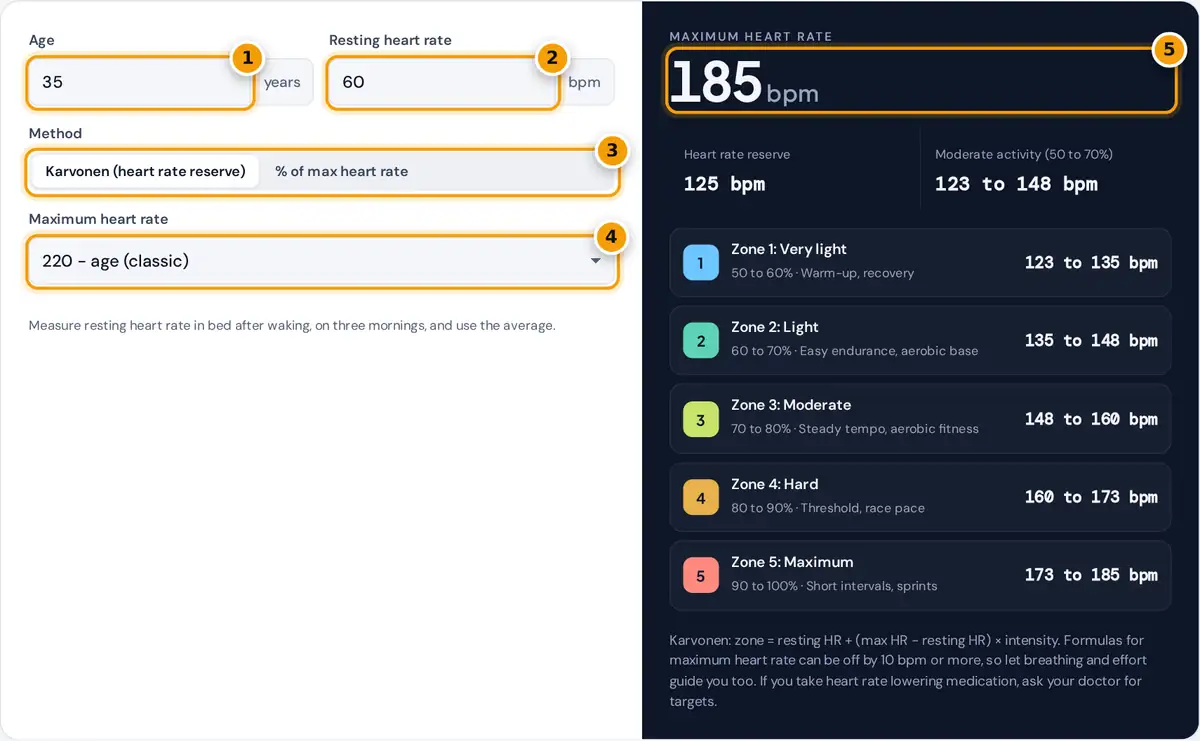
- Enter your age in years.
- Enter your resting heart rate, measured in bed after waking.
- Choose Karvonen, which uses heart rate reserve, or percent of max heart rate.
- Pick a max heart rate formula, or choose your measured maximum.
- Read your maximum heart rate, then the bpm range for each of the five zones.
Enter your age and resting heart rate, then choose a method. The Karvonen method uses your heart rate reserve, the gap between resting and maximum heart rate, so it adapts to your current fitness level.
The percent of max heart rate method only needs your maximum and is simpler, but it gives lower numbers for the easy zones. The table shows all five training zones in beats per minute (bpm).
Pick a formula for maximum heart rate: 220 minus age, Tanaka or Gulati. If you have measured your maximum in a hard, supervised test or a race finish, enter that number instead for better accuracy.
Heart Rate Zone Formulas
Every zone is a percentage band, called intensity, applied either to your heart rate reserve or to your maximum heart rate. The Karvonen formula adds your resting heart rate back on after applying the percentage.
% of max: target HR = max HR × intensity
Max HR: 220 − age, or Tanaka 208 − 0.7 × age, or Gulati 206 − 0.88 × age
The Karvonen method was described by Martti Karvonen and colleagues in 1957. The Tanaka equation comes from a 2001 analysis of 351 studies and usually suits adults over 40 better than the 220 minus age.
The Gulati equation was developed in 2010 from more than 5,000 women, and it gives a lower maximum heart rate than 220 minus age. All three formulas estimate an average value for your age group.
Worked Example for a 35-Year-Old
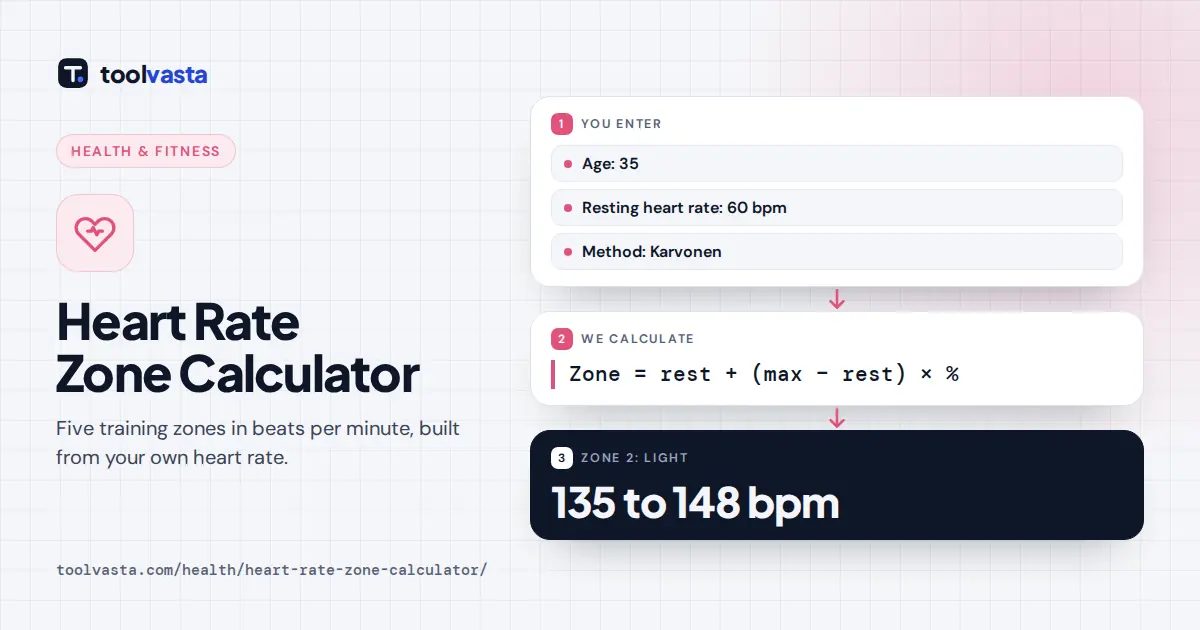
A 35-year-old with a resting heart rate of 60 bpm has an estimated maximum of 220 minus 35, which is 185 bpm, and a heart rate reserve of 185 minus 60, which is 125 bpm.
With Karvonen, zone 2 (60 to 70%) runs from 60 plus 125 times 0.6, which is 135 bpm, to 60 plus 125 times 0.7, or 147.5, rounded up to 148 bpm in the zone table.
With the percent of max method, the same zone is 185 times 0.6, or 111 bpm, to 185 times 0.7, rounded to 130 bpm. Karvonen gives higher easy zones for people with low resting rates.
The Five Training Zones
The calculator splits your range into five heart rate zones, from very easy recovery work to all-out sprints. Each zone has a typical feel, measured by how easily you can talk while you are exercising.
| Zone | Intensity | How it feels | Typical use |
|---|---|---|---|
| 1 | 50 to 60% | Very easy, full conversation | Warm-up, recovery days |
| 2 | 60 to 70% | Easy, can talk in sentences | Long easy runs and rides, aerobic base |
| 3 | 70 to 80% | Moderate, short phrases | Steady tempo work |
| 4 | 80 to 90% | Hard, a few words at a time | Threshold intervals, race pace |
| 5 | 90 to 100% | All out, cannot talk | Short intervals and sprints |
The American Heart Association describes moderate exercise as about 50 to 70% of maximum heart rate and vigorous exercise as about 70 to 85%, which roughly spans zones 1 to 4 in this calculator's table.
Zone 4 sits around your lactate threshold, the effort where lactate builds faster than your body clears it. Zone 5 is close to VO2 max and can only be held for short intervals lasting minutes.
What Is Zone 2 Training?
Zone 2 is the easy aerobic zone where you can still speak in full sentences. Endurance athletes spend most of their training time here, because it builds aerobic fitness and endurance with relatively little fatigue.
Many coaches follow a rough 80/20 split: about 80% of training at easy intensity in zones 1 and 2, and about 20% at harder efforts. Easy sessions also support recovery between the hard training days.
If your heart rate drifts up during a long easy session, slow down rather than push through. This drift is normal in heat or as you tire, and means the effort has quietly become harder.
How to Measure Resting Heart Rate
Measure your resting heart rate in the morning, before you get out of bed or drink caffeine. Count your pulse for 60 seconds, or for 30 seconds and double it, at the wrist or neck.
Repeat this on three to five mornings and use the average, since a single reading can be thrown off by poor sleep or stress. Many fitness watches also record your resting heart rate automatically overnight.
For most adults, a resting heart rate of 60 to 100 bpm is normal, and fit people are often lower. A falling resting rate over months of training is a common sign of improving fitness.
Limits of Age-Based Zones
Age-based formulas estimate an average, and your real maximum can be 10 to 20 bpm higher or lower. A tested maximum from a supervised exercise test gives far more accurate zones than any age formula.
Heat, caffeine, dehydration, stress and poor sleep all raise your heart rate at the same effort. Wrist-based heart rate monitors can lag or misread during intervals, while chest straps are generally more accurate for intervals.
Beta blockers and some other medicines lower heart rate, so ask your doctor for safe targets if you take them or have a heart condition. These zones are estimates for general information, not medical advice.
Frequently asked questions
What is the Karvonen formula?
Target heart rate equals resting heart rate plus maximum heart rate minus resting heart rate, times intensity. It bases zones on your heart rate reserve, so it accounts for your own resting heart rate and fitness.
How do I calculate my maximum heart rate?
The classic estimate is 220 minus your age. The Tanaka formula, 208 minus 0.7 times age, is often more accurate for older adults. A supervised exercise test gives the most reliable value.
What heart rate is zone 2?
Zone 2 is 60 to 70% of your heart rate reserve or maximum. For a 35-year-old with a resting heart rate of 60, it is about 135 to 148 bpm using the Karvonen method.
Which is better, Karvonen or percent of max?
Karvonen is usually more personal because it includes your resting heart rate. Percent of max is simpler and is the method the American Heart Association uses in its target heart rate guidance.
What is a normal resting heart rate?
For most adults it is 60 to 100 beats per minute. Very fit people often have resting rates in the 40s or 50s. Measure it in the morning before getting out of bed for a reliable number.
Should I train only in zone 2?
No. Zone 2 builds an aerobic base, but most training plans also include some harder work in zones 3 to 5. A common approach keeps about 80% of training easy and 20% hard.