How to Use the Macro Calculator
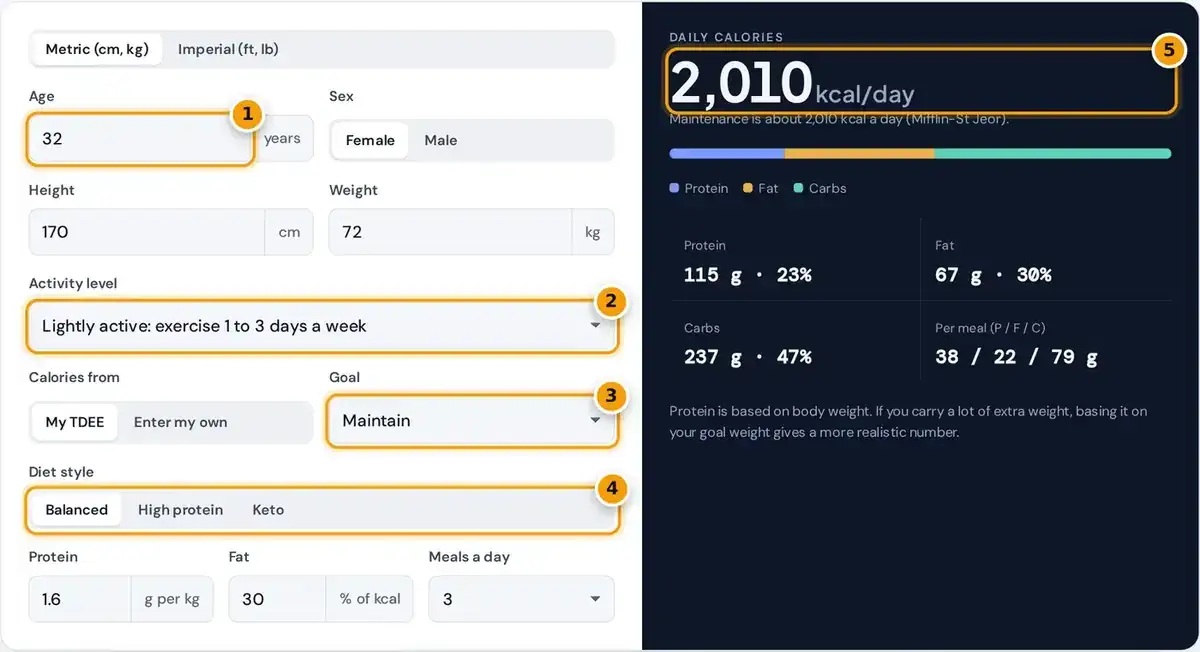
- Enter your age, sex, height and weight so your TDEE can be estimated.
- Choose your activity level, or switch to Enter my own calories.
- Pick a goal: lose fat, lose slowly, maintain or build muscle.
- Choose a balanced, high-protein or keto split, or fine-tune protein and fat.
- Read your daily calories, then your protein, fat and carb grams and the per-meal split.
Enter your age, sex, height, weight and activity level, in metric or imperial units, so the macro calculator can estimate your maintenance calories. Then pick a goal: lose fat, lose slowly, maintain or build muscle.
If you already know your calorie target, switch to Enter my own and type it in. Next, choose a diet style: balanced, high protein or keto. Each preset fills in protein and fat for you.
You can adjust protein per kg and fat percentage freely, and choose from two to six meals a day. The result shows daily calories, grams of each macro, percentages and a handy per meal split.
How the Macros Are Calculated
First the calculator estimates your BMR, the energy your body burns at complete rest, using the Mifflin-St Jeor equation. It multiplies that by an activity factor from 1.2 to 1.9 to get your daily TDEE.
Protein (g) = body weight (kg) × protein per kg
Fat (g) = calories × fat % / 9
Carbs (g) = (calories − protein g × 4 − fat g × 9) / 4
Your goal then adjusts the TDEE, from 20% below for fat loss to 10% above for muscle gain. Protein is then set from body weight, and fat is set as a percentage of total calories.
Protein and carbohydrate supply 4 kcal per gram, while fat supplies 9 kcal per gram. Carbs simply fill whatever calories remain, and dividing each calorie figure by its energy value converts it into daily grams.
Worked Example: Maintenance Macros
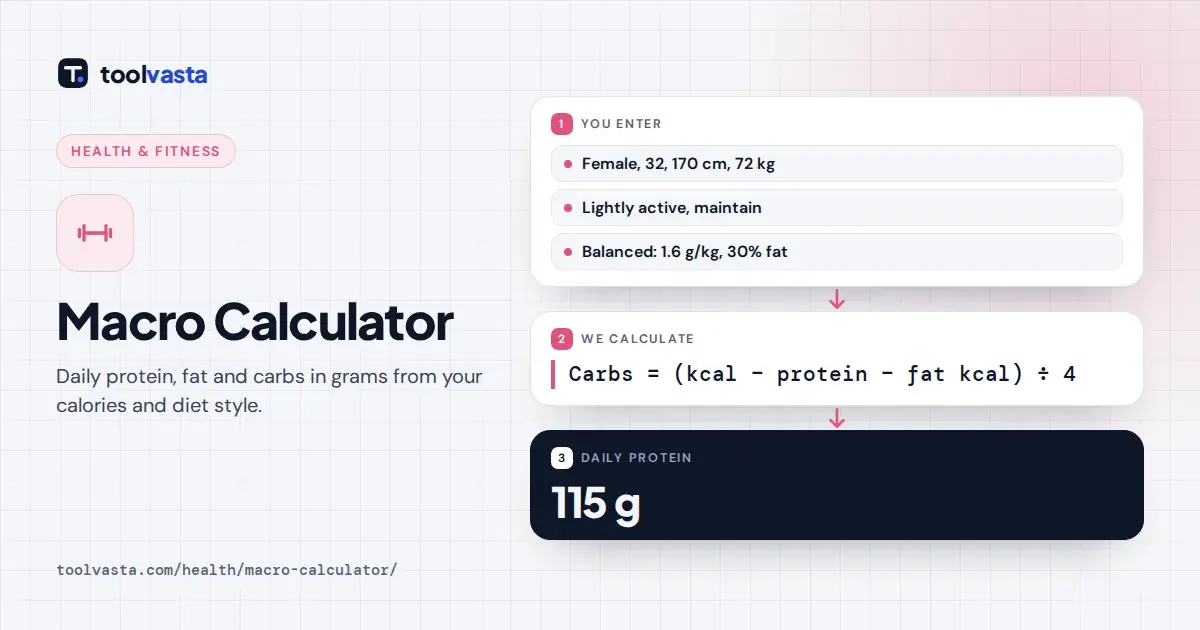
A 32-year-old woman who is 170 cm, weighs 72 kg and is lightly active has a TDEE of about 2,010 kcal a day. On the balanced preset for maintenance, the calculator works out as follows.
Protein is 72 kg times 1.6, or 115 g. Fat is 30% of 2,010 kcal, which is 67 g. Carbs then take the remainder, 946 kcal or 237 g, spread over three meals a day.
Switching to keto, with 1.6 g/kg protein and 70% fat, keeps protein at 115 g, raises fat to 156 g and leaves about 36 g of carbs. That falls well within a typical ketogenic range.
Diet Style Presets
Each preset is a starting point you can edit. Balanced suits most people well, high protein supports hard training and dieting, and keto shifts most calories to fat while keeping carbs very low each day.
| Preset | Protein | Fat | Carbs |
|---|---|---|---|
| Balanced | 1.6 g/kg | 30% of calories | Remainder |
| High protein | 2.2 g/kg | 25% of calories | Remainder |
| Keto | 1.6 g/kg | 70% of calories | Remainder, usually under 50 g |
The balanced preset sits inside the Acceptable Macronutrient Distribution Ranges used in Canada's Dietary Reference Intakes: 10 to 35% protein, 20 to 35% fat and 45 to 65% carbohydrate. They are the ranges for adults.
Keto usually keeps carbs under 50 g a day, often lower. It is not suitable for everyone, so the calculator notes when your carbs sit above or within a typical ketogenic level for your settings.
How Much Protein Do You Need?
The Recommended Dietary Allowance for adults is 0.8 g/kg of body weight a day, which prevents deficiency in most healthy people. It is a minimum for health rather than an ideal target for building muscle.
Intakes of 1.6 to 2.2 g of protein per kg are common in sports nutrition. They support muscle growth when combined with regular strength training and help protect muscle while eating in a calorie deficit.
Protein based on total body weight can be too high for people carrying a lot of body fat. In that case, enter your goal weight instead to get a more realistic and affordable protein target.
Macros for Cutting and Bulking
For fat loss, the lose fat goal uses a 20% calorie deficit and lose slowly uses 10%. Higher protein during cutting helps preserve muscle, and in the example the cutting target becomes 1,610 kcal daily.
For muscle gain, the build muscle goal adds a 10% calorie surplus, or 2,210 kcal in the example. Combined with consistent, regular strength training, a small surplus limits unwanted fat gain during a bulking phase.
When you change your goal, protein grams stay the same, because they depend on body weight. The change in calories comes mostly out of carbs, with a smaller change in fat grams from the percentage.
Choosing Your Fat and Carbs
Fat supports hormones and helps you absorb the fat-soluble vitamins A, D, E and K. The calculator accepts 15% to 80% of calories from fat, and 25% to 30% suits most balanced eating plans well.
Carbs are the most flexible macro and help fuel hard training performance and recovery. Choosing whole grains, vegetables, fruit and legumes adds fibre, while nuts, seeds and fish provide unsaturated fats instead of saturated ones.
Food quality still matters when the numbers match. The Canada's food guide healthy eating recommendations favour vegetables, fruit, whole grains and protein foods, including plenty of plant-based choices. Meet your macros mostly with whole foods.
Tracking, Adjusting and Limits
TDEE is an estimate that can be off by about 10%. Weigh food with a food scale, track your weight for two to three weeks, then adjust calories if weight is not moving as planned.
Results are estimates for general information, not medical advice. Talk with a doctor or registered dietitian before making any big dietary changes, especially if you are pregnant, breastfeeding, under 18 or managing a health condition.
The calculator warns when calories fall below 1,200 a day for women or 1,500 for men, since intakes that low are not recommended without medical supervision. Everything runs privately in your browser, with nothing stored.
Frequently asked questions
How do I calculate my macros?
Find your daily calories, set protein in grams per kg of body weight, set fat as a percentage of calories, and give the remaining calories to carbs. Divide protein and carb calories by 4 and fat calories by 9.
What is a good macro ratio for weight loss?
Many people do well with a 10 to 20% calorie deficit, 1.6 to 2.2 g of protein per kg and 25 to 30% of calories from fat. The best split is one you can stick to.
What are keto macros?
A typical keto split is about 70 to 75% of calories from fat, moderate protein and under 50 g of carbs a day, often 20 to 30 g. The keto preset here uses 70% fat.
How much protein do I need on a high-protein diet?
High-protein plans usually aim for 1.6 to 2.2 g per kg of body weight a day, especially when strength training or eating in a calorie deficit. The adult minimum is 0.8 g per kg.
How do I split macros per meal?
Divide each daily total by the number of meals you eat. The calculator does this for two to six meals, so a 115 g protein target over three meals is about 38 g each.
Is this macro calculator free?
Yes. It runs in your browser with no sign-up, and nothing you type is stored or sent anywhere. You can change inputs as often as you like and the results update instantly.