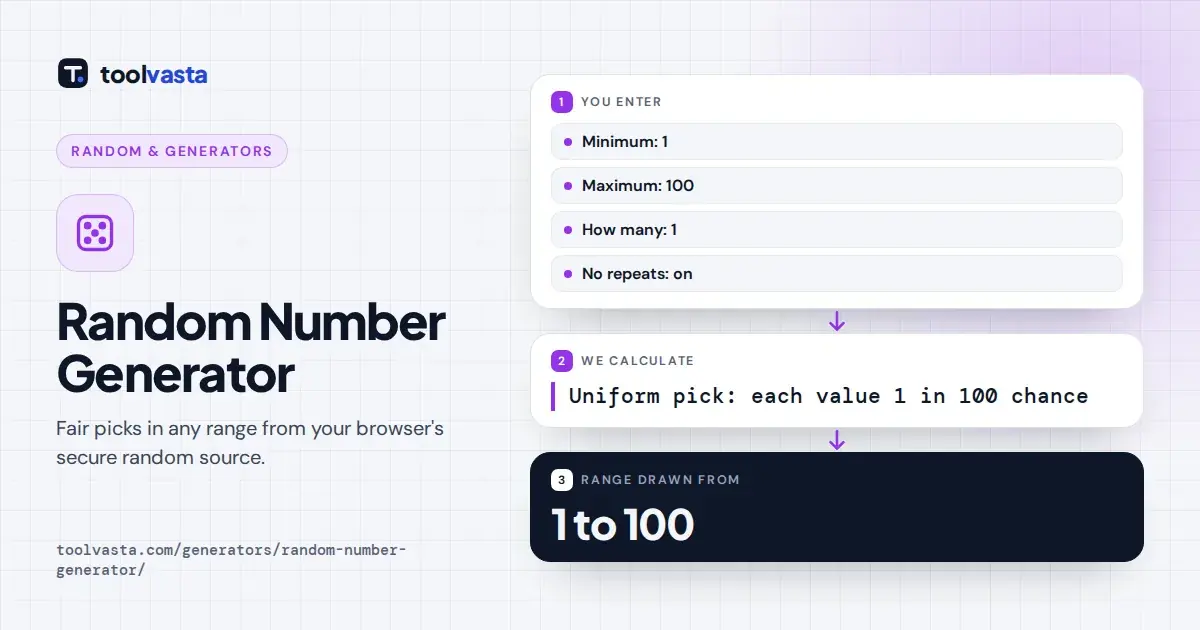
How to Use the Random Number Generator
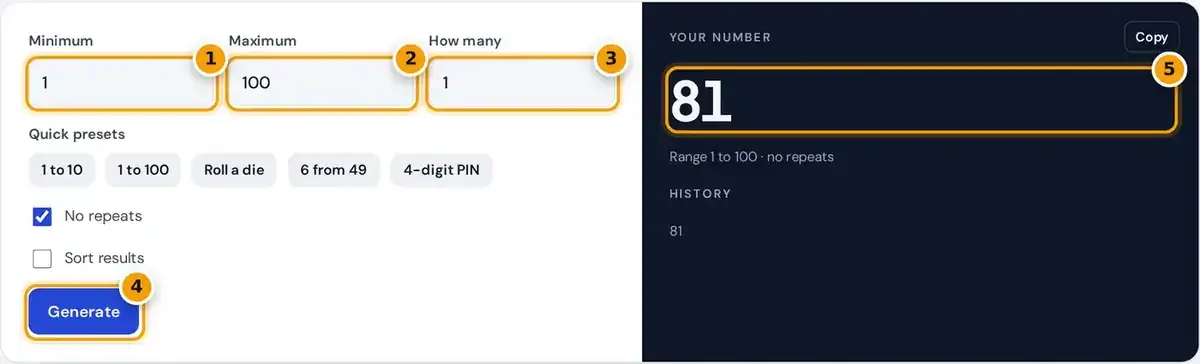
- Enter the smallest number you want in the draw, such as 1.
- Enter the largest number, such as 100, or 49 for a lotto style draw.
- Choose how many numbers to draw at once.
- Tick No repeats or Sort results if you need them, then press Generate for a fresh fair draw.
- Read your random number here and copy it with one tap. Earlier draws stay in the history.
Type the lowest value in the Minimum box and the highest in the Maximum box. Both limits are included, so a range of 1 to 100 can return 1, 100 or any whole number between.
Next, enter how many numbers you need, from 1 to 10,000, and press Generate. Tick No repeats when every result must be different, and tick Sort results when you want the list in ascending order.
The presets cover common jobs: 1 to 10, 1 to 100, roll a die, 6 from 49 and a 4-digit PIN. The last five draws stay in the history panel, and Copy grabs the list.
How Random Are the Numbers?
Most tools use Math.random or another pseudo-random algorithm that starts from a seed. Those numbers look random, yet anyone who knows the seed and algorithm could reproduce the sequence, so they suit games, not security.
This number generator calls the W3C Web Crypto API. It draws from the operating system's cryptographically secure source, the same one used to create encryption keys, so each result is unpredictable and cannot be replayed.
True random services capture physical noise, such as atmospheric noise or thermal noise. For picking winners, sampling rows or rolling dice, a cryptographically secure generator is effectively indistinguishable from true random output and far faster.
The Formula Behind Each Draw
values that would cause bias are discarded and redrawn
The browser supplies a random 32-bit integer between 0 and 4,294,967,295. The formula folds that value into the size of your range with the modulo operation, then adds the minimum to shift it into place.
Plain modulo creates a small bias, because 4,294,967,296 rarely divides evenly by the range size, so the lowest values would win more often. Rejection sampling fixes this: any value in the leftover is thrown away.
Discarded values are redrawn until one falls inside the even block. The result is a uniform distribution: every number in your range has an equal chance on every draw. No value ever gets special treatment.
Repeats, Duplicates and Sampling
With No repeats ticked, the tool performs sampling without replacement. Each number can appear once per draw, like pulling tickets out of a hat, so the count cannot exceed the unique numbers in your range.
Untick the box to allow duplicate values. That is sampling with replacement: every pick is independent, like rolling a die several times, and the same value can come up twice or more in one list.
The PIN preset switches repeats on, because real PINs such as 7, 7, 0, 3 often reuse digits. Raffles, seating plans and team draws need the opposite setting, where each person or ticket appears once.
Common Uses for a Number Generator
- Raffle or giveaway: number the entries, then draw one or more winners with no repeats.
- Games: roll a die with the 1 to 6 preset, or pick 1 to 20 for tabletop play.
- Classroom: give each student a number and call on them fairly.
- Research: choose a random sample of rows for an audit or survey.
- Lottery numbers: pick 6 from 49 without favorite-number bias.
Teachers use the classroom approach to pick presenters or split groups without anyone claiming favoritism. Pressing Generate on a projector makes the draw visible, and the history panel shows that earlier results were not changed.
Researchers and auditors use a random sample to check records from a large file. Number the rows in a spreadsheet, generate unique numbers inside that range, and review only the rows whose numbers were drawn.
A random pick is handy for small daily decisions: which chore comes first, which restaurant from a numbered list, or which question to study next. It removes hesitation and keeps repeated choices fair over time.
Odds of a Specific Number
When you draw one number from a range containing n values, each value has a probability of 1 in n. A range from 1 to 100 gives any number a 1 percent chance per draw.
Drawing several unique numbers changes the question to combinations. Choosing 6 from 49 gives 13,983,816 possible sets, so the odds of matching one set are 1 in 13,983,816, whichever numbers you or the tool pick.
| Draw | Possible outcomes | Odds of one exact result |
|---|---|---|
| 1 number from 1 to 10 | 10 | 1 in 10 |
| 1 number from 1 to 100 | 100 | 1 in 100 |
| Roll a die (1 to 6) | 6 | 1 in 6 |
| 4-digit PIN, repeats allowed | 10,000 | 1 in 10,000 |
| 6 from 49, no repeats | 13,983,816 | 1 in 13,983,816 |
Random picks cannot improve lottery odds, but they avoid popular patterns like birthdays, so a win is less likely to be shared. The NIST Randomness Beacon shows how verifiable random values are produced and published.
Frequently asked questions
Is this random number generator truly random?
It uses the Web Crypto API, which draws from your operating system's cryptographically secure random source. The results are unpredictable and evenly distributed, which makes them suitable for draws, games, sampling and other everyday uses.
Are the minimum and maximum numbers included?
Yes. Both limits are inclusive, so a range of 1 to 100 can return 1, 100 or any whole number in between. Decimal limits are rounded inward to the nearest whole number before the draw.
How do I generate numbers without repeats?
Tick the No repeats box before pressing Generate. Every number in the list will then be unique. The count cannot be larger than the number of values in your range, and the tool warns you if it is.
Can I pick a random number from 1 to 10?
Yes. Click the 1 to 10 preset, or type 1 as the minimum and 10 as the maximum, then press Generate. Each of the ten numbers has an equal one in ten chance on every draw.
How many random numbers can I generate at once?
You can generate up to 10,000 numbers in one draw. The screen shows the first 500 so the page stays fast, and the Copy button copies the complete list for pasting into a spreadsheet or document.
What is a seed in a random number generator?
A seed is the starting value for a pseudo-random algorithm. The same seed always produces the same sequence. This tool does not use a seed, so every draw is fresh and cannot be reproduced.