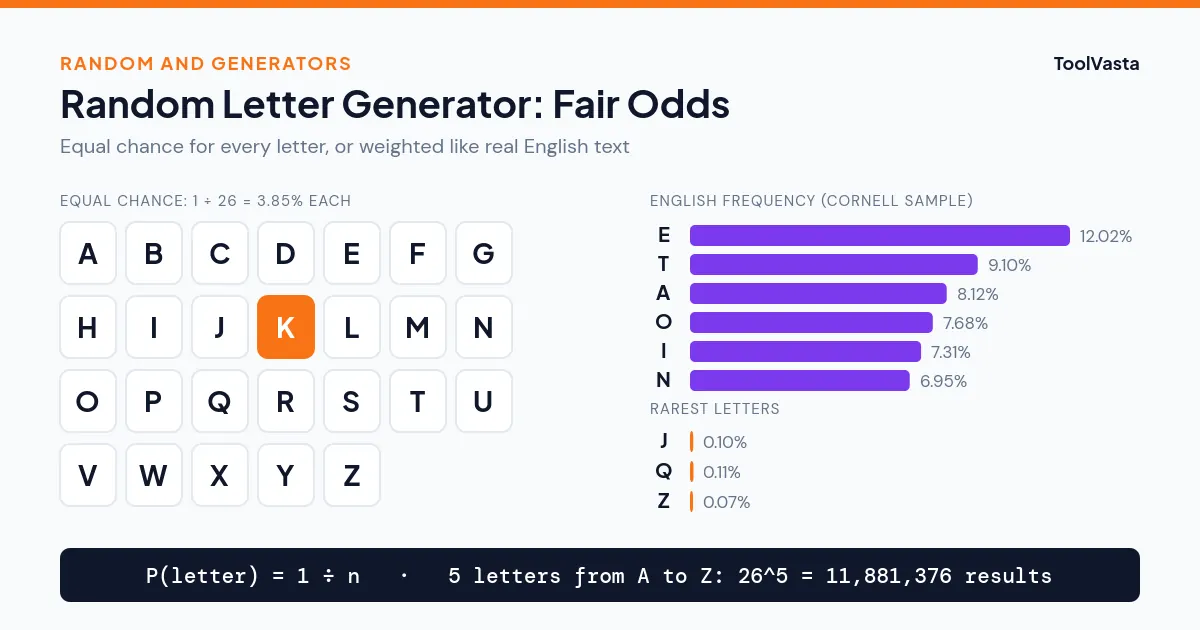
Quick answer: This random letter generator draws one or more letters from A to Z, or from vowels, consonants or your own set, with an equal chance for each. With 26 letters, the chance of any one letter is 1 ÷ 26 = 3.85%, and 5 letters can come out in 26^5 = 11,881,376 different ways.
What Is a Random Letter Generator?
A random letter generator is a tool that picks letters of the alphabet at random, the way a fair 26-sided die would. It settles the start letter in word games, makes practice drills for spelling and handwriting, and produces random codes or labels in a second.
This generator goes further than a single A to Z draw. You can use lowercase or mixed case, vowels only, consonants only, a party game set that leaves out Q, U, V, X, Y and Z, or your own letters, including accented and non-Latin ones. You can leave letters out, stop repeats and even weight the draw by how often letters appear in English text. Letters are drawn with your browser's cryptographic random number source, defined in the W3C Web Cryptography API, so no pattern carries over from one draw to the next.
How Do You Use the Random Letter Generator?
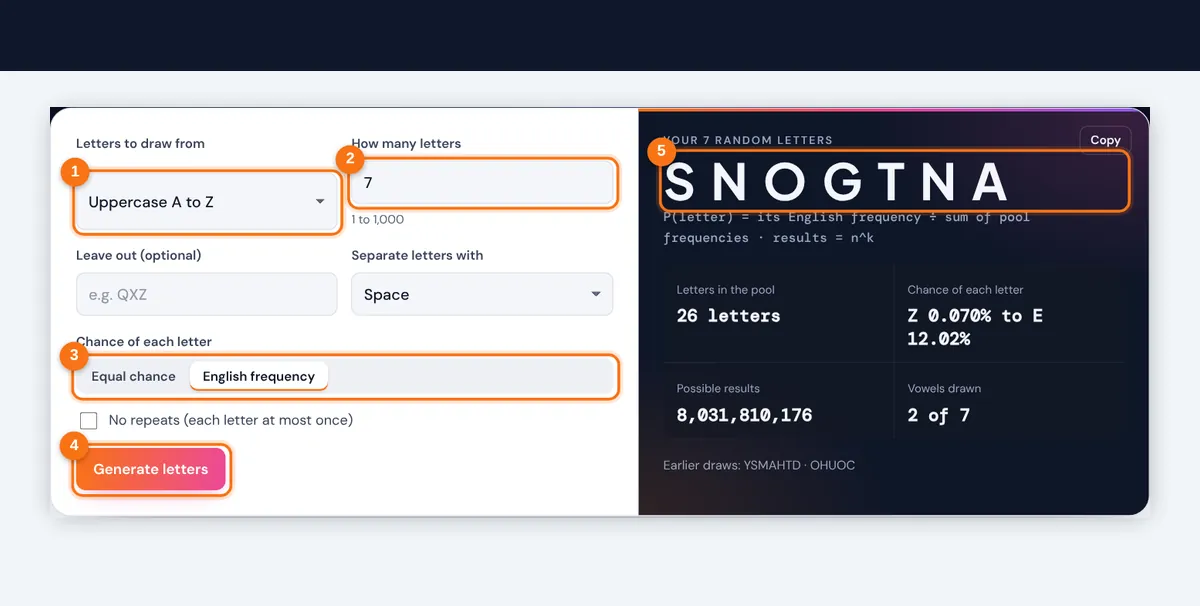
- Choose the letters to draw from, such as Uppercase A to Z, Vowels only or My own letters.
- Enter how many letters you want, from 1 to 1,000.
- Optionally type letters to leave out (for example QXZ) and choose how to separate the results: space, comma, new line or nothing.
- Choose Equal chance or English frequency, and tick No repeats if each letter may appear only once.
- Press Generate letters. Press it again for a new draw, or press Copy to paste the letters anywhere. Your last few draws are listed under the result.
What Are the Odds of Each Letter?
With equal chance, every letter in the pool has a probability of 1 divided by the number of letters, and the number of possible results grows as a power of the draw size. With No repeats on, each letter drawn leaves one fewer for the next pick.
Possible results with repeats = n^k
Possible results without repeats = n! ÷ (n − k)!
n = letters in the pool, k = letters drawn
Worked example: drawing 3 letters from A to Z gives P(any one letter) = 1 ÷ 26 = 3.85% per pick and 26^3 = 17,576 possible results. Without repeats the count drops to 26 × 25 × 24 = 15,600. With only the 5 vowels, a single draw gives each vowel a 1 in 5 chance, or 20%.
| Letter set | Letters (n) | Chance per letter | 3 letters, repeats allowed |
|---|---|---|---|
| A to Z | 26 | 3.85% | 17,576 |
| A to Z without Q, X, Z | 23 | 4.35% | 12,167 |
| Party game set | 20 | 5.00% | 8,000 |
| Consonants | 21 | 4.76% | 9,261 |
| Vowels | 5 | 20.00% | 125 |
| Upper and lowercase | 52 | 1.92% | 140,608 |
In English frequency mode, each letter's chance equals its share of letters in ordinary English text. The tool uses the table from a 40,000-word sample published by the Cornell University Department of Mathematics, where E makes up 12.02% of letters, T 9.10% and A 8.12%, while Z is just 0.07%. If you leave letters out, the remaining shares are scaled up so they still add to 100%.
What Can You Use Random Letters For?
Random letters are most useful when a game or exercise needs a fair starting point that nobody chose. Popular uses include:
- Category games: draw one letter and everyone names a city, animal or food that starts with it. The party game set skips Q, U, V, X, Y and Z, which are hard to play.
- Word puzzles: draw 7 to 9 letters with English frequency on, which gives a playable mix of vowels and consonants, and see who makes the longest word. Check the vowel count in the result panel.
- Classroom drills: call out random letters for phonics, handwriting or sign language practice. Lowercase mode helps younger readers.
- Character and place names: pick a first letter, then use it in the Starts with box of the DnD name generator.
When you need whole words instead of single letters, the random word generator filters words by first letter and length, and the random number generator handles numbers and digit codes.
Related Tools
Frequently asked questions
Is every letter equally likely?
Yes, in Equal chance mode. Each of the 26 letters has a 1 in 26 (3.85%) chance on every draw, and earlier draws have no effect on the next one.
How do I get random letters without repeats?
Tick No repeats. Each letter can then appear only once, so you can draw at most as many letters as the pool holds, for example all 26 letters in a random order.
Which letters are hardest for word games?
Q, X, Z and J are the rarest letters in English text, each under 0.2% in the Cornell sample. Type them in Leave out, or use the party game set, to keep the game fun.
Can I use letters from another alphabet?
Yes. Choose My own letters and type any letters, such as Ñ, Ü or Greek α, β and γ. English frequency mode only applies to A to Z, so other letters get an equal chance.
What is the most common letter in English?
E is the most common letter in English text at about 12%, followed by T, A, O and I. Switch to English frequency mode to draw letters in those proportions.