How to Use the Haiku Generator
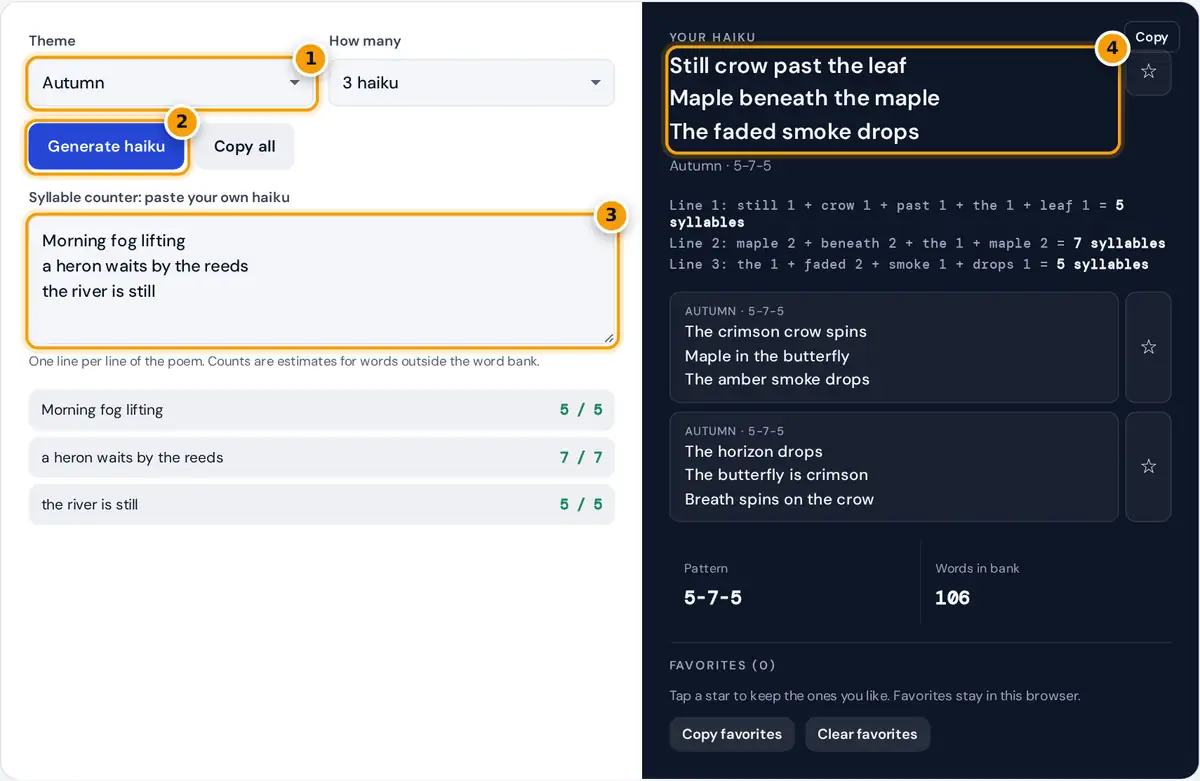
- Choose a season or theme for the word bank.
- Press Generate for new haiku.
- Paste your own haiku to count its syllables.
- Read the top haiku and check the syllable breakdown below it.
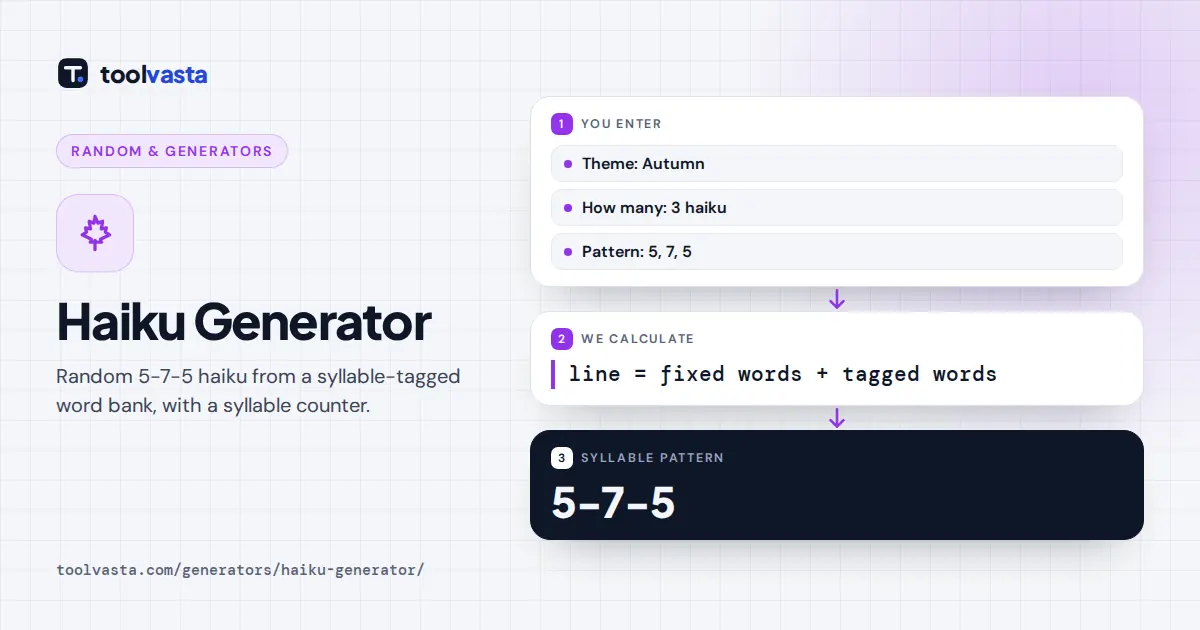
Choose a theme, such as one of the four seasons, the ocean, night, mountains and forest, the city or rain, and press Generate. Each haiku has three lines of 5, 7 and 5 syllables. Under the top poem, a breakdown lists every word with its syllable count and the total for each line, so you can see that the pattern is correct rather than take it on trust.
To check a poem of your own, paste it into the syllable counter, one line of the poem per line of the box. Each line shows its count next to the target, in green when it matches. Click a generated haiku to copy it, or tap the star to keep it in your favorites.
How the Haiku Are Built
The generator uses a word bank in which every word is tagged with its syllable count: adjectives, nouns, verbs and -ing words for each theme, plus a general set such as quiet, river and whispers. Words whose syllable count people disagree on, such as fire, flower and hour, are left out on purpose, so the counts are reliable.
Each line follows a simple grammar pattern, such as "the [adjective] [noun]" or "[noun] [preposition] the [noun]". The generator subtracts the syllables of fixed words like "the" from the target, then searches for words whose counts add up to exactly the remainder. A word is not repeated within one poem, and "a" becomes "an" before a vowel.
Worked Example
| Line | Words and syllables | Total |
|---|---|---|
| The crimson maple | the 1 + crim-son 2 + ma-ple 2 | 5 |
| Rustling beneath the scarecrow | rus-tling 2 + be-neath 2 + the 1 + scare-crow 2 | 7 |
| The orchard settles | the 1 + or-chard 2 + set-tles 2 | 5 |
What Makes a Haiku
Haiku is a Japanese poetic form. Classic Japanese haiku count sound units called on, arranged 5, 7 and 5, and traditionally include a seasonal reference called a kigo and a cutting word, a kireji, that creates a pause or contrast. Basho, Buson and Issa are among the best known masters. English-language poets adapted the form by counting syllables, which is the convention this generator follows.
Many modern poets writing in English do not count strictly, because English syllables are longer than Japanese on. They aim for a short, short, long rhythm instead. Use the 5-7-5 pattern as a reliable starting structure, and feel free to loosen it once you know the form.
Seasons and Themes
Each theme adds its own words to the general bank, and the generator prefers theme words, so an autumn haiku leans on maples, acorns and rustling leaves while a city haiku brings in sirens, taxis and crosswalks. Choose Any theme to mix everything. The Words in bank figure shows how many tagged words the current theme can draw from. Because the poems are assembled by rules, some lines will be strange or surprising. That is part of the fun: keep the striking images and rewrite the rest.
How the Syllable Counter Works
For words in the bank, the counter uses the tagged count. For other words it estimates by counting vowel groups, ignoring a silent final e and the endings -es and -ed when they are not pronounced, and adding a syllable for endings like -ble. English spelling has many exceptions, so treat the result as an estimate and clap out any line that looks wrong. Words such as fire, poem and orange are counted differently by different speakers.
Tips for Writing Your Own Haiku
- Focus on one moment. A haiku captures a single image, like frost on a mitten, not a whole story.
- Use the senses. Show what you see, hear or feel instead of naming an emotion.
- Include a season. A seasonal word, like blossom or snowflake, gives the reader a setting in one word.
- Create a turn. Let the third line add a surprise or contrast to the first two.
- Edit from a generated poem. Keep the line you like best and rewrite the others in your own words.
Frequently asked questions
What is the 5-7-5 rule in haiku?
In English, a haiku has three lines with 5, 7 and 5 syllables. The pattern comes from Japanese haiku, which count sound units called on. Every poem from this generator follows it exactly.
How does the generator make sure the syllables are right?
Every word in the bank is tagged with its syllable count, and words with disputed counts are left out. Each line is filled with words whose counts add up exactly to 5 or 7, with a breakdown shown.
Can I check the syllables in my own haiku?
Yes. Paste your poem into the syllable counter, one line per row. Each line shows its count against the 5-7-5 target. Words outside the bank are estimated, so check unusual words by clapping.
What is a kigo?
A kigo is a seasonal word in traditional Japanese haiku, such as cherry blossom for spring or snow for winter. Choose a season theme in the generator to get haiku with seasonal words built in.
Do haiku have to follow 5-7-5?
Not always. Many modern English-language poets use a looser short, long, short rhythm. The 5-7-5 pattern is still the standard taught in schools and a good starting point for beginners.
Can students use this haiku generator?
Yes. Teachers can use it to show how syllables add up, then ask students to edit a generated haiku or write their own and check it with the counter. The vocabulary is simple and family friendly.