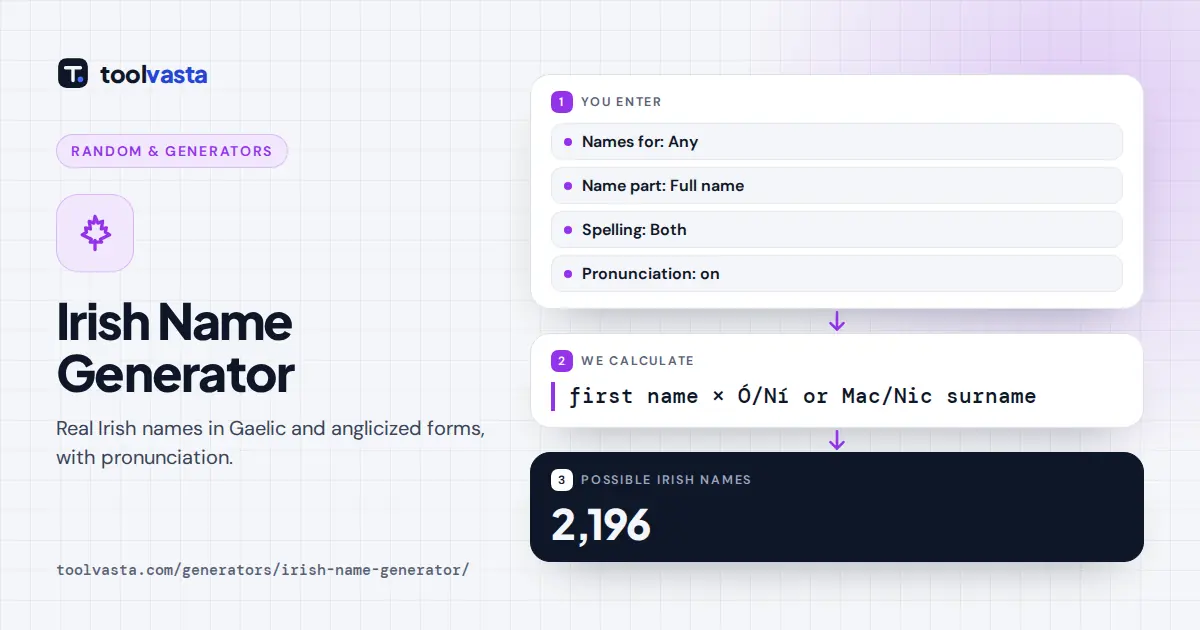
How to Use the Irish Name Generator
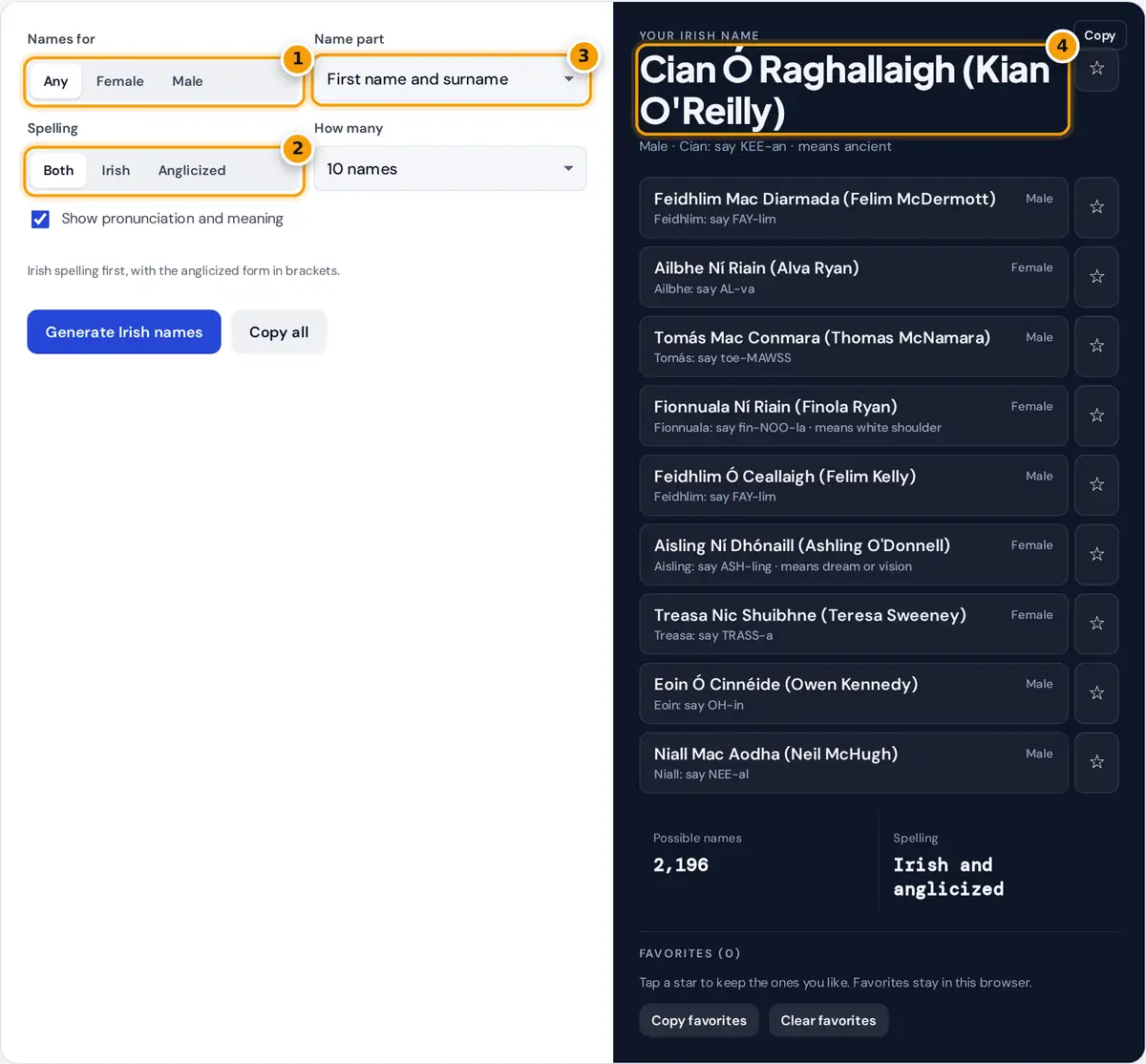
- Choose female, male or any Irish names.
- Pick Irish, anglicized or both spellings.
- Choose a full name, a first name or a surname.
- Read your Irish name with its pronunciation. Copy or save it.
Choose Female, Male or Any, then pick the name part: a full name, a first name only, or a surname only. Choose the spelling: Irish shows names as they are written in the Irish language, Anglicized shows the English forms many families use, and Both shows them side by side, such as Róisín Ní Bhriain (Rosaleen O'Brien).
With the pronunciation box ticked, every first name comes with a simple guide, so you know that Saoirse is said SEER-sha and Tadhg is said TIGE. Meanings appear where they are well established. Click a name to copy it, or tap the star to save your favorites.
How Irish Surnames Work
Most Irish surnames began as a statement of descent. Ó means "grandson" or "descendant of", and Mac means "son of". In Irish, the surname changes for women. A woman uses Ní (from iníon Uí, "daughter of the descendant of") instead of Ó, and Nic (from iníon Mhic) instead of Mac. After Ní and Nic, many names also change their first letter, a sound change called lenition, shown in writing by adding an h.
| Male form | Female form | Anglicized |
|---|---|---|
| Ó Briain | Ní Bhriain | O'Brien |
| Ó Súilleabháin | Ní Shúilleabháin | O'Sullivan |
| Ó Néill | Ní Néill | O'Neill |
| Mac Mathúna | Nic Mhathúna | McMahon |
| Mac Cárthaigh | Nic Cárthaigh | McCarthy |
Not every letter changes: names beginning with a vowel, l, n or r keep their spelling, which is why O'Neill becomes Ní Néill. The generator stores the correct female form for each of its 36 surnames. Traditionally, a married woman could also use the form Bean Uí, as in Bean Uí Bhriain, though many women today keep their own surname.
Irish and Anglicized Names
Over centuries of English rule, Irish names were written down in English forms, either by sound (Ciarán became Kieran) or by an English name thought to match (Seán became John, Siobhán became Joan). Prefixes were often dropped and later restored, which is why both Kelly and O'Kelly exist. Since the Irish language revival, many families have returned to Irish spellings, and names such as Aoife, Niamh and Saoirse are now popular in their original form around the world.
In Irish spelling that gives 2,196 full names. In anglicized spelling some names merge, because Aoife and Éabha are both anglicized as Eva, so there are 2,160. Each list is shuffled with your browser's secure random source.
Pronouncing Irish Names
Irish spelling follows its own consistent rules, which is why names like Niamh (NEEV) and Caoimhe (KEE-va) surprise English speakers. A few patterns help: bh and mh often sound like v or w, dh and gh are often silent or soft, and a fada, the accent over a vowel, makes it long, as in Seán (SHAWN). The guides here are simple approximations of common modern pronunciations. Pronunciation varies by region, so Ulster, Connacht and Munster speakers may say some names a little differently.
Tips for Choosing an Irish Name
- Decide on the spelling. The Irish form honors the language; the anglicized form may be easier for people who do not know Irish spelling.
- Keep the fada. The accent changes the sound and sometimes the meaning, so write Seán, not Sean, when you use the Irish form.
- Use the right surname form. A woman named Ó Briain in Irish would look wrong to Irish speakers. Use Ní Bhriain.
- Say it before you choose. Read the pronunciation guide aloud, and check that friends and family will be comfortable with it.
For a character in a story set in Ireland, think about age and place. Older generations and Gaeltacht families often use Irish forms, while others grew up with anglicized names, and both are completely authentic.
Frequently asked questions
How do you pronounce Irish names?
Irish spelling has its own rules. Bh and mh often sound like v or w, and a fada lengthens a vowel. Saoirse is said SEER-sha, Niamh NEEV and Tadhg TIGE. Tick the box to see a guide for every name.
Why do Irish surnames change for women?
In Irish, a woman's surname uses Ní instead of Ó, and Nic instead of Mac, because they mean daughter rather than son or grandson. Many names also change their first letter, so Ó Briain becomes Ní Bhriain.
What is the difference between Irish and anglicized names?
The Irish form is the name as written in the Irish language, such as Siobhán Ó Súilleabháin. The anglicized form is the English version that developed over centuries, such as Joan O'Sullivan.
What do O and Mac mean in Irish surnames?
Ó means grandson or descendant of, and Mac means son of. They show which ancestor a family descends from. In English spelling they became O' and Mac or Mc, as in O'Brien and McCarthy.
What are popular Irish girl names?
Popular Irish girl names include Aoife, Niamh, Saoirse, Caoimhe, Róisín and Sorcha. Choose Female and First name only to browse 30 names with their pronunciation and, where known, their meaning.
How many Irish names can the generator make?
In Irish spelling it can make 2,196 full names from 61 first names and 36 surnames, each with correct female and male forms. Anglicized spelling gives 2,160 because some names merge.