How to Use the Random Animal Generator
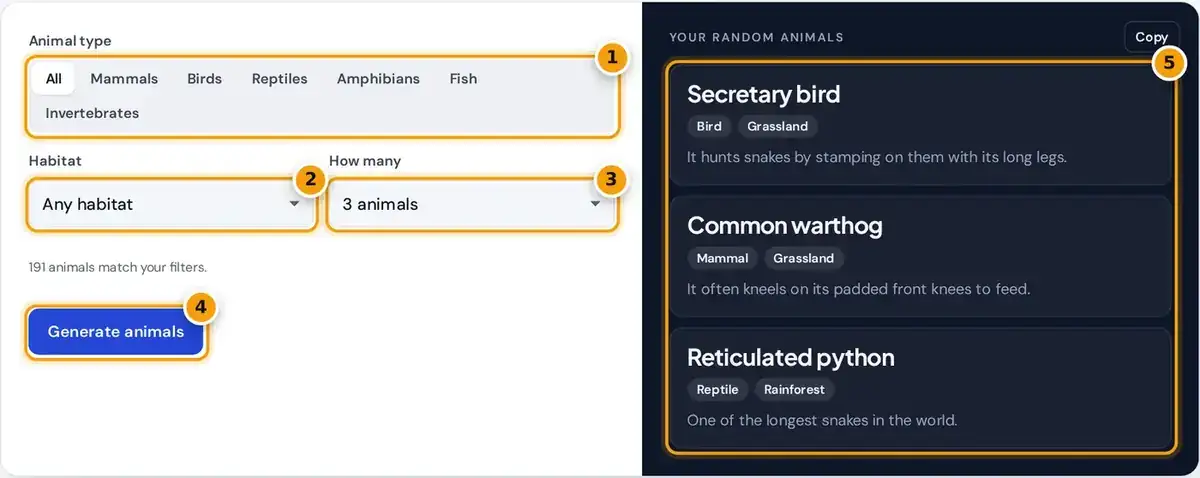
- Pick a group: all, mammals, birds, reptiles, amphibians, fish or invertebrates.
- Narrow it down by habitat, from desert to polar.
- Choose how many animals to draw: 1, 3, 5 or 10.
- Press Generate animals for a new random set.
- Read each animal's name, class, habitat and fun fact, and copy the list.
Press Generate animals to draw random species from the built-in animal list. Before you press it, choose an animal type such as mammals or amphibians, pick a habitat, and set how many animals to show.
You can show 1, 3, 5 or 10 animals at a time. The counter below the filters tells you how many animals match your choices, so you know how varied the results can possibly be.
Each result shows the animal's name, class, habitat and one short fact. Press Copy to quickly paste everything into a lesson plan, game or chat, or press the button again for a completely fresh set.
What Is in the Animal List
This animal generator draws from 191 animals, a mix of well-known species from every continent and ocean. The table shows how many mammals, birds, reptiles, amphibians, fish and invertebrates are included in the full list.
| Type | Animals in list |
|---|---|
| Mammals | 65 |
| Birds | 34 |
| Reptiles | 22 |
| Amphibians | 16 |
| Fish | 24 |
| Invertebrates | 30 |
| Total | 191 |
Each entry was written for this tool and checked against widely accepted natural history references. Every fun fact is kept short and general, because details such as size and speed vary between individuals and studies.
Invertebrates share one filter but each is labeled with its own class, such as insect, arachnid, mollusk or crustacean. That keeps the filter list short while still telling you exactly what kind of animal appeared.
How the Random Pick Works
The tool filters the list, then runs a Fisher-Yates shuffle on matching animals and shows the first few. The random numbers come from your browser's secure random source, defined in the W3C Web Cryptography standard.
Animals are drawn without replacement, so no animal appears twice in one draw. Every matching animal has an equal chance of being picked, and the probability depends only on how many you show and match.
For example, with 3 animals shown from all 191 species, each has a 3 in 191 chance, about 1.6%. Filter to the 16 amphibians and each one has a 3 in 16 chance, about 18.8%.
Ideas for Using Random Animals
Random animals make quick drawing prompts. Sketch whatever comes up, or generate two and combine them into a fantasy creature, a popular warm-up for artists, art students and anyone who simply enjoys doodling for fun.
In the classroom, assign each student an animal to research and present, or read out a habitat and ask the class to name an animal living there. The facts give every student a starting point.
For games, use the result for charades, twenty questions or Pictionary, and use the fact as a clue in trivia. Writers can also drop a surprise animal into a story to spark a new scene.
- Drawing prompts: sketch the animal, or combine two into a fantasy creature.
- Classrooms: assign each student an animal to research.
- Games: charades, twenty questions or Pictionary.
- Writing: add a surprise animal character to a story.
- Trivia: read the fact and let others guess.
Animal Groups Explained
Mammals are warm-blooded, have hair or fur and feed their young milk, although a few, like the platypus, lay eggs. Birds have feathers and beaks, and not all of them can fly, as penguins show.
Reptiles have scaly skin, most lay eggs on land, and they rely on outside heat to control body temperature. Amphibians usually begin life in water and later breathe air, often absorbing water through their skin.
Fish live in water and breathe with gills. Invertebrates have no backbone and make up the vast majority of animal species, including the insects, spiders, mollusks, crustaceans and jellyfish found in this random animal generator.
- Mammals: warm-blooded, hair or fur, feed young milk.
- Birds: feathers, beaks, hard-shelled eggs.
- Reptiles: scaly skin, rely on outside heat.
- Amphibians: usually start life in water, later breathe air.
- Fish: live in water and breathe with gills.
- Invertebrates: no backbone.
About the Habitat Labels
Many animals live in more than one habitat, so each one is tagged with the habitat where it is most typically found. The filter then narrows the list down to a single kind of place.
The habitat options are ocean, forest, rainforest, grassland, desert, polar, mountains, freshwater, wetlands, and farm and city. Combining a habitat with an animal type, such as ocean fish, gives a smaller and more focused list.
The labels are simplified for browsing and are not a full description of an animal's range. For schoolwork, check details with a textbook or a trusted source such as the Smithsonian's National Zoo animal pages.
Frequently asked questions
How many animals are in the generator?
The list contains 191 animals: 65 mammals, 34 birds, 22 reptiles, 16 amphibians, 24 fish and 30 invertebrates. Each entry has a class, a habitat label and a short fact.
Can I get only mammals or only ocean animals?
Yes. Choose an animal type and a habitat, or both together. The counter shows how many animals match your filters before you press Generate animals, so you can widen them if needed.
Are the animal facts accurate?
Each fact was written to reflect widely accepted natural history information and kept deliberately general. If you are using a fact for schoolwork, confirm it with a textbook or museum source.
Will the same animal appear twice in one draw?
No. Animals are drawn without replacement within a single draw, so each result in the list is different. A new draw starts fresh, so an animal can appear again next time.
What can I use a random animal generator for?
Drawing prompts, classroom research topics, charades and trivia games, and story ideas are the most common uses. Teachers also use it to assign animals for projects fairly and quickly.
Is the random pick truly fair?
Yes. The tool shuffles matching animals with the Fisher-Yates method using your browser's secure random source, so every animal that matches your filters has the same chance of appearing.