How to Use the BMI Calculator
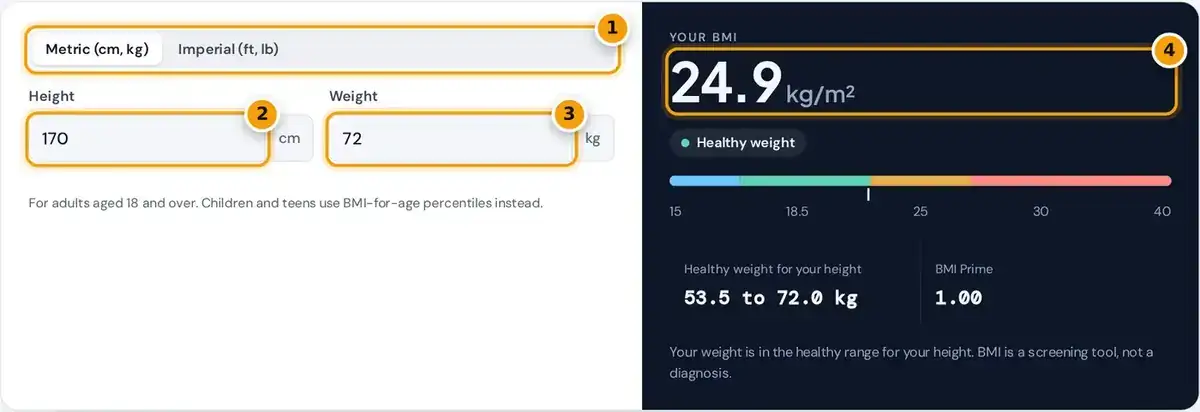
- Choose metric (cm, kg) or imperial (ft, lb) units.
- Enter your height in centimetres.
- Enter your current weight in kilograms.
- Read your BMI, then check your category, healthy weight range and BMI Prime below it.
First, choose metric units or imperial units at the top of the calculator. Metric asks for height in centimeters and weight in kilograms, while imperial asks for feet and inches plus your weight in pounds.
Your body mass index updates as you type, so there is no button to press. A colored marker shows where you sit on the scale, and a badge names the adult BMI category that applies.
Below the result you see the healthy weight range for your height and your BMI Prime. Switching units converts the numbers you already entered, so you can easily compare both systems without typing everything again.
The BMI Formula in Metric and Imperial Units
BMI divides body weight by height squared. With metric measurements the answer is expressed in kg/m², which is exactly why the calculator shows that unit right beside your final result instead of a plain number.
BMI = 703 × weight (lb) / height (in)2
BMI Prime = BMI / 25
Imperial measurements need a conversion factor. Divide pounds by inches squared, then multiply by 703. The factor turns pound and inch units into the same kg/m² scale, so both methods always give closely matching results.
The index was devised by the Belgian statistician Adolphe Quetelet in the 1830s to describe whole populations. Doctors now use it as a screening tool because it needs only a tape measure and a scale.
Worked BMI Examples
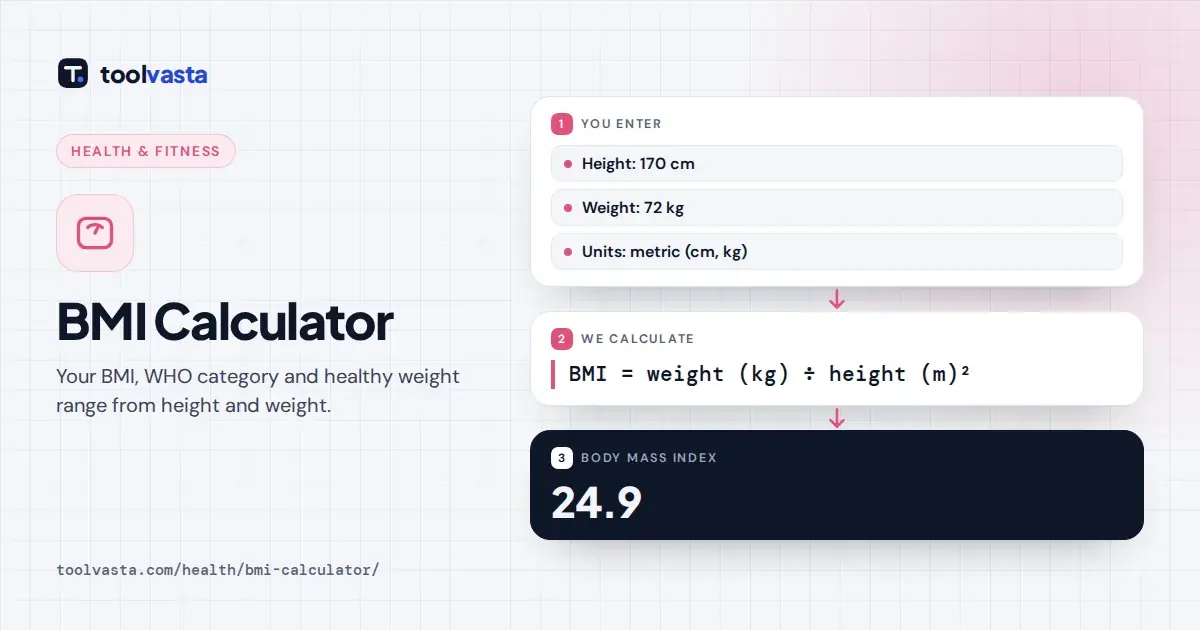
Here is a worked example using default values. A person who is 170 cm tall and weighs 72 kg has a BMI of 72 divided by 1.70 squared, which is 24.9 after you round it.
That result sits just inside the healthy range, so the calculator shows the healthy weight badge. The same height gives a healthy weight range of roughly 53.5 to 72.0 kg, shown just under the result.
Next, imperial units. Someone who is 6 feet tall and weighs 250 pounds has a height of 72 inches, so the BMI is 703 times 250 divided by 5,184, which gives 33.9, obesity class I.
Adult BMI Categories and Chart
The categories below come from the World Health Organization and are used by Health Canada and the CDC for adults. Exactly the same cut-offs also drive the colored BMI chart bar inside the calculator above.
| BMI (kg/m²) | Category | Health risk |
|---|---|---|
| Below 18.5 | Underweight | Increased |
| 18.5 to 24.9 | Healthy (normal weight) | Lowest |
| 25.0 to 29.9 | Overweight | Increased |
| 30.0 to 34.9 | Obesity class I | High |
| 35.0 to 39.9 | Obesity class II | Very high |
| 40.0 and above | Obesity class III | Extremely high |
The classes describe risk across a population, not the health of one person. A result in the overweight band is a prompt to look at other measures, not proof that something is wrong with you.
Some agencies advise lower action points for people of South Asian, Chinese and other Asian backgrounds, because risk of type 2 diabetes can rise from a BMI of about 23. The calculator uses standard cut-offs.
BMI Prime and Your Healthy Weight Range
BMI Prime is your BMI divided by 25, the upper limit of the healthy band. The ratio makes reading easy: 1.00 means you are exactly at the limit, and 1.20 means twenty percent above it.
The healthy weight range multiplies 18.5 and 24.9 by your height in meters squared. It shows which body weight keeps you in the normal weight band, which is more practical than a single BMI number.
If you are outside the range, the note under the result shows how far you are from it in kilograms or pounds. Treat that as information, and agree any target weight with a doctor first.
BMI for Women, Men and Older Adults
Women and men use the same formula and the same adult categories. At an equal BMI, women usually carry a higher body fat percentage than men, a natural difference in body composition between the sexes.
Age matters too. Older adults often experience muscle loss, so a normal BMI can hide extra fat. Some research also links a slightly higher BMI with better outcomes after 65, so interpretation needs real care.
Because the same number can mean different things for different people, clinicians rarely act on BMI alone. Instead, they usually combine it with waist size, blood tests, blood pressure and your personal and family history.
BMI for Children and Teens
This calculator is designed only for adults aged 18 and over. Children and teens are assessed with BMI-for-age, which compares a child with others of the same age and sex on standard CDC growth charts.
The result is a percentile, not a fixed category. For ages 2 to 19, the CDC treats below the 5th percentile as underweight, and the 5th percentile to below the 85th percentile as healthy weight.
From the 85th percentile to below the 95th percentile is overweight, and the 95th percentile or above is classed as obesity. Use the CDC child and teen BMI calculator for anyone under 20 years old.
Limits of BMI
BMI simply cannot tell muscle mass from fat. Strength athletes and very muscular people can score as overweight with little body fat, while someone with low muscle can score normal and still carry excess fat.
It also ignores fat distribution. Fat stored around the abdomen carries more risk than fat on the hips, so a waist circumference measurement adds very useful detail, especially when BMI sits near a category border.
BMI is not a suitable measure during pregnancy, and cut-offs may differ for South Asian and other groups. Use it as one screening number, not as a verdict on your health or your body composition.
Health Risks Linked to a High or Low BMI
According to the World Health Organization obesity fact sheet, a high BMI raises the risk of heart disease, stroke, type 2 diabetes and several common cancers, and that risk grows steadily as your BMI rises.
Excess weight is also linked with high blood pressure, sleep apnea and joint problems. Losing a modest share of your total body weight can improve these markers, even when BMI stays above the healthy band.
A low BMI carries its own health risk. Being underweight is linked with nutrient shortfalls, osteoporosis, a weakened immune system and fertility problems. This page gives estimates only, so please discuss results with your doctor.
Frequently asked questions
What is a healthy BMI for adults?
For adults, a BMI from 18.5 to 24.9 is considered a healthy weight. Below 18.5 is underweight, 25 to 29.9 is overweight, and 30 or more falls into one of the three obesity classes.
Is BMI different for women and men?
No. Adult women and men use the same formula and categories. Women tend to carry more body fat at the same BMI, and children and teens use BMI-for-age percentiles that differ by sex.
How do I calculate BMI in pounds and inches?
Divide your weight in pounds by your height in inches squared, then multiply by 703. For example, 250 pounds at 72 inches gives 33.9. Switch the calculator to imperial units to do this automatically.
What is BMI Prime?
BMI Prime is your BMI divided by 25, the top of the healthy range. A value of 1.00 means you are exactly at that limit, and a value below 0.74 means you are underweight.
Is BMI accurate for muscular people?
Not always. BMI counts total weight, so very muscular people and athletes can score as overweight while carrying little fat. A body fat test or waist measurement gives a clearer picture for them.
How often should I check my BMI?
Once or twice a year is enough for most adults. If you are actively changing your weight, a monthly check can help you track progress, but judge health with your doctor, not BMI alone.