How to Use the Keto Macro Calculator
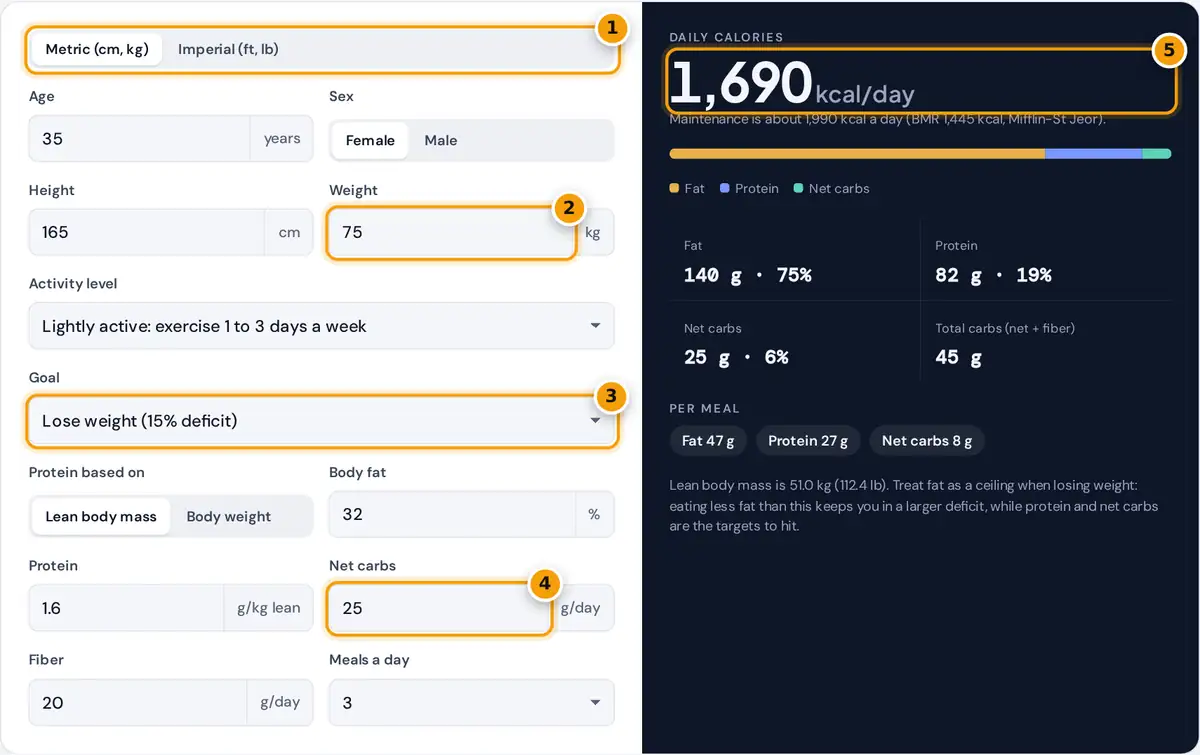
- Choose metric or imperial units.
- Enter your age, sex, height and weight so the calculator can estimate your energy needs.
- Pick your goal: a calorie deficit to lose weight, maintenance or a small surplus.
- Set net carbs, protein per kg of lean mass and fiber.
- Read daily calories, then your fat, protein and net carb grams and the per-meal split.
Choose metric or imperial units, then enter your age, sex, height, weight and activity level so the calculator can estimate your daily energy needs. Pick a goal: a 10 to 20% calorie deficit to lose weight, maintenance, or a small surplus. Then set the three keto inputs: protein, net carbs and fiber.
Protein works best when it is based on lean body mass, because body fat does not need protein. If you do not know your body fat percentage, switch to body weight and the default changes to 1.2 g per kg. Net carbs are a fixed number of grams, usually 20 to 50 g. Fat fills whatever calories are left.
How Keto Macros Are Calculated
BMR (men) = 10 × kg + 6.25 × cm − 5 × age + 5
calories = BMR × activity factor × (1 + goal)
protein g = g per kg × lean mass, where lean mass = kg × (1 − body fat %)
fat g = (calories − protein g × 4 − net carbs g × 4) ÷ 9
Protein and carbohydrate supply 4 kcal per gram and fat supplies 9 kcal per gram. The Mifflin-St Jeor equation (1990) is the BMR formula most dietitians use for adults.
Worked Example
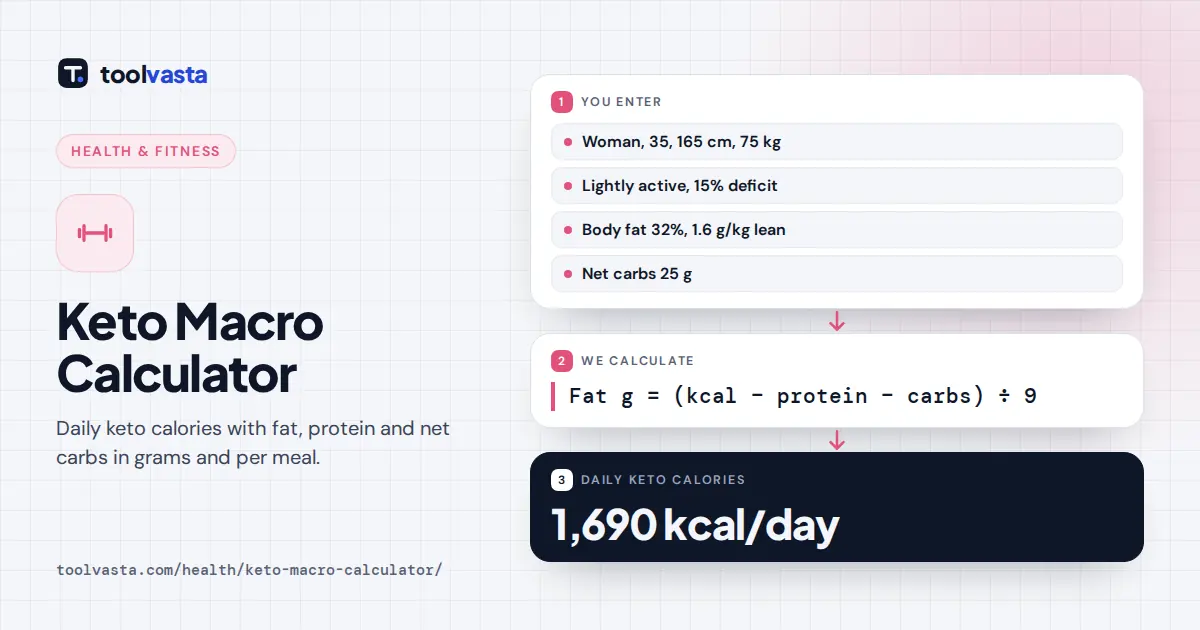
A 35-year-old woman, 165 cm and 75 kg, lightly active, with 32% body fat:
- BMR = 750 + 1,031.25 − 175 − 161 = 1,445 kcal
- Maintenance = 1,445.25 × 1.375 = 1,987 kcal. A 15% deficit gives 1,690 kcal after rounding to the nearest 10.
- Lean mass = 75 × 0.68 = 51 kg, so protein = 1.6 × 51 = 82 g (326 kcal)
- Net carbs = 25 g (100 kcal)
- Fat = (1,690 − 326 − 100) ÷ 9 = 140 g
The split is about 75% fat, 19% protein and 6% carbs. With 20 g of fiber, total carbs on a food label would add up to about 45 g.
Net Carbs vs Total Carbs
Net carbs are total carbohydrates minus fiber. Fiber is not digested into glucose in the same way, so most keto plans count only net carbs toward the daily limit. In Canada, nutrition labels list fiber inside total carbohydrate, so subtract it yourself. In the US, labels also list total carbohydrate with fiber included.
| Approach | Net carbs per day |
|---|---|
| Strict keto | 20 g or less |
| Standard keto | 20 to 30 g |
| Liberal keto | 30 to 50 g |
| Low carb, not keto | 50 to 100 g |
How Much Protein on Keto?
Older keto advice warned against protein, but current practice is to eat enough to keep muscle. Intakes of about 1.2 to 2.0 g per kg of lean mass are common, with the higher end for strength training or a large deficit. The default of 1.6 g per kg of lean mass is a balanced middle ground.
Adjusting Your Keto Macros Over Time
Recalculate whenever your weight changes by about 5 kg (10 lb), because both your calorie needs and your protein target change with it. If your weight has not moved for three to four weeks on a weight loss goal, lower calories by about 100 to 150 kcal a day, taking the cut from fat rather than protein. Keep net carbs where they are as long as you feel well.
Limits and Safety
- Calorie needs from any equation can be off by about 10%. Track your weight for two to three weeks and adjust.
- Body fat estimates from scales and tape measures can be several points off, which changes the protein target.
- Keto diets are not suitable for everyone. People who are pregnant, breastfeeding, have kidney or liver disease, or take diabetes or blood pressure medication should speak with a doctor first.
Results are estimates for general information, not medical advice. Talk with a doctor or registered dietitian before big changes to diet, exercise or sleep, especially if you are pregnant, under 18 or managing a health condition.
Frequently asked questions
How do I calculate my keto macros?
Estimate your daily calories, set net carbs at 20 to 50 g, set protein at about 1.6 g per kg of lean body mass, then give the remaining calories to fat. Divide fat calories by 9 to get grams.
What are typical keto macro percentages?
Most keto plans end up around 70 to 80% of calories from fat, 15 to 25% from protein and 5 to 10% from carbs. Grams matter more than percentages, especially for carbs.
How many net carbs can I eat on keto?
Most people stay in ketosis below about 20 to 50 g of net carbs a day. Start at 20 to 25 g and increase slowly if you want more vegetables or fruit.
Why base protein on lean body mass?
Body fat does not need protein for repair, so lean mass gives a more realistic target for people with higher body fat. Using total body weight would overestimate protein for them.
Do I have to eat all the fat grams?
No. On a weight loss goal, fat works as an upper limit. Hit your protein and stay under your net carbs, and eating a little less fat simply deepens the deficit.
What is the difference between net carbs and total carbs?
Net carbs are total carbohydrates minus fiber. Most keto plans count only net carbs, because fiber has little effect on blood sugar. The calculator shows both numbers.