How to Use the Standard Drink Calculator
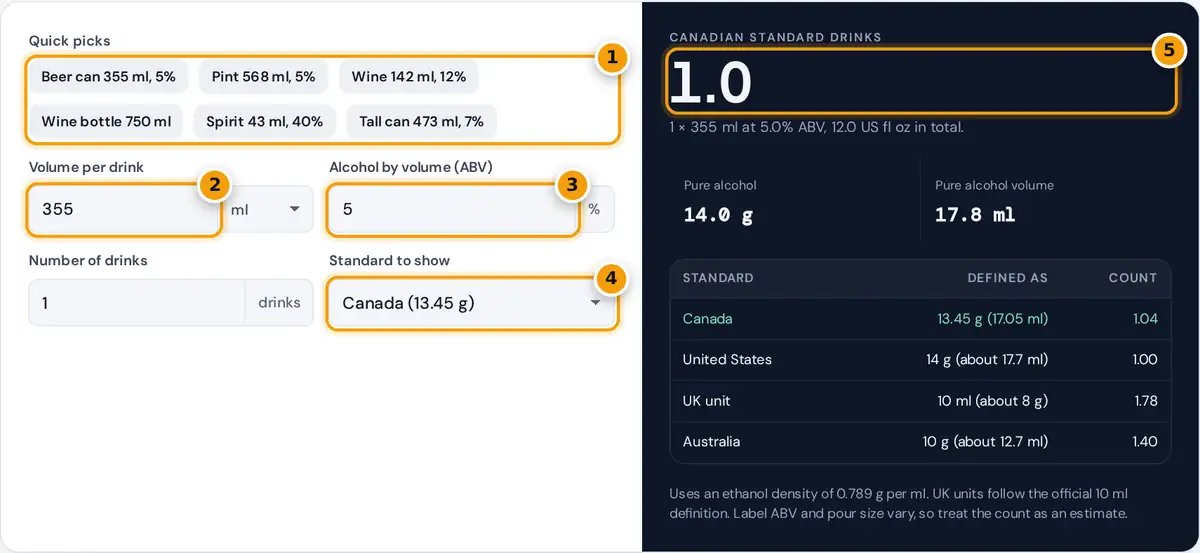
- Tap a quick pick such as a beer can, pint, glass of wine or shot of spirits.
- Or type the volume of one drink in ml, US fl oz or UK fl oz.
- Enter the alcohol by volume from the label.
- Choose which national standard to show in the large result.
- Read the standard drinks, grams of pure alcohol and the count under all four standards.
Tap a quick pick such as a 355 ml beer can or a 142 ml glass of wine, or type the volume of one drink in milliliters, US fluid ounces or UK fluid ounces. Enter the alcohol by volume (ABV) from the label and how many of those drinks you had or plan to pour.
Choose which national standard to show in the large result. The table underneath always shows the count under all four definitions, because a "standard drink" is not the same size everywhere. You also see the grams and milliliters of pure alcohol, which are the same in every country.
Standard Drink Formula
pure alcohol (g) = pure alcohol (ml) × 0.789
standard drinks = grams ÷ grams per standard drink
The 0.789 factor is the density of ethanol in grams per milliliter at room temperature. One US fluid ounce is 29.574 ml and one UK fluid ounce is 28.413 ml.
Worked Example
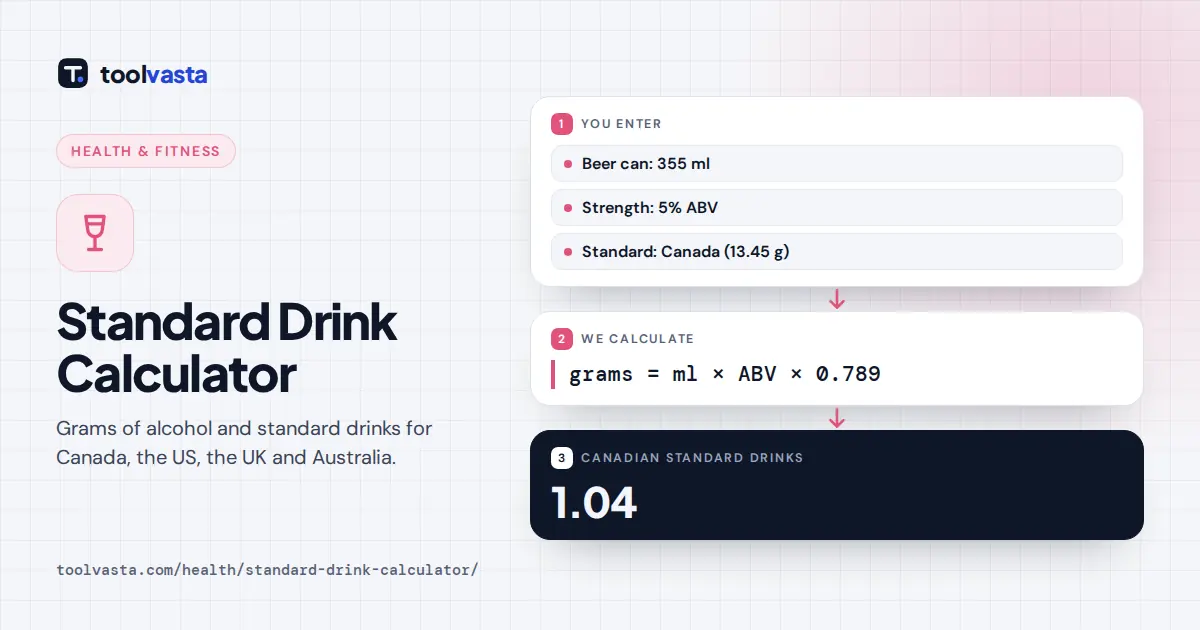
A 355 ml can of 5% beer holds 355 × 0.05 = 17.75 ml of pure alcohol, which weighs 17.75 × 0.789 = 14.0 g. That is 1.04 Canadian standard drinks (14.0 ÷ 13.45), 1.00 US standard drink, 1.8 UK units and 1.40 Australian standard drinks. A 750 ml bottle of 13.5% wine holds 79.9 g of alcohol: 5.94 Canadian standard drinks, or 7.99 in Australia.
Standard Drink Sizes by Country
| Country | One standard drink | Typical example |
|---|---|---|
| Canada | 13.45 g (17.05 ml) | 341 ml beer at 5%, 142 ml wine at 12%, 43 ml spirits at 40% |
| United States | 14 g | 12 fl oz beer at 5%, 5 fl oz wine at 12%, 1.5 fl oz spirits at 40% |
| United Kingdom | 1 unit = 10 ml (about 8 g) | A 25 ml single measure of 40% spirits |
| Australia | 10 g (about 12.7 ml) | About 100 ml of 13% wine |
Because the definitions differ, the same 568 ml pint of 5% beer is about 1.7 drinks in Canada and 2.8 units in the UK. Always compare a guideline with the standard used in the country that wrote it.
Common Drinks Compared
| Drink | Alcohol | Canada | UK units |
|---|---|---|---|
| Beer can, 355 ml at 5% | 14.0 g | 1.04 | 1.8 |
| Pint, 568 ml at 5% | 22.4 g | 1.67 | 2.8 |
| Wine, 142 ml at 12% | 13.4 g | 1.00 | 1.7 |
| Wine bottle, 750 ml at 13.5% | 79.9 g | 5.94 | 10.1 |
| Spirit, 43 ml at 40% | 13.6 g | 1.01 | 1.7 |
Why Pour Size Changes the Count
Labels show ABV, but the glass decides how much you drink. A generous home pour of wine is often 175 to 250 ml rather than the 142 ml of a Canadian standard glass. At 13% ABV, 250 ml holds 25.6 g of alcohol, which is 1.9 Canadian standard drinks or 3.3 UK units in a single glass. Cocktails are harder still because they often combine two or three spirits. When you are unsure, measure the pour once with a kitchen measuring cup, enter that volume here, and use the result as your personal reference for that glass.
Tips and Limits
- Restaurant and home pours are often larger than a standard glass. Measure once at home to see what you really pour.
- Craft beers and ciders often run 6 to 9% ABV, so one tall can can be close to three standard drinks.
- This tool counts alcohol. It does not estimate blood alcohol or whether it is safe to drive; for that, see our BAC calculator and never drive after drinking.
- Canada's Guidance on Alcohol and Health and similar national guidelines are written in their own country's standard drinks. See Health Canada for Canadian information.
Results are estimates for general information, not medical advice. Talk with a doctor or registered dietitian before big changes to diet, exercise or sleep, especially if you are pregnant, under 18 or managing a health condition.
Frequently asked questions
What is a standard drink in Canada?
A Canadian standard drink contains 13.45 g of pure alcohol, which is 17.05 ml. Examples are a 341 ml bottle of 5% beer, a 142 ml glass of 12% wine and a 43 ml shot of 40% spirits.
How many standard drinks are in a bottle of wine?
A 750 ml bottle of 13.5% wine holds about 79.9 g of alcohol. That is about 5.9 Canadian standard drinks, 5.7 US standard drinks, 10 UK units or 8 Australian standard drinks.
How do you calculate UK alcohol units?
Multiply the volume in milliliters by the ABV percentage and divide by 1,000. A 568 ml pint of 5% beer is 568 × 5 ÷ 1,000 = 2.84 units, about 2.8, because one unit is 10 ml of pure alcohol.
Is a US standard drink the same as a Canadian one?
They are close but not equal. A US standard drink is 14 g of alcohol and a Canadian one is 13.45 g, so the same drink counts slightly higher in Canada, about 4% more.
Why does the calculator use 0.789?
Ethanol is lighter than water. One milliliter of pure alcohol weighs about 0.789 g at room temperature, so the tool multiplies milliliters of alcohol by 0.789 to get grams for the standard drink definitions.
Does a standard drink tell me if I can drive?
No. Standard drinks measure how much alcohol you consumed, not your blood alcohol level, which depends on body size, food and time. The only safe choice is not to drive after drinking.