How to Use the CRA Payroll Calculator
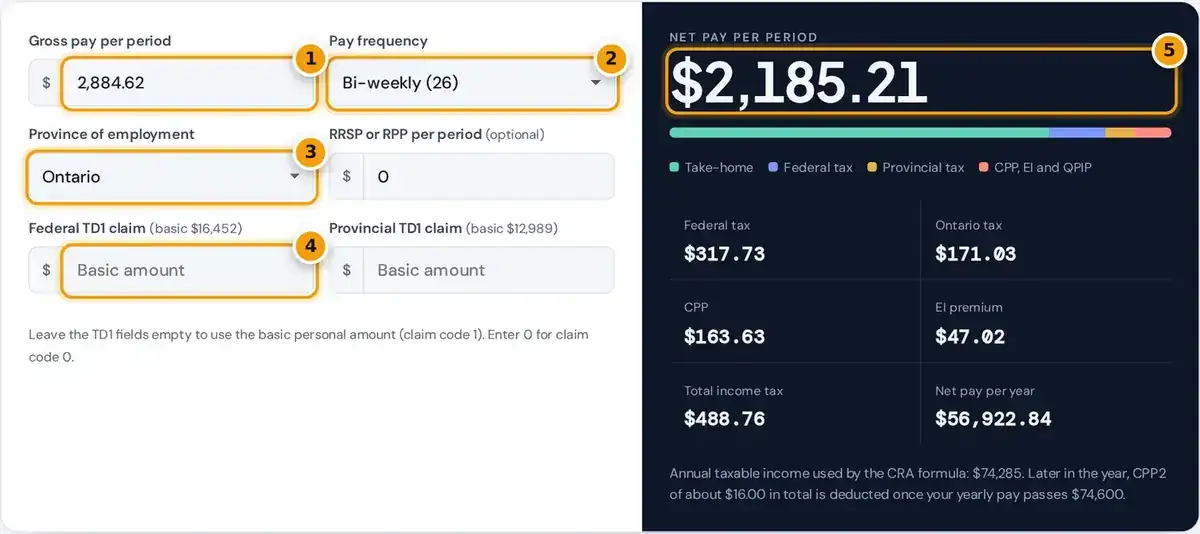
- Enter gross pay for one pay period.
- Choose the pay frequency: weekly, bi-weekly, semi-monthly or monthly.
- Pick the province of employment for the provincial tax table.
- Leave the TD1 claim fields empty for the basic amount, or enter your claim.
- Read net pay per period with federal tax, provincial tax, CPP and EI.
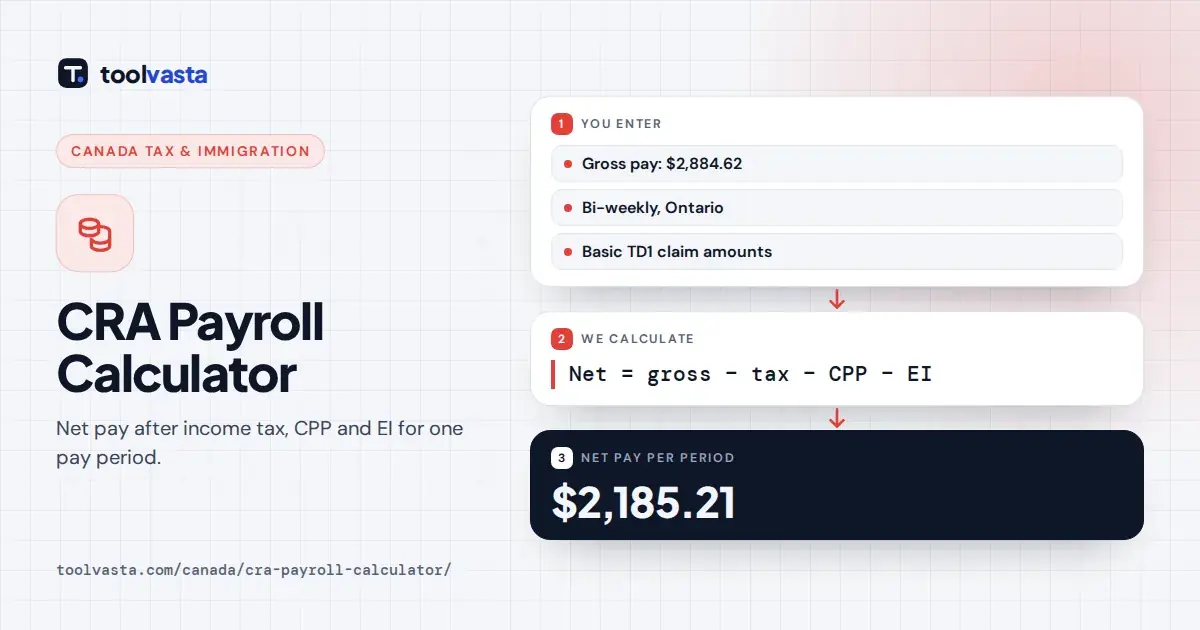
Enter your gross pay for one pay period, choose a pay frequency such as weekly or semi-monthly, and select your province of employment. The default is a $75,000 salary paid bi-weekly, or $2,884.62 per period.
If your employer deducts RRSP or RPP contributions at source, enter it per period, because the CRA formula taxes income left after them. Leave the TD1 claim boxes empty to use the basic personal amounts.
The result panel shows net pay, the income tax withheld, and your CPP and EI deductions. A table underneath lists every deduction per period and per year, so you can check your take-home pay quickly.
How Payroll Deductions Are Calculated
The CRA source deductions method comes from guide T4127. Your pay for the period is annualized, income tax is worked out on that yearly figure, and the result is divided back over the pay periods.
EI = 1.63% × insurable pay
A = periods × (pay − RRSP − enhanced CPP)
Federal tax = R × A − K − 14% × (TD1 claim + CPP base + EI + $1,501)
Tax per period = (federal tax + provincial tax) ÷ periods
CPP applies to pay above the basic exemption of $3,500 a year, and EI premiums apply to insurable earnings. Enhanced CPP, 1% of the 5.95%, is deducted from income instead of claimed as a credit.
R and K are the federal rate and constant for the bracket where A falls. Credits include the TD1 claim, base CPP, EI and the Canada employment amount. Claim code 1 means the basic amount.
Worked Example From the CRA Tables
The CRA example in the 2026 Ontario and B.C. payroll deductions tables, guide T4032, uses weekly pay of $1,300 with an $80 RRSP deduction. CPP is $73.35, EI is $21.19 and enhanced CPP is $12.33.
Annual taxable income is therefore ($1,300 − $12.33 − $80) × 52, which equals $62,798.84. Federal tax comes to $5,957.85 a year, and Ontario tax including the Health Premium is $3,264.26, giving a weekly tax deduction of $177.35.
In British Columbia the provincial tax is $2,975.57, so the weekly deduction is $171.80. Enter the same values and it reproduces both CRA results to the cent. That is the easiest way to confirm accuracy.
2026 Payroll Rates and Maximums
| Item | 2026 figure |
|---|---|
| CPP rate (employee) | 5.95% |
| Year's maximum pensionable earnings (YMPE) | $74,600 |
| Basic exemption | $3,500 |
| Maximum CPP contribution | $4,230.45 |
| CPP2 rate, earnings $74,600 to $85,000 | 4% (maximum $416) |
| EI rate (outside Quebec) | 1.63% (maximum $1,123.07) |
| EI maximum insurable earnings | $68,900 |
| Quebec: QPP 6.30%, EI 1.30%, QPIP 0.43% | QPP max $4,479.30, QPIP max $442.90 |
| Federal basic personal amount | $16,452 (falls to $14,829 above $181,440) |
| Canada employment amount | $1,501 |
| Lowest federal rate | 14% |
CPP runs at 5.95% on pensionable earnings between the $3,500 exemption and the year's maximum pensionable earnings (YMPE) of $74,600. The maximum contribution is $4,230.45, and CPP2 adds 4% on earnings from $74,600 to $85,000.
The EI rate outside Quebec is 1.63% of insurable earnings up to $68,900, for a maximum premium of $1,123.07. Quebec workers pay a lower EI rate because QPIP funds parental benefits in that province instead.
The federal basic personal amount is $16,452, shrinking to $14,829 for high incomes, and the lowest federal rate is 14%. Provinces set their own basic amounts, such as $12,989 in Ontario for claim code 1.
Provincial Differences Across Canada
The calculator covers all 13 provinces and territories, so it works as a payroll calculator for Ontario, a payroll tax calculator for BC, or a net pay calculator for Manitoba, each with its own brackets.
Ontario adds a surtax and the Ontario Health Premium on top of its provincial tax brackets, and the calculator includes both automatically. Alberta, Manitoba and the other provinces apply their own rates and tax credits.
Quebec workers pay QPP at 6.30% instead of CPP, plus QPIP and reduced EI. Revenu Québec uses its own formula, explained in its 2026 employer changes, so Quebec provincial tax here is only an estimate.
Mid-Year Changes From July 1, 2026
The CRA issued a July edition of the T4127 payroll deductions formulas, effective July 1, 2026. Employers must use those values for pay periods from July onward, and this calculator applies the same July figures.
British Columbia raised its lowest rate to 5.60% for 2026, so payroll uses a prorated 6.14% and an $805 tax reduction for the second half of the year. That keeps the annual total on target.
Newfoundland and Labrador uses a prorated basic amount of $15,000. Prince Edward Island now applies its new 20% rate on income over $200,000 as a prorated 21% for the remaining pay periods of the year.
Why Your Take-Home Pay Changes During the Year
CPP and EI stop once you reach the annual maximum, so higher earners often see a bigger paycheck late in the year. CPP2 then starts after your pay passes $74,600, up to its $416 limit.
A one-time bonus is taxed with a separate CRA method that compares annual tax with and without the bonus, so withholding often looks high. This calculator handles regular pay only, not bonus or commission runs.
Employers also pay their share: matching CPP, and EI at 1.4 times your premium. They send the employer contributions and your deductions to the CRA in a regular remittance, then report everything on your T4.
Limits of This Payroll Calculator
This is an estimate for a regular pay period with no year-to-date amounts. It does not handle taxable benefits, union dues, the northern residents deduction, or periods after you reach the CPP or EI maximums.
For an exact figure or official payroll records, use the CRA Payroll Deductions Online Calculator (PDOC), or ask your employer's payroll team. PDOC also handles bonuses, commissions and other special cases that this tool skips.
This estimate is for planning and is not tax, legal or financial advice. Your final tax depends on your full return, credits and deductions, so confirm important numbers with the CRA or a qualified professional.
Frequently asked questions
How do I calculate my net pay in Canada?
Start with gross pay, then subtract CPP at 5.95% above the basic exemption, EI at 1.63%, and federal and provincial income tax. The CRA annualizes your pay, applies brackets and credits, then divides by your pay periods.
How much tax is taken off a $75,000 salary in Ontario?
Paid bi-weekly, a $75,000 salary is $2,884.62 per period. About $488.76 of income tax, $163.63 of CPP and $47.02 of EI are deducted, leaving roughly $2,185.21 of net pay per period.
Why is CPP no longer deducted from my pay late in the year?
CPP stops once you reach the 2026 maximum of $4,230.45, and EI stops at $1,123.07. After your yearly pay passes $74,600, a separate CPP2 contribution of 4% starts, up to $416.
What does TD1 claim code 1 mean?
Claim code 1 means you claim only the basic personal amount: $16,452 federally in 2026 and your province's basic amount, such as $12,989 in Ontario. Claim code 0 applies no personal credits, so more tax is withheld.
Is this the same as the CRA Payroll Deductions Online Calculator?
It uses the same T4127 formulas and reproduces the CRA's published worked examples to the cent. PDOC also handles bonuses, year-to-date amounts and other special cases, so use it for official payroll records.
How is a one-time bonus taxed in Canada?
Employers tax a bonus by working out the annual tax with and without it and withholding the difference. Withholding on a bonus paycheck often looks high, but the final amount is settled on your tax return.