How to Use the Interest Calculator
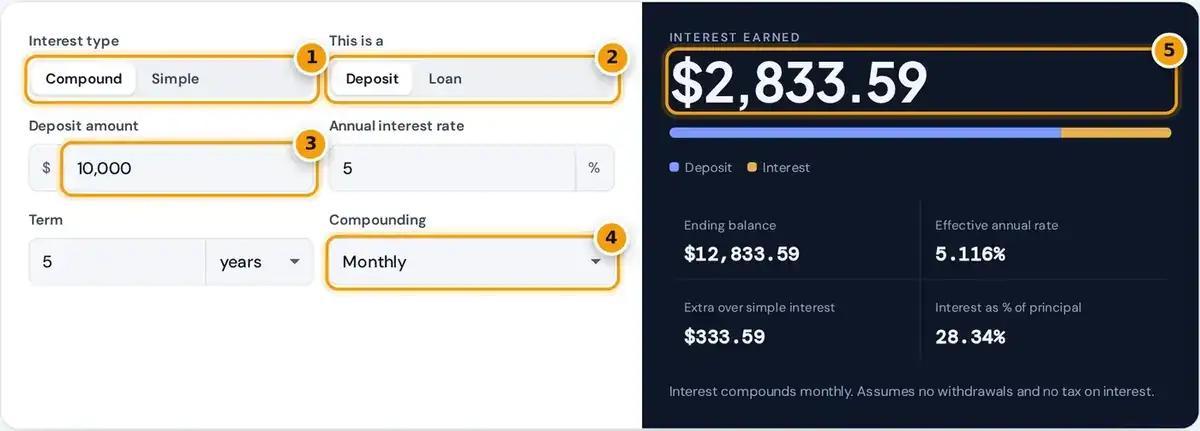
- Choose compound or simple interest.
- Say whether this is a deposit or a loan.
- Enter the amount deposited or borrowed.
- Pick how often interest compounds, from annually to daily.
- Read the interest, then check the ending balance and effective annual rate.
Choose Compound or Simple interest, then say whether the money is a deposit that earns interest or a loan that builds up interest. The labels in the result panel then change to match your choice.
Enter the principal amount, the annual interest rate and the term, measured in years or months. For compound interest, pick how often interest is added to the balance: annually, semi-annually, quarterly, monthly or daily compounding.
The result shows interest earned or owed, the ending balance, the effective annual rate and the gain over simple interest. A year-by-year table below the tool tracks the balance to the end of the term.
Simple and Compound Interest Formulas
Simple interest is paid only on the original principal, so it grows by the same amount every year. Compound interest is paid on the principal plus interest already added, so growth speeds up over time.
Compound: A = P × (1 + r / m)m × t and I = A − P
Effective annual rate = (1 + r / m)m − 1
Here P is the principal, r is the annual rate written as a decimal, t is the time in years and m is the number of compounding periods per year. A is the ending amount.
A term entered in months is divided by 12 before it is used, so 18 months becomes 1.5 years. The interest itself is always the ending amount minus the principal, rounded to the nearest cent.
Worked Example
Suppose you deposit $10,000 at 5% interest for 5 years. With simple interest, you earn $10,000 times 0.05 times 5, which is exactly $2,500.00, or $500 each year for the full five year savings term.
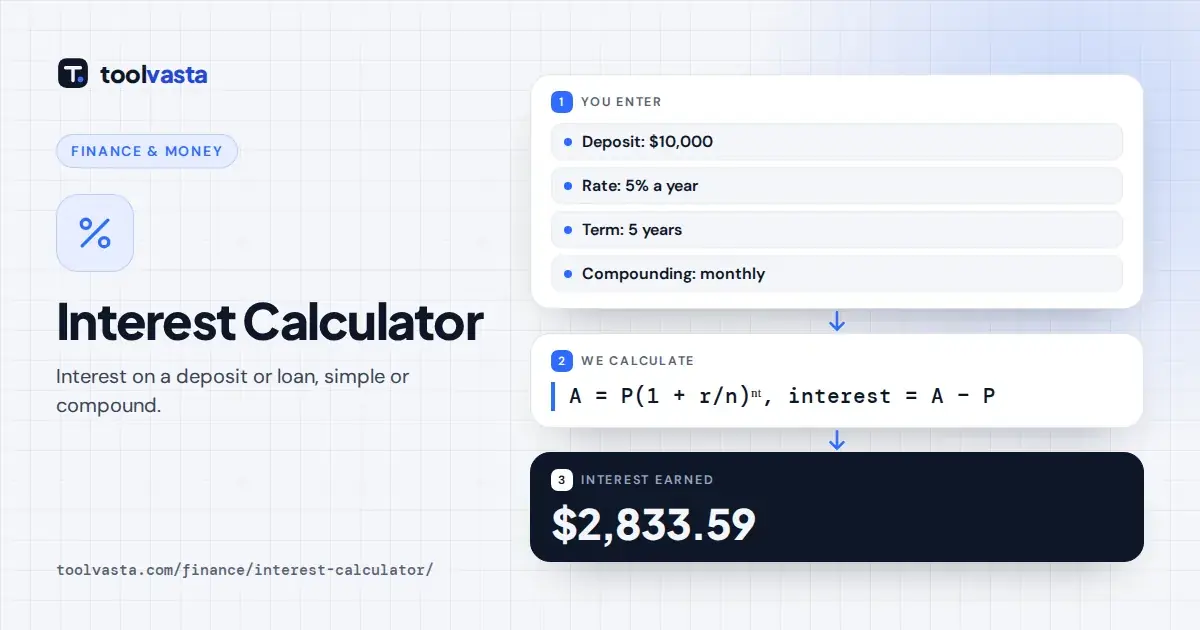
With monthly compounding, the balance becomes $10,000 times 1 plus 0.05 over 12, raised to the 60th power. That gives a balance of $12,833.59, so you earn $2,833.59, which is $333.59 more than simple interest.
In the first year alone, monthly compounding earns $511.62 instead of $500. Over 18 months, the same deposit earns $777.16 in total. The extra amount grows every year because earlier interest keeps earning more interest.
How Compounding Frequency Changes the Result
The more often interest compounds, the more you earn at the same quoted rate. The table shows $10,000 at 5% over 5 years for each compounding frequency the calculator offers, plus simple interest for comparison.
| Compounding | Interest earned | Effective annual rate |
|---|---|---|
| Simple (none) | $2,500.00 | n/a |
| Annually | $2,762.82 | 5.000% |
| Semi-annually | $2,800.85 | 5.062% |
| Quarterly | $2,820.37 | 5.095% |
| Monthly | $2,833.59 | 5.116% |
| Daily | $2,840.03 | 5.127% |
The extra gain from compounding more often shrinks very quickly. Moving from annual to monthly adds about $71 in this example, but moving from monthly to daily adds only $6.44 over the entire five years.
That means the interest rate itself matters far more than the compounding schedule. A half point higher rate with annual compounding usually beats a lower rate compounded daily, so always compare the rates themselves first.
Effective Annual Rate and APY
The effective annual rate is the rate you actually earn or pay in one year once compounding is included. A 5% nominal rate compounded monthly has an effective annual rate of about 5.116% a year.
Banks in the United States and elsewhere call this the APY, or annual percentage yield. The quoted rate on a savings account or GIC is usually the nominal rate, before the compounding effect is counted.
When you compare two products, compare their effective annual rates, never quoted ones. The calculator shows it for every scenario, and for simple interest it shows the equivalent yearly growth rate over the whole term.
The Rule of 72
The rule of 72 is a quick mental way to estimate how long money takes to double. Divide 72 by the annual rate in percent, and the answer is roughly the number of years needed.
At 5%, the rule gives 72 divided by 5, or 14.4 years. The exact answer with annual compounding is about 14.2 years, so the shortcut is close enough for quick planning done in your head.
The rule works best for rates between about 4% and 12%. For an exact doubling time, enter your own rate in the calculator and extend the term until the ending balance reaches twice the principal.
Interest on Loans
Choose Loan to see the interest owed and the total to repay when interest builds up without payments. Typical cases are a lump sum loan between family members, a deferred interest plan or unpaid balances.
For example, $5,000 borrowed at 8% for 2 years costs $800 in simple interest alone. With monthly compounding and no payments, the interest owed grows to $864.44 instead, and the total to repay is $5,864.44.
Most loans are repaid in regular instalments instead, which lowers the interest over time. For those loans, use a full amortization schedule. An unpaid credit card balance works against you in the same compounding way.
Interest in Canada
Canadian banks usually calculate savings account interest daily and pay it monthly. A GIC may pay simple interest each year or compound it until maturity, so check which option your particular GIC uses before buying.
Fixed-rate mortgages in Canada must state interest calculated yearly or half-yearly, not in advance, under the Interest Act. That is why Canadian lenders compound them semi-annually, and why this calculator includes a semi-annual compounding option.
Interest earned outside a TFSA or RRSP is taxable in the year it is earned, as the CRA guidance on line 12100 explains. Your after-tax return will be lower than the figure the calculator shows.
Assumptions and Limits
The calculator assumes one fixed rate for the whole term, no deposits or withdrawals after the start and no fees or taxes. Real accounts with variable rates can end up higher or lower than this.
It also ignores inflation, which steadily reduces what the ending balance can actually buy. A 5% return in a year with 3% inflation grows your purchasing power by only about 2% in real, inflation-adjusted terms.
For regular deposits, use a compound interest calculator with contributions. Results shown here are estimates for planning, rounded to the cent, and a bank's own figures may differ slightly because of different day count conventions.
Frequently asked questions
How do I calculate interest on $10,000?
For simple interest, multiply the principal by the rate and the time: $10,000 at 5% for one year earns $500. With monthly compounding the same deposit earns $511.62 in the first year.
What is the difference between simple and compound interest?
Simple interest is charged only on the original principal. Compound interest is charged on the principal plus interest already added, so the balance grows faster the longer you hold it.
Is daily compounding much better than monthly?
Only slightly. At 5% over 5 years, daily compounding earns $2,840.03 on $10,000 versus $2,833.59 with monthly compounding. The rate itself matters far more than the compounding frequency.
What is the effective annual rate?
It is the rate you actually earn or pay in one year once compounding is included. A 5% rate compounded monthly has an effective annual rate of about 5.116%, sometimes shown as APY.
Does this calculator work for loans?
Yes, for loans where interest builds up without payments. Choose Loan to see the interest owed and total to repay. For loans with regular payments, use an amortization or loan interest calculator.
How much interest do I earn per month?
A quick estimate is the balance times the annual rate divided by 12. At 5%, $10,000 earns about $41.67 in the first month, and a little more each month after as interest compounds.