How to Use the CCB Calculator
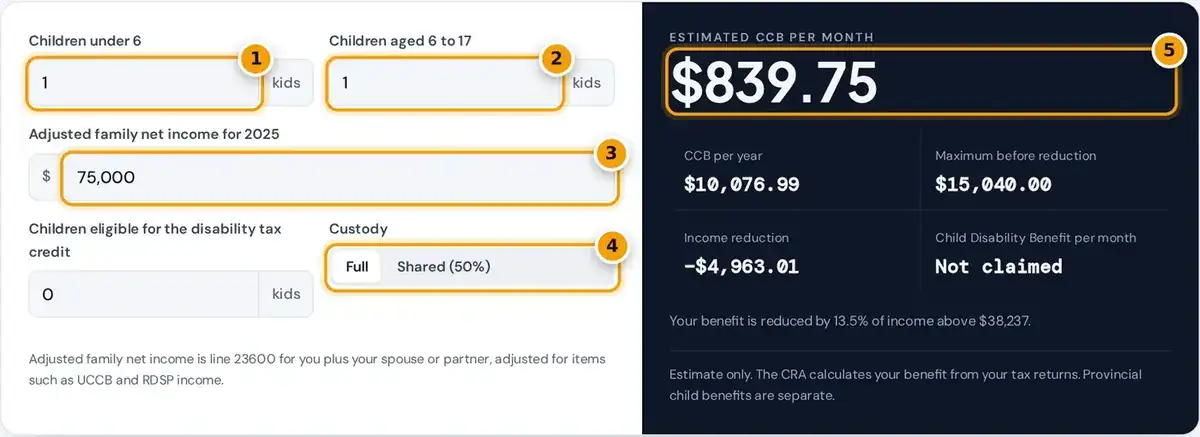
- Enter how many children are under 6.
- Enter how many children are aged 6 to 17.
- Enter your 2025 adjusted family net income: line 23600 for you and your partner.
- Choose full or shared custody; shared custody pays 50%.
- Read your estimated monthly CCB, the yearly total and the income reduction.
Enter the number of children under 6 and the number aged 6 to 17, then type your adjusted family net income from your 2025 tax return. Commas and dollar signs are perfectly fine to include.
Add how many children qualify for the disability tax credit, and choose full or shared custody. The result updates as you type, so you can test several different incomes without pressing any button at all.
You get the estimated monthly payment, the yearly total, the maximum before any reduction and the income reduction itself. A full table below the tool then shows each line of the calculation, step by step.
What Is the Canada Child Benefit
The Canada Child Benefit is a tax-free monthly payment from the Canada Revenue Agency to eligible families raising children under 18. It replaced the older child tax benefit and the UCCB back in July 2016.
The payment goes to the primary caregiver, the person mainly responsible for the child's care and upbringing. In a two parent home CRA usually presumes this is the female parent, unless the parents say otherwise.
Each benefit year runs from July to June and uses the previous year's tax returns. Payments from July 2026 to June 2027 are therefore based on the income both partners reported for the 2025 year.
CCB Amounts for July 2026 to June 2027
The figures below come from the CRA page How much you can get and match the tool exactly. Maximum amounts are indexed to inflation, so they rise slightly every July when the new year starts.
| Item | Amount |
|---|---|
| Maximum per child under 6 | $8,157 a year ($679.75 a month) |
| Maximum per child aged 6 to 17 | $6,883 a year ($573.58 a month) |
| Reduction starts at AFNI of | $38,237 |
| Second reduction step starts at | $82,847 |
| Child Disability Benefit | up to $3,480 a year per eligible child |
A family with adjusted family net income of $38,237 or less receives the full maximum amount for every child. Above that income, the benefit shrinks gradually rather than stopping at one single, sharp cutoff point.
The rate for a child changes the month after the 6th birthday, dropping from $8,157 to $6,883 a year. The calculator simply assumes each child stays in the same age group for the whole year.
How Income Reduces Your CCB
The phase-out works in two separate steps. Between $38,237 and $82,847, the reduction rate depends on the number of children. Above $82,847, a fixed amount applies plus a lower rate on all extra income earned.
| Children | AFNI $38,237 to $82,847 | AFNI over $82,847 |
|---|---|---|
| 1 | 7% of income over $38,237 | $3,123 + 3.2% of income over $82,847 |
| 2 | 13.5% | $6,022 + 5.7% |
| 3 | 19% | $8,476 + 8% |
| 4 or more | 23% | $10,260 + 9.5% |
For example, a family with two children loses 13.5% of every extra dollar between the two thresholds. A family with one child loses 7% there, then 3.2% of every dollar above the second income threshold.
The reduction applies to the family total, not to each child separately. The yearly result is then divided by 12 for the monthly payment, and it can never fall below zero for anyone at all.
CDB = eligible children × $3,480 − 3.2% (one child) or 5.7% (two or more) of AFNI over $82,847
Worked Example and Sample Amounts
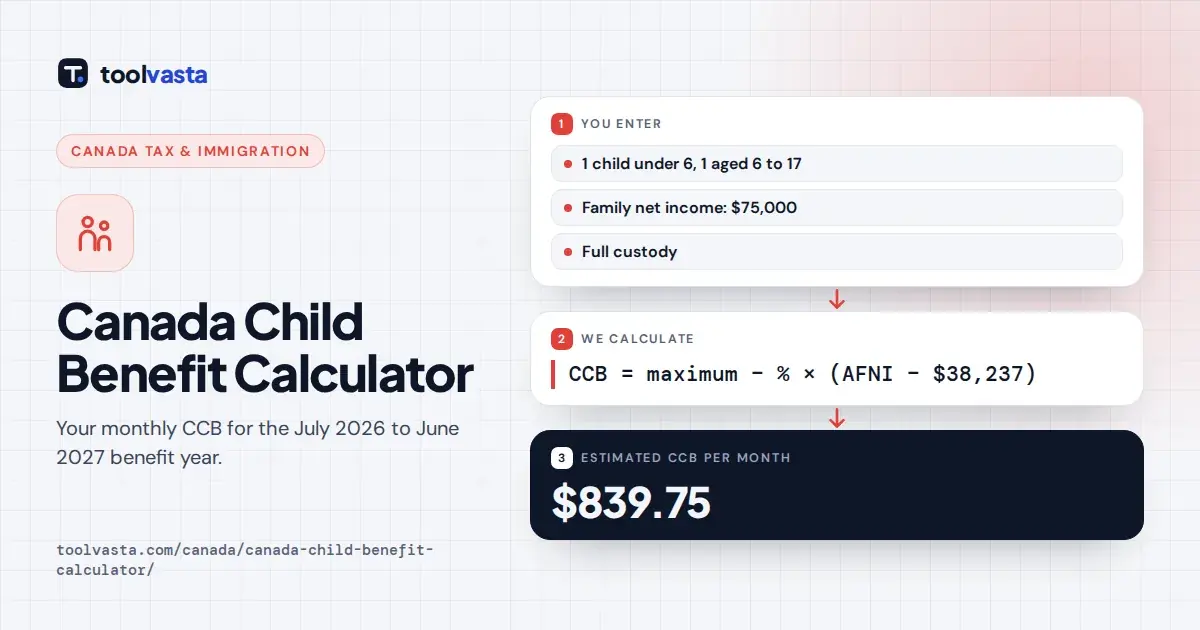
In this worked example, a family has a 3-year-old and an 8-year-old, with an AFNI of $75,000 reported for 2025. The maximum is $8,157 plus $6,883, which equals $15,040 per year before any income reduction.
Their income is $36,763 above the $38,237 threshold. With two children, the reduction is 13.5% of that amount, or exactly $4,963.01. The CCB is $10,076.99 a year, which works out to about $839.75 every month.
| AFNI | One child under 6 and one aged 6 to 17 | One child aged 6 to 17 |
|---|---|---|
| $30,000 | $1,253.33 a month | $573.58 a month |
| $50,000 | $1,121.00 a month | $504.97 a month |
| $75,000 | $839.75 a month | $359.13 a month |
| $100,000 | $669.99 a month | $267.62 a month |
| $150,000 | $432.49 a month | $134.28 a month |
These sample amounts use exactly the same formula as the tool above. The clawback is quite gentle: a single child aged 6 to 17 still receives a small payment until family income reaches roughly $200,356.
What Counts as Adjusted Family Net Income
Adjusted family net income is your net income from line 23600 of your return, plus the net income of your spouse or common-law partner. It is not gross salary, and not your take home pay.
Some items are then adjusted. UCCB and RDSP income you received are subtracted, and repayments of those amounts are added back. If you had a partner on December 31, both of your incomes always count.
Newcomers to Canada must also report world income for the part of the year before they arrived, even though it was not taxed in Canada. Without it, CRA cannot calculate the family benefit amount correctly.
Child Disability Benefit
The Child Disability Benefit adds up to $3,480 a year, or $290 a month, for each eligible child under 18. A child is eligible when CRA has approved the disability tax credit for that child.
It is paid along with the monthly CCB, not as a separate cheque. It is reduced only when family income is above $82,847, by 3.2% for one eligible child or 5.7% for two or more.
Enter the number of eligible children and the calculator adds the benefit to the yearly total and shows the monthly amount on its own line. It cannot be more than your total number of children.
Who Qualifies and How to Apply
To qualify, you must live with a child under 18, be the primary caregiver and be a resident of Canada. You or your partner must also meet the status rules in the Income Tax Act.
Most parents apply when they register a newborn, because provincial birth registration can include a consent to share the details with CRA. Otherwise, apply online through CRA My Account or mail a completed Form RC66.
Apply as soon as a child is born or starts living with you. You never need to reapply, but both parents must file a tax return every year, even with no income, or payments stop.
Things That Change Your CCB
RRSP contributions and FHSA contributions are tax deductions that lower net income, so they can raise your CCB in the following benefit year. For families on the phase-out, the extra benefit can be quite meaningful.
Payments are recalculated each July from the latest returns. A change in marital status, a new child, a move or a change in custody can also change the amount, so report these to CRA promptly.
If the benefit works out to less than $20 a month, CRA pays the whole year as one lump sum in July. The calculator notes this automatically when your estimate falls under that $20 line.
Provincial Benefits and Limits
Many provinces pay their own child benefit alongside the CCB, such as the Ontario Child Benefit and the B.C. Family Benefit. These provincial benefits use their own rules and are not included in this estimate.
The calculator also leaves out the GST/HST credit, mid-year custody changes and birthdays that move a child between age groups. It also assumes the same number of children for the full July to June year.
Treat the result as an estimate for planning only. CRA calculates your actual CCB from filed returns, and your notice of determination is the final word on how much your family will receive each month.
Frequently asked questions
How much is the Canada Child Benefit for 2026-2027?
From July 2026 to June 2027 the maximum CCB is $8,157 a year for each child under 6 and $6,883 for each child aged 6 to 17, before any reduction for family income.
At what income does the CCB start to go down?
The benefit starts to shrink when adjusted family net income is above $38,237. The reduction rate depends on the number of children and changes again above $82,847.
Which year's income is used for the CCB?
Payments from July 2026 to June 2027 are based on your 2025 adjusted family net income, so both you and your spouse or partner need to file your 2025 returns.
Is the Canada Child Benefit taxable?
No. The CCB is tax-free, so you do not report it as income on your return, and it does not reduce other income-tested benefits that are calculated from net income.
How does shared custody affect the CCB?
When a child lives with each parent about equally, each parent receives 50% of the amount they would get with full custody, calculated from their own adjusted family net income.
How much is the Child Disability Benefit?
Up to $3,480 a year, or $290 a month, for each child eligible for the disability tax credit. It is reduced only when family income is above $82,847.