How to Use the CPP Calculator
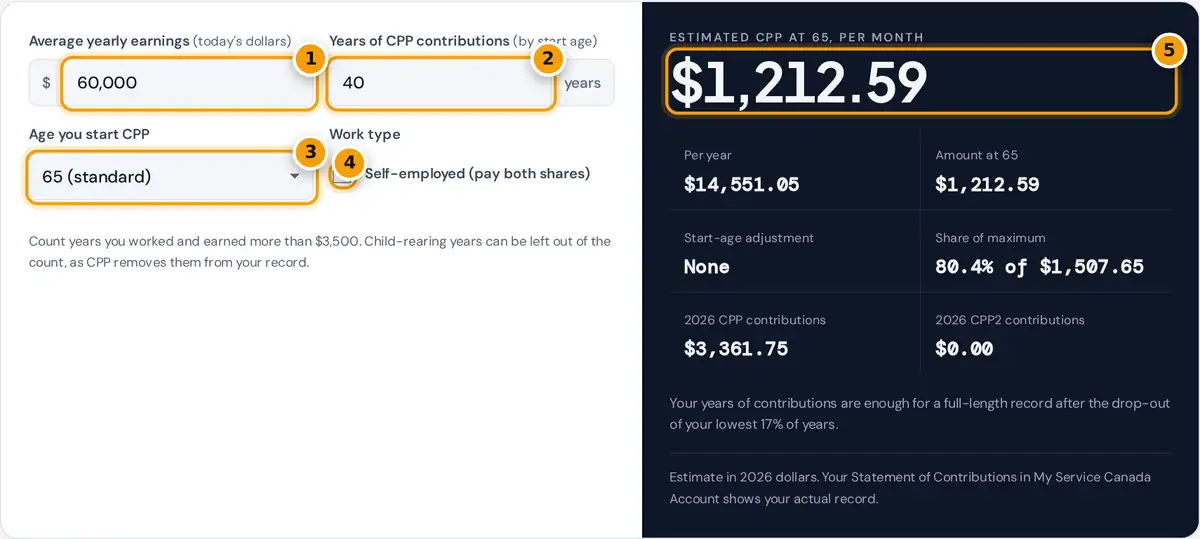
- Enter your average yearly earnings in today's dollars, up to the yearly maximum pensionable earnings.
- Enter how many years you have paid into CPP, or expect to by the time you start.
- Pick the age you plan to start CPP, from 60 to 70, to see the early or late adjustment.
- Tick self-employed if you pay both the employee and employer share of contributions.
- Read your estimated monthly CPP pension, then check the yearly amount and your 2026 CPP and CPP2 contributions.
Enter your average yearly earnings in today's dollars, then the years of contributions you have made, or expect to make, to the Canada Pension Plan by the time your monthly pension actually starts paying out.
Pick a start age from 60 to 70 and tick the self-employed box if you pay both shares. The result shows your monthly and yearly pension, the start-age adjustment and your share of the maximum.
Two lines show the CPP and CPP2 contributions you pay on those earnings in 2026. The table under the calculator lists every start age side by side, so you can compare 60, 65 and 70.
How the CPP Retirement Pension Is Calculated
The pension replaces part of the earnings you contributed on, up to the yearly maximum pensionable earnings (YMPE) of $74,600 in 2026. Earnings above that cap do not raise the base pension you eventually receive.
Years ratio = min(1, years contributed ÷ (contributory years × 83%))
CPP at 65 = $1,507.65 × earnings ratio × years ratio
Before 65: −0.6% per month. After 65: +0.7% per month
Your contributory period runs from age 18 until your pension starts. Under the drop-out, Service Canada removes up to 17% of your lowest earning months, about 8 years, so a full record needs 39 years.
The calculator multiplies the 2026 maximum pension of $1,507.65 by both ratios, then applies the monthly adjustment for your chosen start age. The result is a simplified estimate of the official Service Canada pension calculation.
Worked Example: $60,000 Over 40 Years
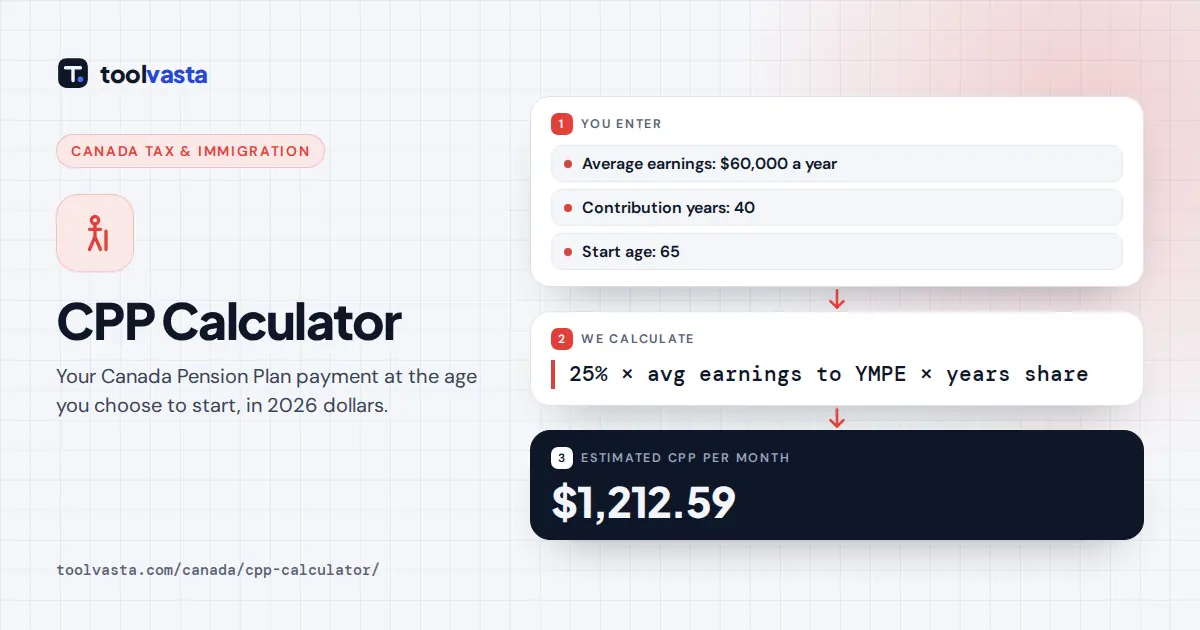
Say you earned an average of $60,000 a year for 40 years. The earnings ratio is $60,000 divided by $74,600, or 80.43%, and 40 years is easily enough for a full years ratio of one.
The estimated pension at 65 is $1,507.65 times 0.8043, which gives $1,212.59 a month. Starting at 60 gives $776.06 a month, and waiting until 70 gives $1,721.87 a month for the rest of your life.
| Start age | Adjustment | Per month |
|---|---|---|
| 60 | −36% | $776.06 |
| 65 | None | $1,212.59 |
| 70 | +42% | $1,721.87 |
On $60,000 of employment income you contribute 5.95% of the amount above the $3,500 basic exemption, which works out to $3,361.75 in 2026. You pay no CPP2, because your earnings stay below the $74,600 YMPE.
CPP Contribution Rates and Maximums for 2026
Employees and employers each pay 5.95% of earnings between the $3,500 basic exemption and the YMPE. The maximum employee contribution for 2026 is $4,230.45, and your employer matches every dollar you pay into the plan.
| Item | 2026 |
|---|---|
| Maximum retirement pension at 65 | $1,507.65 a month |
| Average new retirement pension at 65 | $858.34 a month |
| YMPE | $74,600 |
| YAMPE | $85,000 |
| Basic exemption | $3,500 |
| Employee rate and maximum | 5.95%, $4,230.45 |
| CPP2 rate and employee maximum | 4%, $416 |
| Self-employed maximums | $8,460.90 CPP, $832 CPP2 |
CPP2 is a second tier of contributions added in 2024. It charges 4% on earnings between the YMPE and the year's additional maximum pensionable earnings (YAMPE) of $85,000, up to a $416 maximum per employee.
Self-employed workers pay both the employee and employer shares, so their maximums double to $8,460.90 of CPP and $832 of CPP2. The CRA contribution rates page lists the current figures alongside those for earlier years.
Taking CPP at 60, 65 or 70
Your pension falls by 0.6% for each month you start before 65, so starting at 60 cuts it by 36% for life. It rises by 0.7% for each month after 65, reaching 42% at 70.
Taking CPP early gives smaller cheques for more years, while delaying gives a larger, inflation-indexed pension. The breakeven age, where waiting from 65 to 70 pays off in dollars, usually lands in your early 80s.
Life expectancy, health, other savings and your marginal tax rate all matter, since CPP is taxable income. A larger pension also raises the survivor's pension your spouse may receive, which makes delaying even more valuable.
Working While Receiving CPP
You can collect your CPP retirement pension and keep working. If you are under 65, you and your employer must keep contributing. Between 65 and 70, contributing becomes optional, but it can raise your pension.
Contributions made while you receive CPP build a post-retirement benefit, a small extra amount added to your payments the following year. Each year of contributions adds another benefit, and each one is paid for life.
Couples can apply for pension sharing, which splits the CPP earned during the relationship and can lower the household tax bill. Both spouses must be at least 60, and at least one must receive CPP.
What This Estimate Leaves Out
This is a simplified estimate. The real calculation uses your actual reported earnings for each year, indexed to wage growth, plus the CPP enhancement that has been phasing in since 2019 for more recent contributors.
The child-rearing provision, disability years and the separate Quebec Pension Plan are not modelled by this tool. Quebec workers should use a QPP estimate instead, because the QPP sets its own contribution rules and amounts.
For your exact figure, sign in to My Service Canada Account and check your Statement of Contributions and estimate. Treat this result as a planning estimate, not a promise of what Service Canada will pay.
Frequently asked questions
What is the maximum CPP payment in 2026?
The maximum CPP retirement pension for someone starting at 65 in January 2026 is $1,507.65 a month. The average new pension at 65 is much lower, at $858.34 a month, because few people have a full record.
How much do I lose if I take CPP at 60?
Your pension is reduced by 0.6% for each month before 65, so starting at 60 reduces it by 36% for life. On a $1,212.59 pension at 65, that means $776.06 a month instead.
How much more do I get if I wait until 70?
Your pension rises by 0.7% for each month after 65, so starting at 70 gives you 42% more for life. There is no extra increase for waiting past 70, so apply by then.
How many years do I need to work to get the maximum CPP?
You need about 39 years of earnings at or above the YMPE between 18 and 65, because CPP drops out up to 17% of your lowest earning years. Earnings above $74,600 in 2026 do not count.
How much CPP will I pay in 2026?
Employees pay 5.95% of earnings between $3,500 and $74,600, up to $4,230.45, plus 4% CPP2 on earnings between $74,600 and $85,000, up to $416. Self-employed people pay double both amounts.
Is CPP taxable income?
Yes. CPP is taxable income, so it is added to your other income on your tax return. You can ask Service Canada to deduct tax from each payment to avoid a bill at tax time.