How to Use the CMHC Insurance Calculator
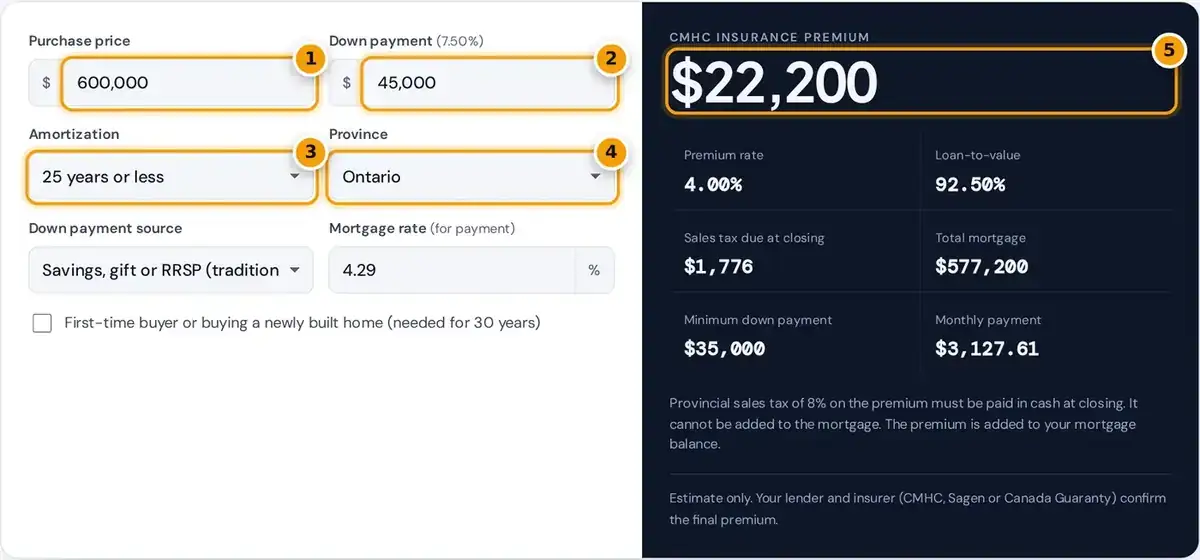
- Enter the purchase price of the home.
- Enter your down payment; the loan-to-value ratio sets the premium rate.
- Choose 25 years or 30 years; 30 adds a surcharge and needs first-time buyer or new build.
- Pick your province to see any sales tax due on the premium at closing.
- Read the premium, rate, loan-to-value, total mortgage and monthly payment.
Enter the purchase price and your down payment. The calculator shows the down payment percentage beside the field, checks it against the minimum down payment for that price and flags amounts that are too low.
Choose the amortization, your province and whether the down payment is traditional or borrowed. Tick the box if you are a first-time buyer or buying a new build, because that unlocks a 30-year insured amortization.
Results include the premium rate, the premium in dollars, any sales tax due at closing and the total mortgage amount. Add your mortgage rate to see the monthly payment on the insured balance, compounded semi-annually.
CMHC Premium Rates for 2026
Mortgage default insurance, also called mortgage loan insurance, is required when you borrow more than 80% of the price. The premium rate depends on your loan-to-value ratio, or LTV, and rises in steps with borrowing.
| Loan-to-value | Down payment | Premium on total loan |
|---|---|---|
| Up to 65% | 35% or more | 0.60% |
| 65.01% to 75% | 25% to 34.99% | 1.70% |
| 75.01% to 80% | 20% to 24.99% | 2.40% |
| 80.01% to 85% | 15% to 19.99% | 2.80% |
| 85.01% to 90% | 10% to 14.99% | 3.10% |
| 90.01% to 95% | 5% to 9.99% | 4.00% |
| 90.01% to 95%, borrowed down payment | 5% to 9.99% | 4.50% |
A high-ratio mortgage, with less than 20% down, falls in the top three bands, paying 2.80% to 4.00%. The lower bands apply when a lender chooses to insure a conventional mortgage at its own cost.
An amortization over 25 years adds a surcharge of 0.20%, or 20 basis points, to whichever rate applies. So a 90% LTV loan over 30 years pays 3.30% rather than 3.10% of the loan amount.
How the CMHC Premium Is Calculated
The premium is a percentage of the loan amount, not of the purchase price. First the calculator finds your LTV, then looks up the rate for that band and applies any surcharge for longer amortization.
Premium = loan × rate for LTV (+0.20% if over 25 years)
Sales tax = premium × 8% ON, 9% QC or 6% SK
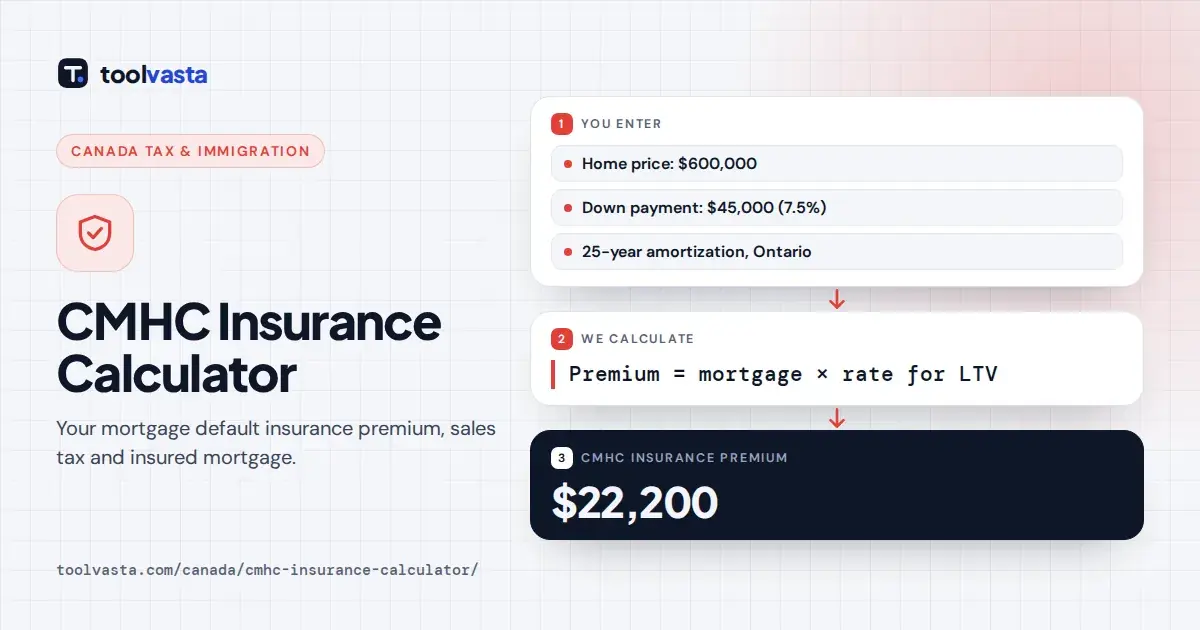
Here is a worked example: a $600,000 Ontario home bought with $45,000 down, or 7.5%. The loan is $555,000 and LTV is 92.5%, so the 4.00% rate gives a premium amount of $22,200 in total.
That premium is added to the mortgage, making a total mortgage of $577,200. At 4.29% over 25 years the monthly payment is about $3,128. Ontario's 8% sales tax on the premium, $1,776, is paid separately.
Minimum Down Payment Rules
The minimum down payment depends entirely on the purchase price. The calculator applies these rules automatically and will not produce any premium figure until your down payment meets the minimum for the price you entered.
| Purchase price | Minimum down payment |
|---|---|
| $500,000 or less | 5% |
| $500,000 to $1,499,999 | 5% of the first $500,000 + 10% of the rest |
| $1.5 million or more | 20% (not insurable) |
For the $600,000 example, 5% down on the first $500,000 is $25,000 and 10% of the remaining $100,000 is $10,000, a $35,000 minimum. The chosen $45,000 down payment therefore comfortably qualifies for an insured mortgage.
Homes priced at $1.5 million or more need 20% down, because that price cap is the insurable limit. The Financial Consumer Agency of Canada explains how saving a bigger down payment reduces total borrowing costs.
Who Needs Mortgage Default Insurance
Federally regulated lenders must insure any mortgage with less than 20% down. It protects the lender if you stop paying, not you, and it is not the same as mortgage life insurance for your family.
To qualify, you pass the mortgage stress test, keep your GDS ratio and TDS ratio within the insurer's limits and meet a minimum credit score. The home must be owner-occupied, with one to four units.
CMHC is one of three insurers, alongside Sagen and Canada Guaranty, and your lender chooses which one applies. A non-traditional down payment, such as borrowed funds, costs 4.50% instead of 4.00% at the highest band.
Provincial Sales Tax on the Premium
Three provinces currently charge provincial sales tax on the premium: Ontario at 8%, Quebec at 9% and Saskatchewan at 6%. Pick your province in the calculator and the tax appears as a separate result figure.
Unlike the premium itself, the tax cannot be added to the mortgage. It is paid at closing, usually through your lawyer or notary, so budget for it alongside land transfer tax and other closing costs.
In the worked example, the Ontario tax is $1,776 on a $22,200 premium. Buyers in the other provinces and the territories pay no sales tax on the premium, and the calculator shows None for them.
Ways to Lower the Premium
A larger down payment helps most when it moves you into a lower band. Going from 9.99% down to 10% down drops the rate from 4.00% to 3.10%, a big saving for one small step.
- Choose a 25-year amortization to avoid the 0.20% surcharge and pay less interest overall.
- Reach 20% down and default insurance is no longer required.
- Use savings or gifted funds rather than borrowing the down payment.
If you already have an insured mortgage, portability may let you carry the insurance to a new home. When switching lenders at renewal, the existing insurance usually stays fully in place, with no new premium.
All results are estimates based on published premium rates and the insured mortgage rules announced by the Department of Finance Canada. Confirm the final premium with your lender or mortgage broker before you sign anything.
Frequently asked questions
How much is CMHC insurance?
With less than 20% down, CMHC charges 2.80% to 4.00% of the loan, depending on your loan-to-value ratio. A borrowed down payment at the top band pays 4.50%, and amortizations over 25 years add 0.20%.
How is CMHC insurance calculated?
Divide the loan by the purchase price to get the loan-to-value ratio, find the matching premium rate, add 0.20% if amortization exceeds 25 years, then multiply the rate by the loan amount.
Can CMHC insurance be added to my mortgage?
Yes. The premium is normally added to the mortgage balance and repaid with your regular payments. Provincial sales tax on the premium in Ontario, Quebec and Saskatchewan must be paid in cash at closing.
Do I need CMHC insurance with 20% down?
No. Mortgage default insurance is only required when your down payment is less than 20% of the purchase price. A lender may still insure a conventional mortgage, but it pays that cost itself.
What is the maximum price for an insured mortgage?
Since December 15, 2024, homes priced under $1.5 million can be bought with less than 20% down and an insured mortgage. At $1.5 million or more, you need at least 20% down.
Do I have to get my insurance from CMHC?
No. Sagen and Canada Guaranty also provide mortgage default insurance, and your lender chooses the insurer. Their premium rates are generally similar, so this calculator gives a useful estimate for all three.