How to Use the Closing Cost Calculator
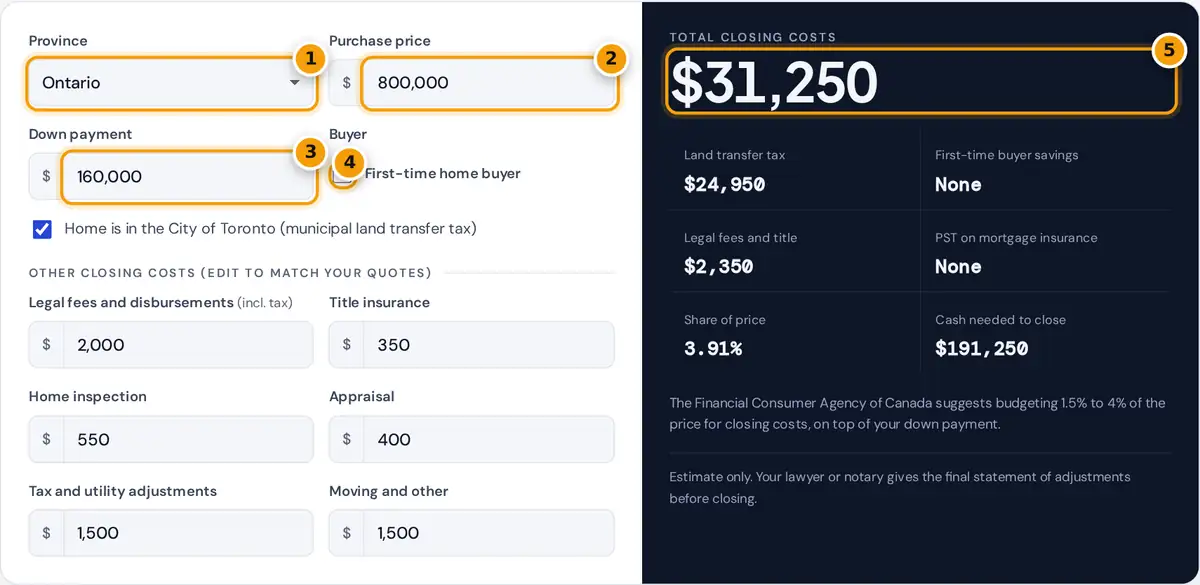
- Pick the province where the home is: Ontario or British Columbia.
- Enter the purchase price from your offer.
- Enter your down payment. Under 20% adds the PST on CMHC insurance where it applies.
- Tick first-time home buyer to apply the land transfer tax rebate or exemption.
- Read your total closing costs, then check land transfer tax and the cash needed to close.
Choose Ontario or British Columbia, then enter the purchase price and your down payment. The closing cost calculator checks that the down payment meets the federal minimum before it shows any land transfer tax figures.
Tick first-time buyer if it applies to you. In Ontario, keep the City of Toronto box ticked for a Toronto address. In B.C., a newly built home box appears instead, because that exemption works differently.
The other costs start with example amounts. Replace them with real quotes from your lawyer, inspector and lender. Results update instantly and include a line-by-line breakdown, the share of price and your total cash needed.
What Closing Costs Include When Buying a Home
Closing costs are the one-time amounts you pay on top of the down payment before you get the keys. Most are due on closing day, and lenders expect you to pay them from your savings.
- Land transfer tax: the largest item for most buyers, and Toronto buyers pay two.
- Legal fees and disbursements: your real estate lawyer, or a notary in B.C., registers the title and the mortgage.
- Title insurance: a one-time premium against title defects and fraud.
- Home inspection and appraisal: the appraisal is often required by the lender.
- Adjustments: your share of property tax and utilities the seller already prepaid.
- Moving costs and other small items.
Legal quotes look low because disbursements, such as registration and search fees, are listed separately. Ask for one all-in number that includes HST or GST, then enter that figure in the legal fees box above.
Adjustments depend on your closing date. If the seller prepaid the property tax, you repay them for days after closing. Your lawyer lists these amounts on the statement of adjustments a few days before closing.
How Land Transfer Tax Is Calculated
Land transfer tax uses marginal rates, like income tax. Each slice of the price is taxed at its bracket rate, then the slices are added. A higher price never makes the cheaper slices more expensive.
Total closing costs = land transfer tax + PST on insurance + legal + title + inspection + appraisal + adjustments + other
| Bracket | Ontario | Toronto | B.C. |
|---|---|---|---|
| Up to $55,000 | 0.5% | 0.5% | 1% (to $200,000) |
| $55,000 to $250,000 | 1.0% | 1.0% | 2% above $200,000 |
| $250,000 to $400,000 | 1.5% | 1.5% | 2% |
| $400,000 to $2 million | 2.0% | 2.0% | 2% |
| $2 million to $3 million | 2.5% | 2.5% | 3% |
| Over $3 million | 2.5% | 4.4% to 8.6% | 5% (3% + 2% further tax) |
Ontario publishes its provincial tax brackets in full on the Ontario land transfer tax guide. The City of Toronto adds its own municipal land transfer tax, which matches the provincial tax up to $3 million.
In B.C. the equivalent is called property transfer tax, charged on the fair market value. A $500,000 home pays $6,475 of provincial tax in Ontario, or $12,950 in Toronto once the municipal tax is added.
Worked Example: An $800,000 Toronto Home
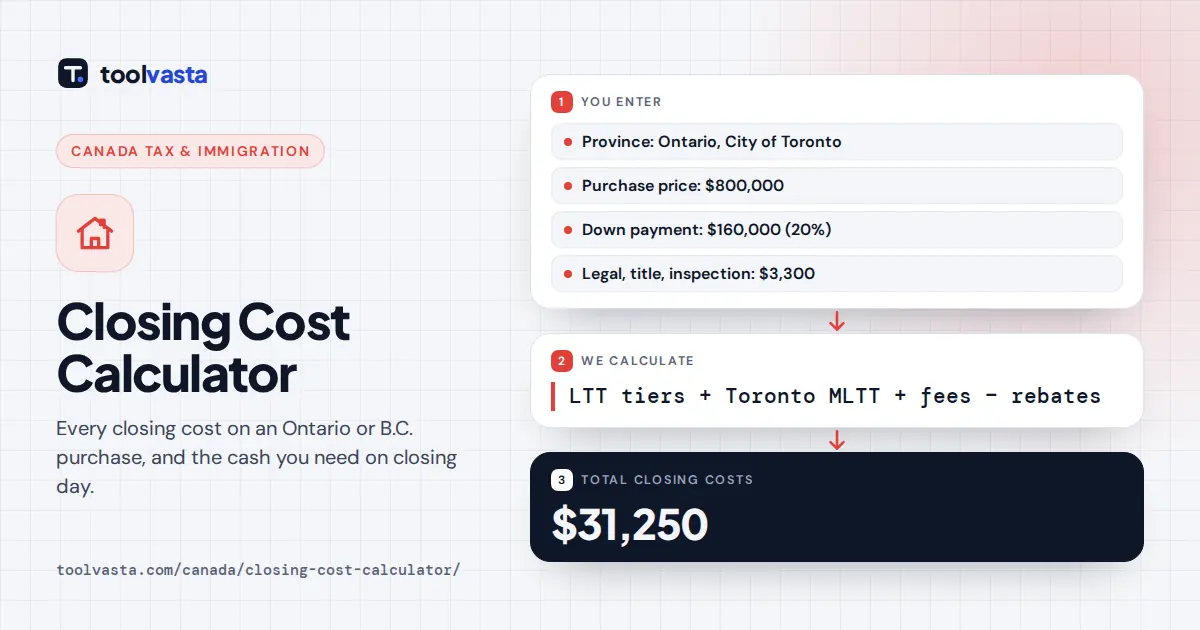
You buy an $800,000 Toronto home with $160,000 down. The Ontario tax is $275 plus $1,950 plus $2,250 plus $8,000, which equals $12,475 in total. The Toronto tax is also $12,475, for a combined $24,950.
| Item | Amount |
|---|---|
| Ontario land transfer tax | $12,475 |
| Toronto municipal land transfer tax | $12,475 |
| Legal fees and disbursements | $2,000 |
| Title insurance | $350 |
| Home inspection | $550 |
| Appraisal | $400 |
| Adjustments | $1,500 |
| Moving and other | $1,500 |
| Total closing costs | $31,250 |
Adding the example fees brings total closing costs to $31,250, a share of price of 3.91%. With the down payment, you need $191,250 of cash on closing day, all of it from your own funds.
As a first-time buyer, the Ontario refund and the Toronto rebate together save $8,475, so the total drops to $22,775. That combined rebate is the most a first-time buyer can receive on a Toronto purchase.
First-Time Buyer Rebates and Exemptions
Ontario gives first-time buyers a refund of up to $4,000, which fully covers the provincial tax on homes priced up to $368,333. Above that price you still pay the remaining provincial tax after the refund.
The Toronto rebate is worth up to $4,475, so a first-time buyer in the city can save up to $8,475 in total. You claim both through your lawyer when the transfer is registered, not afterwards.
The B.C. exemption removes tax on the first $500,000 on homes worth $835,000 or less, then begins to phase out, ending at $860,000. Newly built homes are exempt below $1,100,000 and partly exempt to $1,150,000.
PST on CMHC Insurance When You Put Less Than 20% Down
With less than 20% down, your mortgage needs mortgage default insurance from CMHC or a private insurer. The insurance premium is a percentage of the loan, set by your loan-to-value ratio, and is added on.
So the premium is not a closing cost. In Ontario, however, the 8% sales tax on it is PST that must be paid in cash at closing, as lenders cannot add it to the loan.
On a $500,000 home with 5% down, the $475,000 loan carries a 4.00% premium of $19,000, and the PST due at closing is $1,520. The calculator flags this whenever your down payment is below 20%.
Cash to Close and How Much to Budget
Cash to close is your down payment plus every closing cost. The calculator shows this total so that you can confirm your savings cover both, since lenders do not usually finance closing costs for you.
The Financial Consumer Agency of Canada suggests budgeting 1.5% to 4% of the purchase price for them. Toronto buyers usually land near the top of that range because they pay two separate land transfer taxes.
Keep a buffer for the final statement of adjustments, which can shift by a few hundred dollars. Also check the minimum down payment: 5% of the first $500,000 and 10% of the portion above it.
Costs This Calculator Leaves Out
The calculator covers a residential purchase made by Canadian residents. It does not include GST/HST on new construction, which is usually built into the price, or the 25% Ontario non-resident speculation tax for foreign buyers.
Condo buyers may pay for a status certificate, while some rural or older properties need a land survey. Lender fees, B.C. speculation and vacancy tax and seller costs such as commission are not included either.
You can sometimes negotiate smaller items such as a survey or a repair credit, but the land transfer tax is fixed by law. Treat every result as an estimate and confirm totals with your lawyer.
Frequently asked questions
How much are closing costs in Ontario?
The Financial Consumer Agency of Canada suggests budgeting 1.5% to 4% of the price. On an $800,000 Toronto home they come to about $31,250 with typical fees, or $22,775 for a first-time buyer.
How do you calculate closing costs?
Add the land transfer tax, worked out bracket by bracket, to legal fees, title insurance, inspection, appraisal, adjustments and any PST on mortgage insurance. Subtract any first-time buyer rebate to get the total.
Do first-time buyers pay land transfer tax in Toronto?
They pay it but receive rebates: up to $4,000 from Ontario and up to $4,475 from the City of Toronto, for a combined maximum of $8,475. Your lawyer claims both when the transfer is registered.
Is CMHC insurance a closing cost?
The premium itself is added to your mortgage. In Ontario, the 8% PST on the premium must be paid in cash at closing, and it cannot be added to the mortgage.
What closing costs do you pay in B.C.?
The main costs are property transfer tax, legal or notary fees, title insurance, inspection and adjustments. First-time buyers can be exempt from tax on the first $500,000 if the home is worth $835,000 or less.
Can you negotiate closing costs?
Some items, such as legal fees, inspection costs or a seller credit, can be negotiated or shopped around. Land transfer tax and PST on mortgage insurance are set by law and cannot be negotiated.