How to Use the Mortgage Affordability Calculator
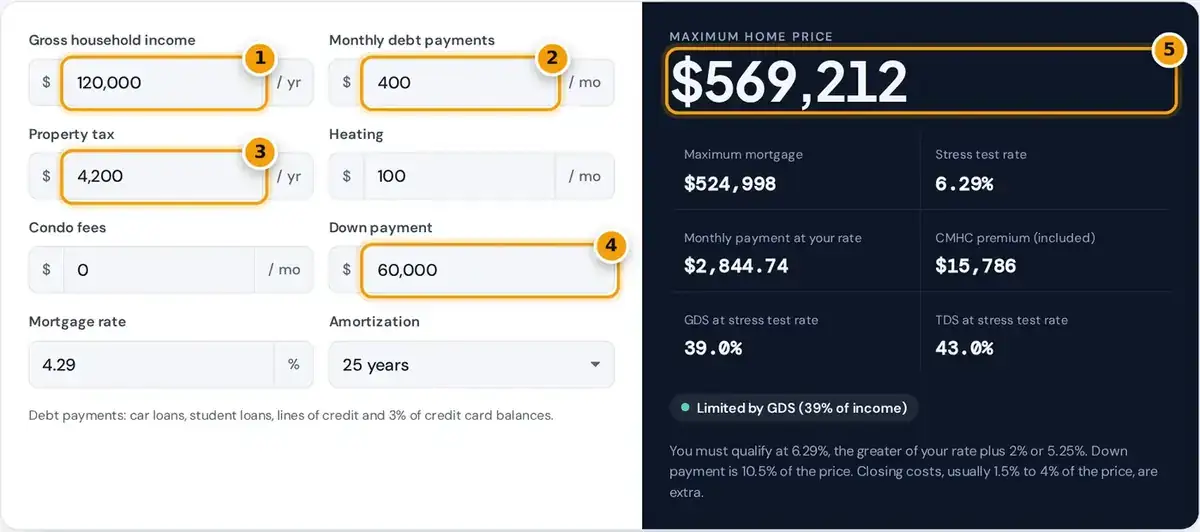
- Enter your household's gross annual income.
- Add monthly debt payments such as car and student loans.
- Enter the yearly property tax for the kind of home you want.
- Enter the down payment you have saved.
- Read your maximum home price, mortgage, stress test rate and GDS and TDS ratios.
Enter your household's gross annual income before tax, your monthly debt payments, the expected property tax and heating costs, any condo fees, the down payment you have already saved and the mortgage rate you expect.
Choose a 25 or 30 year amortization. The mortgage affordability calculator then shows the most expensive home you could qualify for, the matching mortgage, your stress test rate and the monthly payment at your rate.
A badge shows what limits the result: GDS, TDS or your down payment. For debts, include car loans, student loans, lines of credit and support payments, plus 3% of any credit card balance each month.
GDS and TDS Ratios
Canadian lenders test affordability with two debt service ratios. The gross debt service ratio covers housing costs only, while the total debt service ratio adds every other monthly debt, such as a car loan payment.
TDS = (GDS costs + all other debt payments) / gross monthly income ≤ 44%
The 39% and 44% limits are the maximums set by CMHC for insured mortgages. Lenders count half of any condo fees, and usually count 3% of each outstanding credit card balance as a monthly payment.
Many lenders use stricter ratios for uninsured mortgages, often closer to 35% and 42%, and each sets its own credit criteria. Treat the result as a realistic upper limit rather than a guaranteed approval amount.
The Mortgage Stress Test
Both ratios are calculated at the stress test rate rather than your contract rate. That qualifying rate is the greater of your contract rate plus 2 percentage points or a 5.25% floor, whichever is higher.
The rule is the OSFI minimum qualifying rate for uninsured mortgages, and CMHC applies the same test to insured mortgages. It checks that you could still pay if rates rose by 2 points at renewal.
As of 2026, OSFI exempts an uninsured straight switch at renewal and adds lender-level loan-to-income limits, but new purchases must still pass it. The test means you qualify for less than your actual rate suggests.
Down Payment and CMHC Insurance
The maximum price must respect the minimum down payment: 5% of the first $500,000, then 10% of the portion from $500,000 to $1,499,999. Homes priced at $1.5 million or more need at least 20% down.
With less than 20% down, you need mortgage default insurance, making it an insured mortgage. The insurance premium ranges from 2.80% to 4.00% of the loan, depending on loan-to-value, and is added to the mortgage.
Insured 30-year amortizations carry an extra 0.20% premium surcharge. If your savings rather than your income limit the price, the calculator says so, because a larger down payment is then the only real way up.
Worked Example: $120,000 Household Income
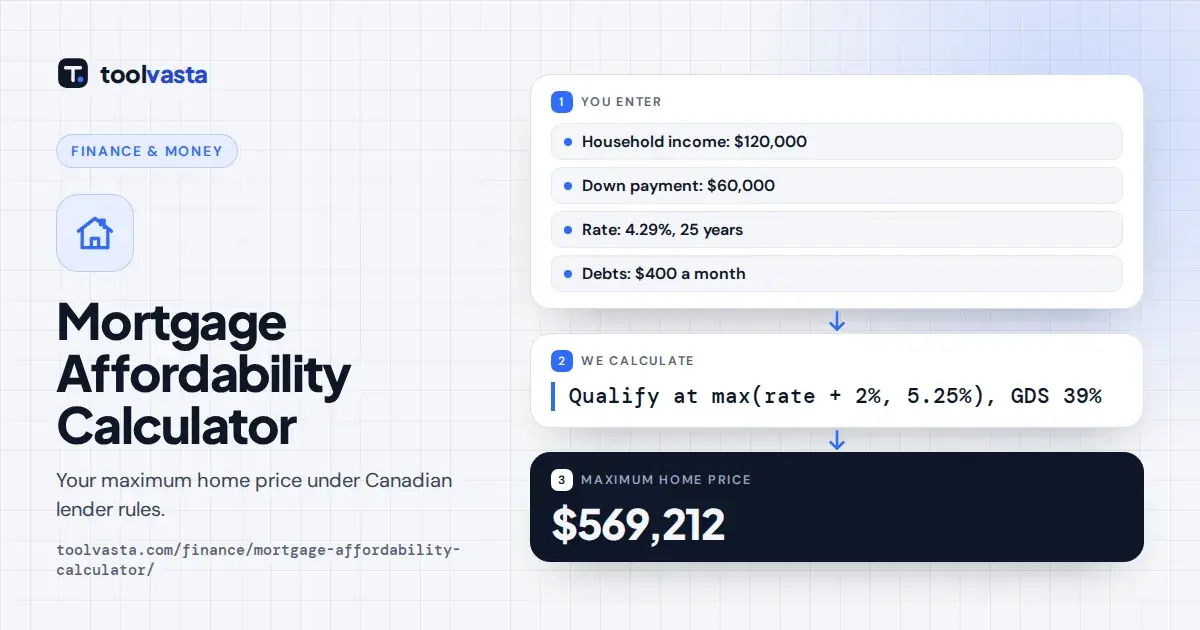
A household earns $120,000 a year, or $10,000 a month. They pay $400 monthly on a car loan, expect $4,200 a year in property tax and $100 a month for heating, and have $60,000 saved.
At a 4.29% rate, the stress test rate is 6.29%. GDS allows $3,900 for housing, leaving $3,450 for the mortgage after tax and heating. TDS leaves slightly more, $3,550, so GDS is the limiting factor.
Over 25 years at 6.29%, that supports a maximum mortgage of $524,998, including a 3.10% premium of $15,786. The maximum home price is $569,212, with a monthly payment of $2,844.74 at the real 4.29% rate.
How to Afford More House
A longer amortization lowers the monthly qualifying payment. First-time buyers and buyers of a new build can use a 30-year insured amortization, which lifts the example to $600,066 even after paying the higher insurance premium.
| Change from the example | Maximum home price |
|---|---|
| Example as above | $569,212 |
| 30-year amortization (first-time buyer) | $600,066 |
| Contract rate of 3.29% instead of 4.29% | $614,526 |
| $200,000 down payment | $724,998 |
A bigger down payment reduces or removes the premium: with $200,000 down, the maximum price reaches $724,998 with no premium. A lower rate helps too, and a co-borrower adds income to both ratios at once.
Plans to pay off debts help only when TDS is the limit. In the example, GDS binds first, so dropping the car loan changes nothing. The RRSP Home Buyers' Plan can boost your down payment.
Qualifying Versus Comfortable Affordability
A common rule of thumb says Canadians can borrow about four times income, but real results depend on rates, debts and taxes. The example qualifies for a mortgage of roughly 4.4 times its $120,000 income.
Qualifying for a mortgage is not the same as affording it comfortably. The ratios ignore childcare, commuting, savings goals and lifestyle spending, all of which compete with your mortgage payment for the same money monthly.
Build a budget that includes home insurance, utilities and regular maintenance such as roofs, furnaces and appliances, and keep an emergency fund. Buying below your maximum leaves breathing room when rates or costs rise later.
What This Calculator Does Not Include
This is an estimate, not a pre-approval. Lenders also review your credit score, which must be at least 600 for CMHC-insured loans, plus your employment history, the property itself, your income documents and other assets.
Closing costs are extra and usually run 1.5% to 4% of the price. They include land transfer tax, legal fees, a home inspection, an appraisal and moving costs, which must all be paid in cash.
Uninsured lender ratios, bonus or self-employed income rules and rental income are not modelled. Speak with a lender or a licensed mortgage broker for a pre-approval before you make a firm offer on a home.
Frequently asked questions
How much house can I afford on $120,000 a year in Canada?
With $60,000 down, $400 a month in other debts, typical property tax and heating, and a 4.29% rate, the stress test and 39% GDS limit allow a home price of about $569,000. Your result changes with your inputs.
What is the mortgage stress test rate in 2026?
You must qualify at the greater of your contract rate plus 2% or 5.25%. With a 4.29% rate, the qualifying rate is 6.29%, and with a 3.00% rate it would be the 5.25% floor.
What are GDS and TDS ratios?
GDS is the share of gross income needed for mortgage payments, property tax, heating and half of condo fees. TDS adds all other debt payments. CMHC allows up to 39% GDS and 44% TDS.
Does the down payment limit how much I can buy?
Yes. You need 5% of the first $500,000 and 10% of the amount above that, up to $1.5 million. Homes of $1.5 million or more need 20% down. The calculator flags when savings are the limit.
Does a car loan reduce how much mortgage I can get?
Only when TDS is the limiting ratio. Car payments count in TDS but not GDS, so in the example a $400 car loan changes nothing, while a much larger payment would lower the maximum price.
Is this the same as a mortgage pre-approval?
No. A pre-approval also checks your credit, income documents and the lender's own policies. Use this estimate to set a realistic budget before you speak with a lender or mortgage broker.