How to Use the Savings Calculator
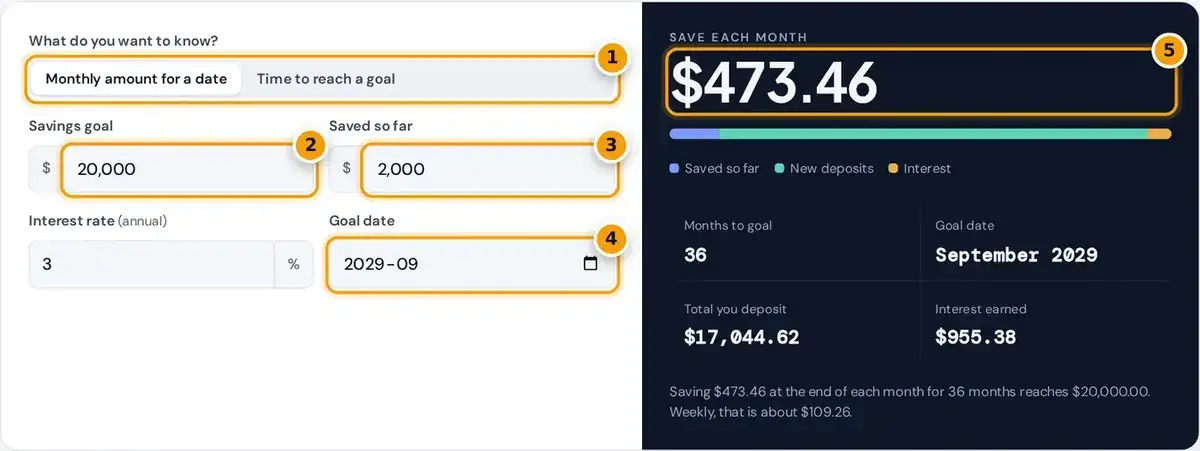
- Choose a monthly amount for a date, or time to reach a goal.
- Enter your savings goal.
- Add what you have already saved.
- Pick the month you want to reach the goal.
- Read the monthly amount, with interest earned and the weekly equivalent.
Choose what you want to work out. Monthly amount for a date tells you how much to set aside monthly to reach your savings goal by a chosen goal date, such as three years away.
Time to reach a goal flips the question: enter a fixed monthly deposit and see how long it takes. In both modes, enter the goal, the amount saved so far and the annual interest rate.
Results show the monthly amount or time needed, the finishing month, the total you deposit and the interest earned. A savings by year table below the tool tracks deposits, interest and balance for each year.
The Savings Goal Formula
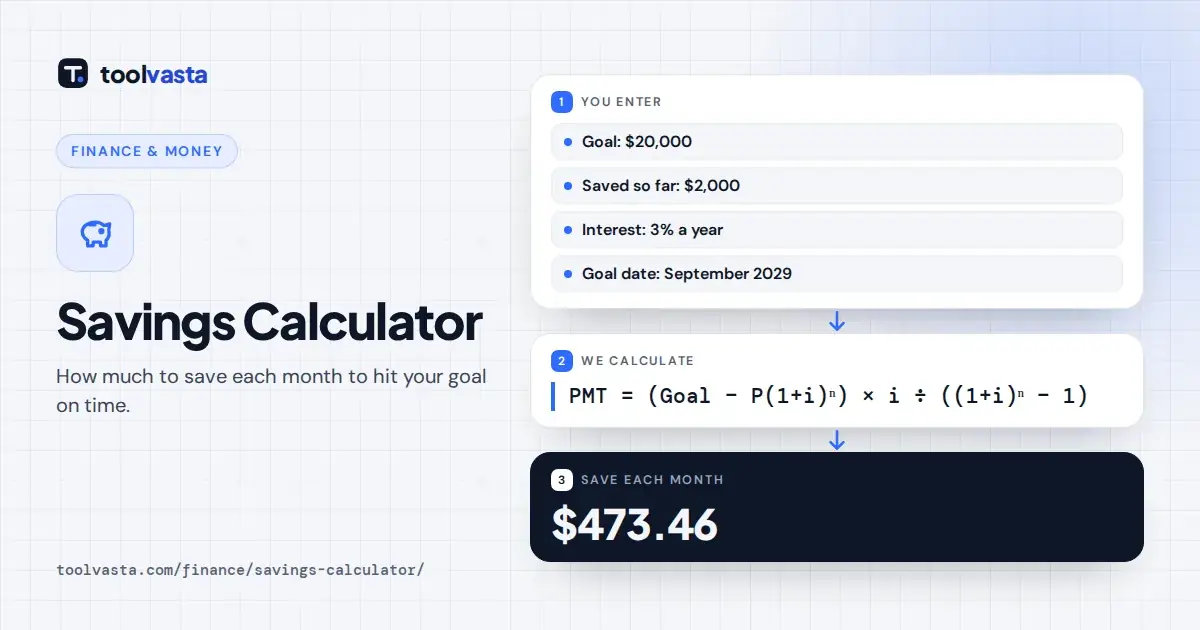
Your starting balance grows with interest, and each deposit grows from the month it is made. The calculator solves the future value of an annuity for the monthly deposit that lands exactly on the goal.
G is the goal, S the amount already saved, i the annual rate divided by 12 and n the number of months. Interest is compounded monthly, and deposits arrive at the end of each month.
When the rate is 0%, the deposit is simply (G − S) divided by n. In time mode, the calculator adds one month of interest and one deposit each step until the balance reaches the goal.
Worked Example: $20,000 in Three Years
Say you want $20,000 in 36 months and already have $2,000 in an account paying 3%. On its own, that $2,000 grows to about $2,188 by the goal date, so deposits must cover the rest.
The calculator says to save $473.46 a month, which is about $109.26 weekly. The total you deposit comes to $17,044.62, and interest earned adds $955.38. With no interest at all, you would need $500.00 monthly.
Flip to time mode and save $500 a month instead: you reach $20,000 after 35 deposits, or 2 years 11 months. A higher monthly deposit shortens the timeline far more than a slightly higher rate.
Common Savings Goals
Most people save for a handful of familiar targets. Setting a specific amount and date for each one makes the monthly figure concrete, which makes it much easier to stick with the plan over time.
| Goal | Typical target |
|---|---|
| Emergency fund | 3 to 6 months of essential expenses |
| Home down payment | 5% to 20% of the purchase price, plus closing costs |
| Car purchase | Enough to avoid a long loan, or a large down payment |
| Travel or a wedding | The full cost by the booking date |
An emergency fund usually comes first, sized at 3 to 6 months of essential expenses such as rent, food, utilities and transport. Lean toward six months if your income varies or you support a family.
The 50/30/20 budget is a simple starting rule: roughly half of take-home pay for needs, 30% for wants and 20% for savings and debt repayment. Adjust the split to fit your own costs and priorities.
Where to Keep Your Savings in Canada
For short-term goals, a high-interest savings account keeps money safe and accessible. A cashable GIC can pay a little more while still allowing early access, and a regular GIC locks funds for a set term.
A TFSA lets interest grow tax-free and can hold both savings accounts and GICs. For a first home, the First Home Savings Account, or FHSA, adds a tax deduction on contributions and tax-free qualifying withdrawals.
Eligible deposits at member institutions are protected by CDIC deposit insurance up to set limits in each category. Most credit unions use provincial deposit insurance instead, so always check which plan covers your savings account.
APY, Compounding and Interest Rates
Banks often quote a nominal rate, while APY, the annual percentage yield, includes compounding. A 3% nominal rate compounded monthly equals an effective annual rate of about 3.04%, slightly higher than the headline figure suggests.
This calculator treats the rate you enter as a nominal annual rate and applies it monthly. If your bank quotes APY, the difference is tiny for savings goals of a few years and moderate rates.
Compound interest matters more for large balances and long timelines. Watch for a promotional rate that quietly drops after the first few months, and remember that inflation reduces what your finished savings can buy later.
Tips to Reach Your Goal Faster
The single biggest lever is the amount you set aside each month, not the interest rate. Small habits make that amount easier to reach and keep, especially when life gets busy or expenses spike unexpectedly.
- Automate a transfer on payday so the money moves before you can spend it.
- Round the monthly target up to build a buffer for missed months.
- Put windfalls such as a tax refund or bonuses toward the goal.
Review the plan each year too. If your rate changes or you miss a month, enter the new balance as saved so far and the calculator gives an updated monthly amount for the remaining time.
The results assume a fixed rate, end-of-month deposits and no fees or withdrawals. Interest outside a TFSA or FHSA is taxable, so treat every figure as an estimate for planning rather than a guaranteed outcome.
Frequently asked questions
How much should I save each month to reach $20,000 in 3 years?
With $2,000 already saved at 3% interest, you need about $473.46 a month. Starting from zero with no interest, you would need $555.56 a month to reach the same $20,000 goal.
How long will it take to save $10,000?
It depends on your monthly deposit and rate. At $500 a month from zero with 3% interest, it takes 20 months. Use the time to reach a goal mode above to test your own numbers.
Does interest make a big difference for short goals?
Not much. For goals under a few years, most of the balance comes from your deposits. Interest matters more for larger balances and longer time frames, where earnings compound on earlier earnings.
How much should I keep in an emergency fund?
A common guideline is 3 to 6 months of essential expenses such as housing, food, transport and insurance. Aim for the higher end if your income is irregular or others depend on you.
Should I save in a TFSA or a savings account?
You can do both: a TFSA can hold a savings account or GIC, and the interest it earns is tax-free. For a first home, the FHSA can also give you a tax deduction.
What rate should I enter?
Use the interest rate your savings account or GIC pays now. If you are unsure, a conservative figure such as 2% to 3% keeps the plan realistic, and you can update it later.