How to Use the Decision Maker
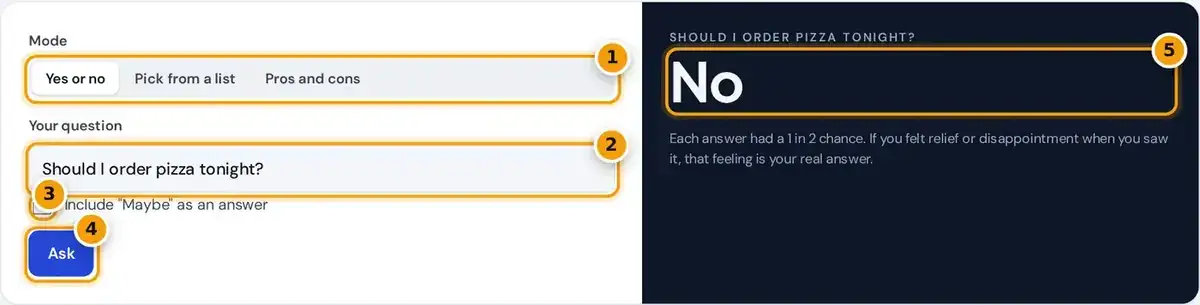
- Choose a mode: yes or no, pick from a list, or pros and cons.
- Type the question you need answered.
- Tick Include Maybe for a three-way answer.
- Press Ask for a fair random answer.
- Read your answer. Notice how you feel about it, that is often your real choice.
Choose one of three modes at the top. Yes or no answers a question you type, pick from a list chooses one option at random, and pros and cons weighs your reasons for and against.
For yes or no, type the question and press Ask, and tick Maybe if you want a possible three way answer. For a list, enter your options one per line, then press Pick one below.
For pros and cons, write each reason and give it a weight from 1 to 5. The verdict, totals and colored bar update as you type, making this an easy decision maker for bigger questions.
How the Random Answers Stay Fair
Every random answer comes from the cryptographic random number generator built into your browser, the same source used for security keys. It is far less predictable than the basic pseudorandom functions many other sites use.
A common shortcut maps a random number to options with a remainder, which slightly favors the first few options. This tool rejects out of range values instead, so it avoids that modulo bias problem completely.
The result is that every option has an equal chance. With two options each has a 50% chance, and with four options each has 25%, which the note under the answer confirms every single time.
Weighted Pros and Cons Formula
A plain list of pros and cons treats every reason as equal, but a higher salary usually matters more than a nicer office. Giving each reason a weight from 1 to 5 fixes that problem.
The tool adds the weights on each side. The net score is pros minus cons, and the pros share is the pros total divided by all weights, shown as a percentage of the combined total.
net score = pros total − cons total
pros share = pros total ÷ (pros total + cons total) × 100
The verdict reads Go for it when the pros share is 60% or more, Probably not at 40% or less, and Too close to call in between. These cutoffs are a handy rule of thumb.
Worked Example: A Job Offer
Take a job offer. The pros are a higher salary weighted 5, a shorter commute weighted 3 and learning new skills weighted 4, which adds up to a pros total of 12 points in all.
The cons are leaving a great team weighted 3 and less vacation at first weighted 2, totaling 5 points. The net score is +7, and the pros share is 12 divided by 17, or 70.6%.
That share is above 60%, so the verdict is Go for it. If salary drops to 1 and leaving the team rises to 5, the totals become 8 and 7, a 53.3% share, too close.
When a Random Decision Helps
Random picks work best for low-stakes choices where any option is fine: what to eat, which movie to watch, or who goes first. They end the back and forth that wastes everyone's time and energy.
They also help with decision fatigue. After a long day of choices, handing small decisions to a coin flip saves your attention for the decisions that genuinely need careful thought, research and planning over days.
Watch your reaction to the answer. If you feel relief or disappointment, that gut feeling shows what you really wanted. Treat the random answer as a way to discover your preference, not as an order.
Choosing From a List
The list picker suits shared choices, such as where a group should eat, which chore to tackle first or which student answers next in a classroom. Everyone can see every option has the same odds.
You can use it for a small raffle by entering each name once. Enter an option twice if the group agrees it deserves a better chance, much like a bigger slice on a spinner wheel.
Empty lines are ignored, and you need at least two options. Press Pick one again to draw another result, since each draw is independent and does not remember the option it chose the last time.
Making Bigger Decisions
Write every reason down, then weight each one honestly. Seeing all the reasons together reduces the pull of whichever one you thought of last, and it often shows that one side is clearly stronger overall.
Look for a deal-breaker. A single con with weight 5 may matter more than several small pros, so ask yourself whether any one reason would make the whole choice wrong for you, now or later.
Sleep on it when the result is close, and revisit the weights the next day. For complex choices, a full decision matrix scores options against several criteria at once and extends the same weighting idea.
Privacy and Limits
Everything runs in your browser, and nothing is stored or sent anywhere. Your questions, options and reasons disappear when you close the page, so copy anything you want to keep somewhere safe before you leave.
The random modes use the secure browser crypto interface that is defined by the W3C Web Cryptography API, which relies on the same kind of approved generators described in the NIST random bit generation guidance.
For financial, medical or legal decisions, use the pros and cons list to organize your thinking, then talk to a qualified professional. A tool can sort reasons, but the final decision should be yours alone.
Frequently asked questions
How does the yes or no decision maker work?
It picks Yes or No with equal probability using your browser's cryptographic random number generator. With Maybe included, each of the three answers has exactly a one in three chance of appearing.
Is the random pick really fair?
Yes. Every option in your list has exactly the same chance, and the generator avoids the small modulo bias found in simple random functions by rejecting out of range values before choosing.
How do weighted pros and cons work?
Give each reason a weight from 1 to 5. The tool adds up the weights on each side and compares them, so important reasons count more than minor ones in the final verdict.
What does too close to call mean?
The pros make up between 40% and 60% of the total weight. Neither side clearly wins, so consider which single reason matters most to you, or gather more information first.
Should I let a random generator make big decisions?
No. Use random answers for everyday choices. For important decisions, the pros and cons mode helps you organize your reasons, but the decision should always be your own.
Can I make one option more likely in the list picker?
Yes. Enter that option on two or more lines. Each line counts as a separate entry, so an option listed twice has double the chance of being picked compared with the others.