How to Use the Book Title Generator
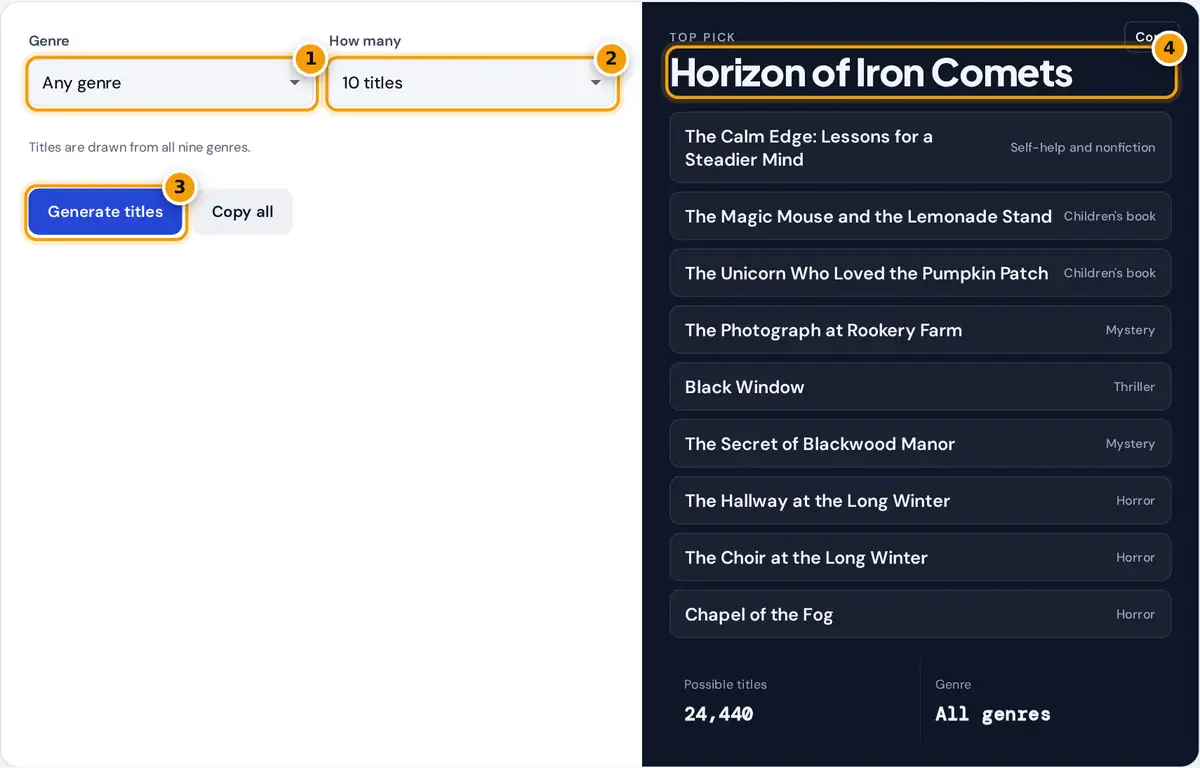
- Pick a genre such as fantasy, mystery or romance, or keep Any genre for a mix.
- Choose how many titles to generate: 5, 10 or 20.
- Press Generate titles for a new batch of book title ideas.
- Read the top pick, then click any title in the list to copy it.
Choose a genre or keep Any genre selected, then pick 5, 10 or 20 titles and press Generate titles. The book title generator shows a top pick in large type, with the rest listed below.
Each title is labeled with the genre it came from. Click any title to copy it, or use Copy all to send the list to your notes. Press Generate again as often as you like.
Every list is fresh, and a title never repeats within one list. Treat the results as a starting point: many writers keep one strong word from a suggestion and build their own title around it.
Book Title Ideas for Every Genre
Each genre has its own word lists and title patterns, written to match the conventions readers expect on that shelf. Fantasy and thriller titles should never sound too alike, and these lists keep them apart.
| Genre | Patterns | Example |
|---|---|---|
| Fantasy | The adjective noun, noun of place, the character of place, the character's noun | The Mapmaker's Compass |
| Science fiction | Same four patterns, with space and technology words | Signal of the Ninth Moon |
| Mystery | The adjective noun, the secret of place, the character's noun, the noun at place | The Locksmith's Diary |
| Thriller | Short, punchy two and three word titles | The Twelfth Hour |
| Romance | Warm adjectives, a noun at a cozy place | Proposal at the Lake House |
| Historical fiction | The character's noun, noun of a place or era | The Bookbinder's Daughter |
| Horror | Unsettling everyday objects and places | The House at Ravenwood |
| Children's book | The adjective animal, the animal who loved something | The Penguin Who Loved the Moon |
| Self-help and nonfiction | The art of an action, a title with a subtitle | The Art of Doing Less |
Fantasy and science fiction lean on concrete objects and invented places alike. Mystery titles hint at a secret, and a thriller usually wants two or three punchy words that suggest danger, urgency or a deadline.
Romance uses warm adjectives and cozy settings, historical fiction often names a trade, and horror twists familiar everyday places. A children's book title can be playful, while self-help and nonfiction titles promise a clear benefit.
How the Title Patterns Work
Every single suggestion follows a proven pattern, such as The Adjective Noun or Noun of Place. Possessive forms like The Mapmaker's Compass add a character, and proper nouns like Ravenwood make a setting feel real.
Most word lists hold 20 words and the character lists hold 15. In fantasy, the four patterns give 400, 400, 300 and 300 combinations, so there are 1,400 possible titles in that one genre alone.
Across all nine genres, there are 24,440 possible titles available. The counter under the results shows the number for the genre you have selected, so you can see how much variety each list still offers.
What Makes a Good Book Title
A title is the reader's first impression, often seen at thumbnail size beside many others. Good titles are short, memorable and specific. Concrete images, like a compass or a lake house, stick better than abstractions.
The strongest titles signal the genre at a glance and spark curiosity at the same time. A double meaning can help, as long as the first reading tells readers what kind of book they hold.
Say it aloud before you commit. A title that is easy to say is easier to recommend and search for. One to five words is typical for fiction, and shorter titles work well on covers.
Working Titles and Brainstorming
Many authors start with a working title to name the file, then change it later. Pride and Prejudice was first called First Impressions, so there is no pressure to get it right on day one.
To brainstorm, list your story's key image, main character names, setting and feeling. Try them in the patterns above, or press generate to see dozens of combinations side by side and spark new directions quickly.
Writers searching for a title generator for story ideas, short fiction or fan fiction can use the same approach. Pick a genre close to your plot, then mix and match words until one truly fits.
Titles for Nonfiction and Series
Nonfiction usually works best with a short main title plus a clear subtitle. The main title gives the hook, and the subtitle states the benefit to the reader, ideally using keywords people actually search for.
Search visibility matters because most books are discovered online. A subtitle that names the topic plainly helps online bookstores match your book to the right readers, while the main title can stay short and memorable.
For a series, choose a series name that can stretch across several books, then give each volume its own title. Keep a shared pattern, such as a repeated word, so readers recognize the set immediately.
Can You Use a Generated Title?
Yes. In the United States, titles are not protected by copyright, according to the US Copyright Office, and Canada generally treats titles the same way, so two different books can legally share the same title.
A series name or brand can still be protected as a trademark, and copying a famous title can easily confuse readers. Because these titles are random combinations of common words, some may match existing books.
Always search Amazon, Goodreads and other online bookstores before you publish. If a well-known book already uses your title, pick another one. This section is general information for writers, not legal advice for your situation.
Frequently asked questions
How do I come up with a title for my story?
List the key image, character, place and feeling of your story, then try them in proven patterns such as The Adjective Noun or Noun of Place. A generator speeds this up by showing many combinations at once.
Can two books have the same title?
Yes. Titles alone are generally not protected by copyright in Canada or the United States, but a title that copies a famous book can confuse readers. Series names and brands can be trademarks.
What makes a good fantasy book title?
Strong concrete nouns such as crown, sword or map, paired with an evocative adjective or a place. Examples include The Gilded Citadel or Oath of the Northern Wilds, which signal the genre instantly.
How long should a book title be?
Most fiction titles are one to five words. Nonfiction often uses a short main title with a longer subtitle that explains the benefit to the reader and includes words people search for.
Are the generated titles original?
They are random combinations of hand-picked words, so most will be uncommon, but some may match existing books. Search online bookstores such as Amazon and Goodreads before you use one.
How many titles can the generator make?
There are 24,440 possible titles across nine genres, including 1,400 in fantasy alone. Each list holds 5, 10 or 20 titles, and no title repeats within the same list.