How to Use the Spanish Name Generator
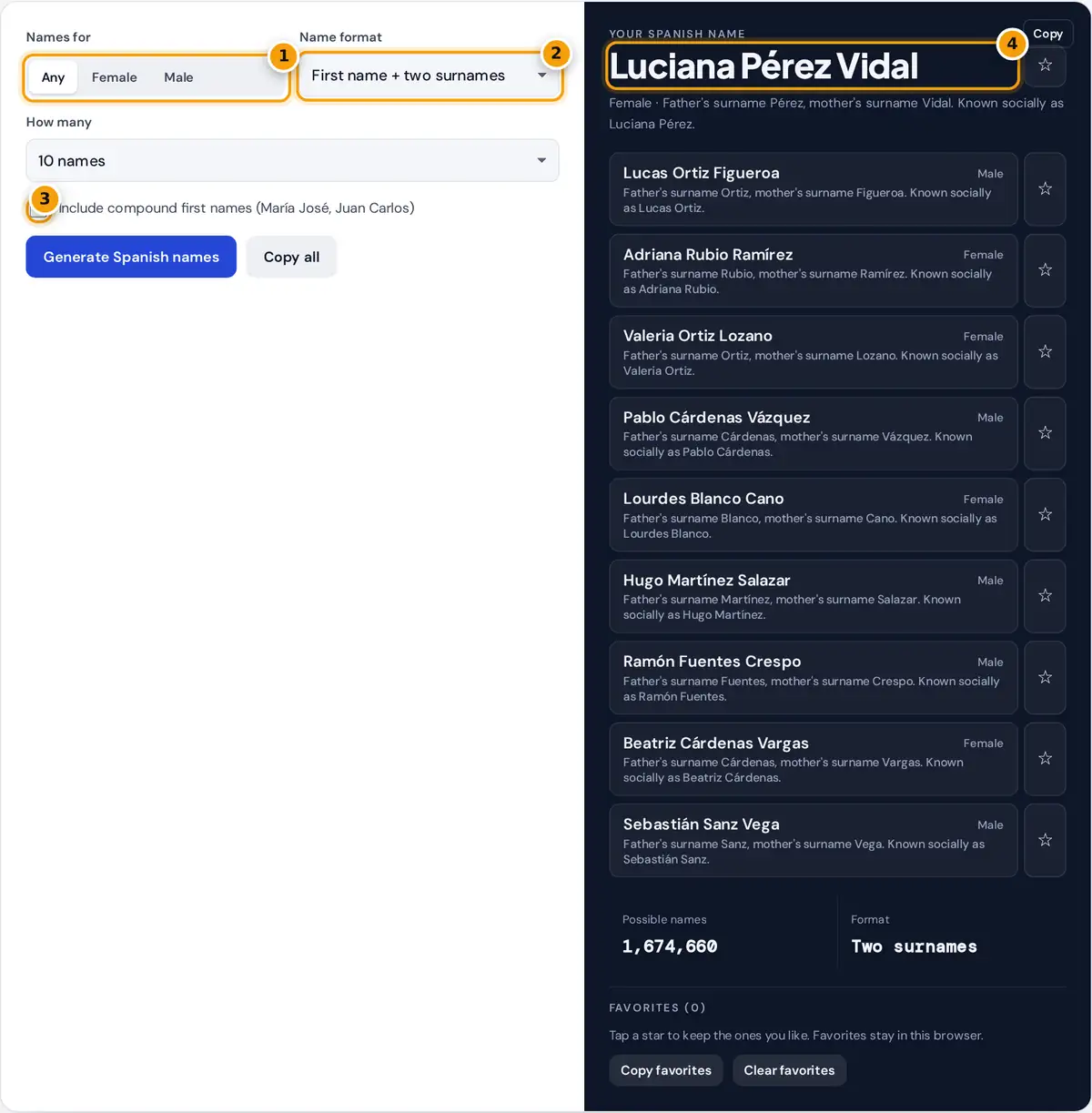
- Choose female, male or any Spanish names.
- Pick two surnames, one surname or first name only.
- Tick to include compound names like María José.
- Read the name and which surname comes from each parent.
Choose Female, Male or Any, then pick a format. The full format gives a first name and two surnames, the form used on official documents in Spain and most of Latin America. You can also choose a single surname, for a shorter everyday name, or a first name only. Tick the compound names box to include traditional double first names such as María José or Juan Carlos.
With two surnames, each result explains which surname came from each parent and how the person would usually be addressed day to day. Click a name to copy it with its accents, or tap the star to keep it in your favorites.
Why Spanish Names Have Two Surnames
In Spanish-speaking countries, people traditionally carry two surnames: the first surname of their father followed by the first surname of their mother. If Carlos García Ruiz and Elena López Torres have a daughter named Lucía, she becomes Lucía García López. When Lucía has children, she passes on García, her first surname, and it is joined by the other parent's first surname.
Women usually keep their own surnames for life rather than taking a spouse's name. In everyday conversation, many people use only the first surname, so Lucía García López is often just Lucía García. Spain has allowed parents to choose the order of the two surnames since 1999, and the rules differ somewhat between countries, but father first remains the most common pattern.
The Name Lists
The generator uses 65 female and 65 male first names that are common across Spain and Latin America, from timeless names like Carmen, José and Isabel to newer favorites like Martina, Mateo and Valentina. It also includes 15 female and 15 male compound names, and 114 surnames. Many surnames end in -ez, an old patronymic ending meaning son of: Rodríguez comes from Rodrigo and Fernández from Fernando.
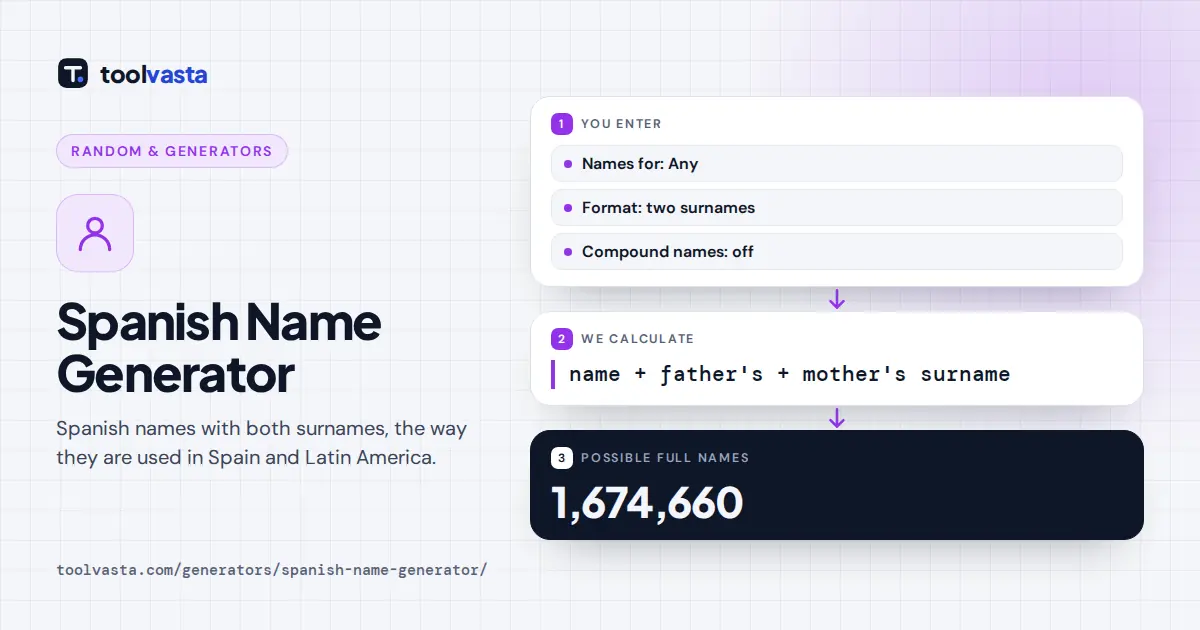
With two different surnames, there are 65 × 114 × 113 = 837,330 female names and 1,674,660 names in total. Adding compound first names raises the total to 2,061,120.
| Example | First name | Father's surname | Mother's surname |
|---|---|---|---|
| Lucía García López | Lucía | García | López |
| Juan Carlos Moreno Vidal | Juan Carlos | Moreno | Vidal |
| María José Herrera Soto | María José | Herrera | Soto |
Accents and Spelling
Accent marks are part of Spanish spelling and change how a name is pronounced. García is stressed on the second syllable, Ramón on the last, and Ángel on the first. Keep the accents when you write a Spanish name, especially for a character or a real person, because leaving them out can look careless to Spanish speakers. A few names have regional forms, such as Ximena and Jimena, both of which are correct.
Compound First Names
Compound names combine two given names into one first name. María is often combined with another name for girls, such as María José or María del Carmen, and José María is a traditional boy's name even though it includes María. People with compound names may use both parts or just one, and many have a familiar short form, so María José is often called Majo and José María is often called Chema.
Using Spanish Names in Stories and Games
For realistic characters, give family members matching surnames: siblings share both surnames, and each parent carries their own pair. Use the full name in formal scenes and the first surname alone in casual dialogue. The names here are random combinations of common names, so they do not refer to any real person.
Popular first names also change over time, just as they do in English. Names such as Dolores, Mercedes and Ramón feel traditional and suit older characters, while Martina, Lucía, Mateo and Hugo are favorites with younger families. Mixing the two gives a cast of characters a believable range of ages.
Frequently asked questions
Why do Spanish people have two last names?
Most Spanish speakers carry two surnames: the father's first surname followed by the mother's first surname. This keeps both family lines in the name, and the tradition is used in Spain and most of Latin America.
Which surname is used in everyday life?
The first surname, usually the father's, is the one most often used on its own. Lucía García López would commonly be called Lucía García, while official documents show both surnames.
Do Spanish women change their surnames when they marry?
Traditionally, no. Women in Spain and most Spanish-speaking countries keep their own two surnames for life. Their children receive the first surname of each parent.
What are compound Spanish names?
Compound names join two given names into one first name, such as María José, Juan Carlos or José María. Tick the compound names option to include them in the results.
Why do so many Spanish surnames end in -ez?
The ending -ez is an old patronymic meaning son of. Rodríguez meant son of Rodrigo, Fernández son of Fernando, and Martínez son of Martín. These names later became fixed family surnames.
How many Spanish names can the generator make?
With two different surnames, it can make 1,674,660 full names, or 2,061,120 with compound first names included. It draws from 130 first names and 114 surnames.