How to Use the Drawing Prompt Generator
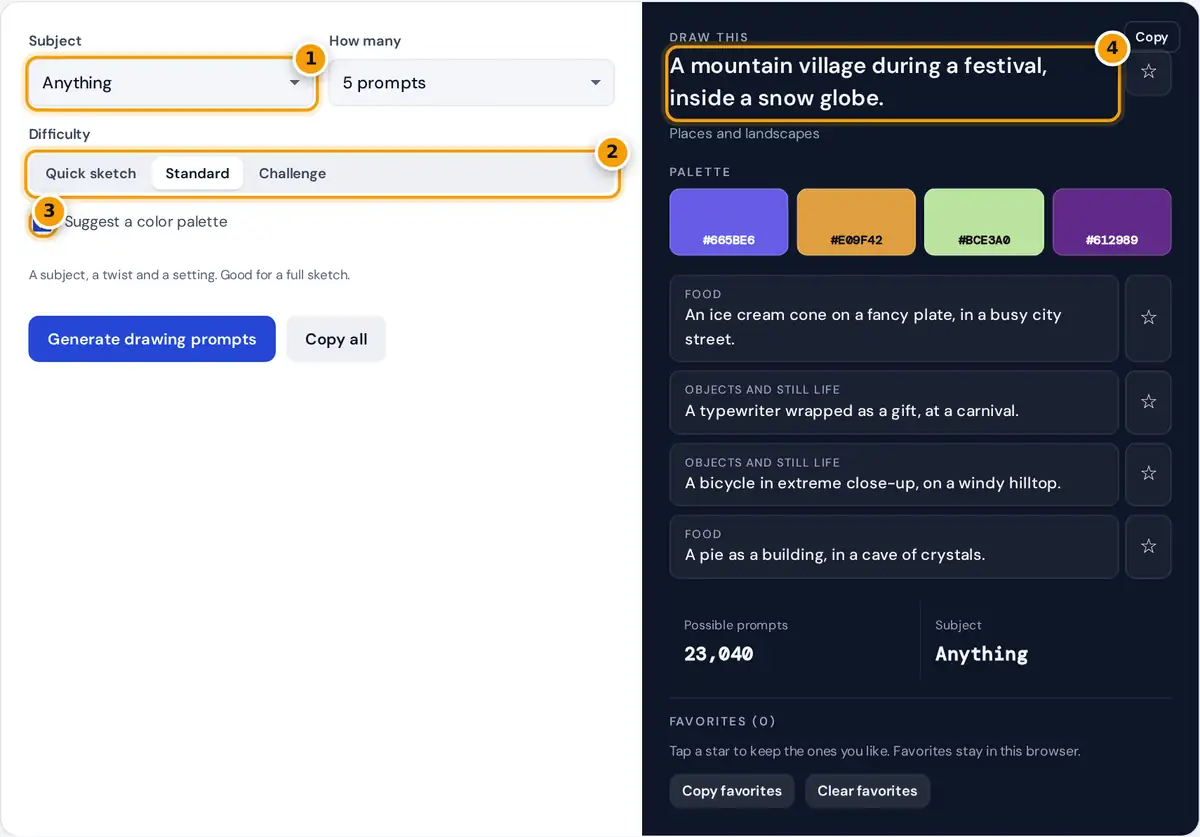
- Choose a subject such as animals, creatures or places.
- Pick quick sketch, standard or challenge.
- Keep the palette on for four colors to use.
- Read your drawing prompt and copy the palette colors.
Choose a subject, such as animals, fantasy creatures, people, objects, places or food, or keep Anything for a surprise. Then pick a difficulty. A Quick sketch gives you a subject with one twist, like "A red fox wearing a knitted scarf." Standard adds a setting, and Challenge adds an art constraint, such as drawing in one continuous line or using only three colors.
With the palette box ticked, you also get four colors to work with. Click a swatch to copy its hex code into your painting app. Click a prompt to copy it, or tap the star to save it to your favorites, so you can build a list of ideas for a sketchbook week or a month-long drawing challenge.
The Three Difficulty Levels
| Level | What you get | Example |
|---|---|---|
| Quick sketch | Subject + twist | An owl carrying a lantern. |
| Standard | Subject + twist + setting | A teapot overgrown with moss, on the moon. |
| Challenge | Standard + art constraint | A lighthouse after the rain, inside a snow globe. Challenge: use only three colors. |
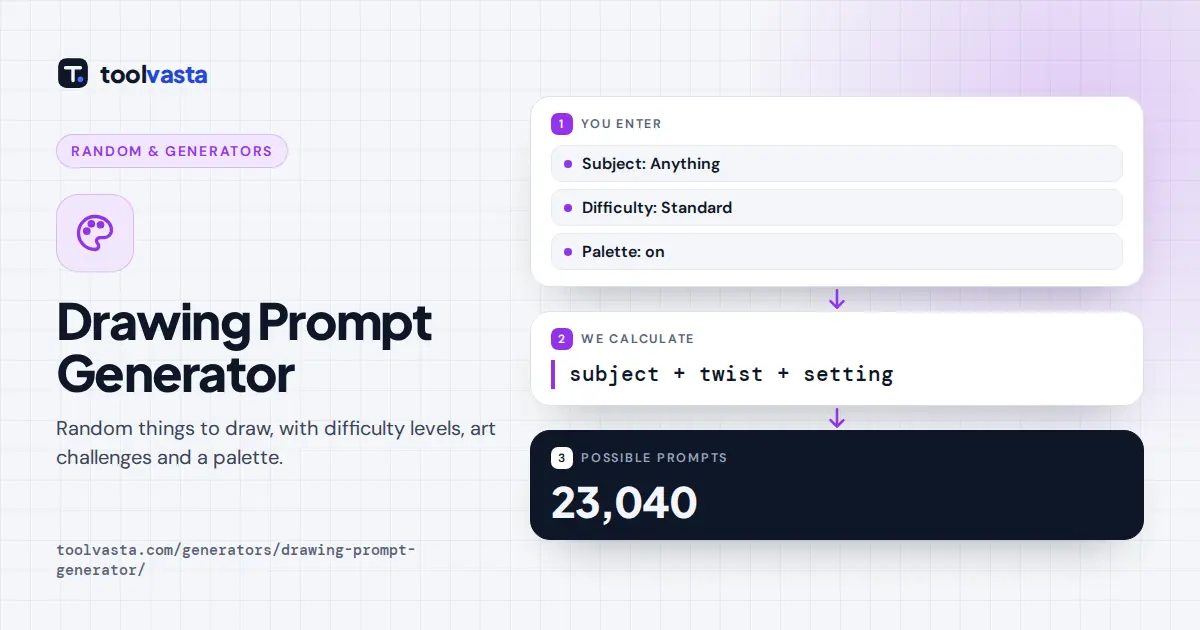
Each subject has 20 things to draw and 12 twists. There are 16 settings and 14 art challenges shared by every subject.
standard, one subject: 20 × 12 × 16 = 3,840
Across all six subjects there are 1,440 quick sketches, 23,040 standard prompts and 322,560 challenge prompts.
How the Color Palette Works
The palette starts from a random hue on the color wheel and builds three more colors using a classic color scheme: analogous colors that sit next to each other, a complementary accent from the opposite side of the wheel, or a triadic set spaced evenly around it. Lightness and saturation vary so you get a light, a mid tone and a dark, which gives your drawing contrast. Treat the palette as a suggestion. If one color does not suit your subject, keep the other three and choose the fourth yourself.
How to Build a Drawing Habit
- Draw every day, even briefly. Ten minutes a day builds skill faster than one long session a week. Quick sketch prompts are made for this.
- Do not erase too much. Treat prompts as practice, not finished art. Move on to the next one rather than perfecting the first.
- Use references for the subject, not the idea. Look up photos of a real hedgehog or teapot, then invent the twist yourself.
- Repeat a favorite. Draw the same saved prompt again a month later and compare. Seeing your progress is a great motivator.
- Push yourself with challenges. Limits such as one continuous line or your non-dominant hand loosen your style and stop you from overthinking.
Who Drawing Prompts Are For
Prompts help beginners who freeze in front of a blank page, experienced artists stuck in a rut, art teachers planning warm-up exercises, and anyone taking part in a drawing challenge month. Parents and kids can draw the same prompt and compare results, and online art groups can post one prompt a day for members to share. The prompts work just as well for pencil, ink, paint and digital art.
Using Prompts with Different Mediums
Pencil and ink suit quick sketches, where line and shape matter most. Watercolor and gouache pair well with the palette, because four planned colors keep a painting fresh and stop colors turning muddy. Digital artists can paste the hex codes straight into a swatch panel. Sculptors and crafters can use the same prompts for clay, collage or embroidery, since a good subject and twist work in any material.
Making a Prompt Your Own
Read the prompt and ask one question before you start: what story does this picture tell? A raccoon caught in the rain can be gloomy, funny or peaceful depending on its expression and the lighting. Decide on the mood first, then choose a composition that supports it. Zoom in close for drama, pull back for loneliness, or tilt the horizon for energy. Two artists given the same prompt should produce two completely different pictures, and that is the point.
Frequently asked questions
What should I draw when I have no ideas?
Generate a quick sketch prompt and give yourself five minutes. A simple subject with one twist, like an owl carrying a lantern, is enough to get your pencil moving and break the blank page.
What are the difficulty levels?
Quick sketch gives a subject and a twist. Standard adds a setting. Challenge also adds an art constraint, such as drawing in one continuous line, using only three colors or finishing in ten minutes.
How is the color palette chosen?
The tool picks a random starting hue and builds four colors with a classic scheme: analogous, complementary or triadic. It varies lightness so the palette includes light, middle and dark tones for contrast.
Can I copy the palette colors?
Yes. Click any color swatch to copy its hex code, such as #3A7BD5, and paste it into a digital painting app, a design tool or a note to match your paints.
Are these prompts good for kids?
Yes. The prompts are family friendly, with subjects like animals, food and friendly creatures. Choose Quick sketch for younger children and let them add their own story to the picture.
How many drawing prompts can the generator make?
There are 23,040 standard prompts across six subjects, 1,440 quick sketches and 322,560 challenge prompts, plus a fresh random four-color palette every time you press Generate.