How to Use the Random Fruit Generator
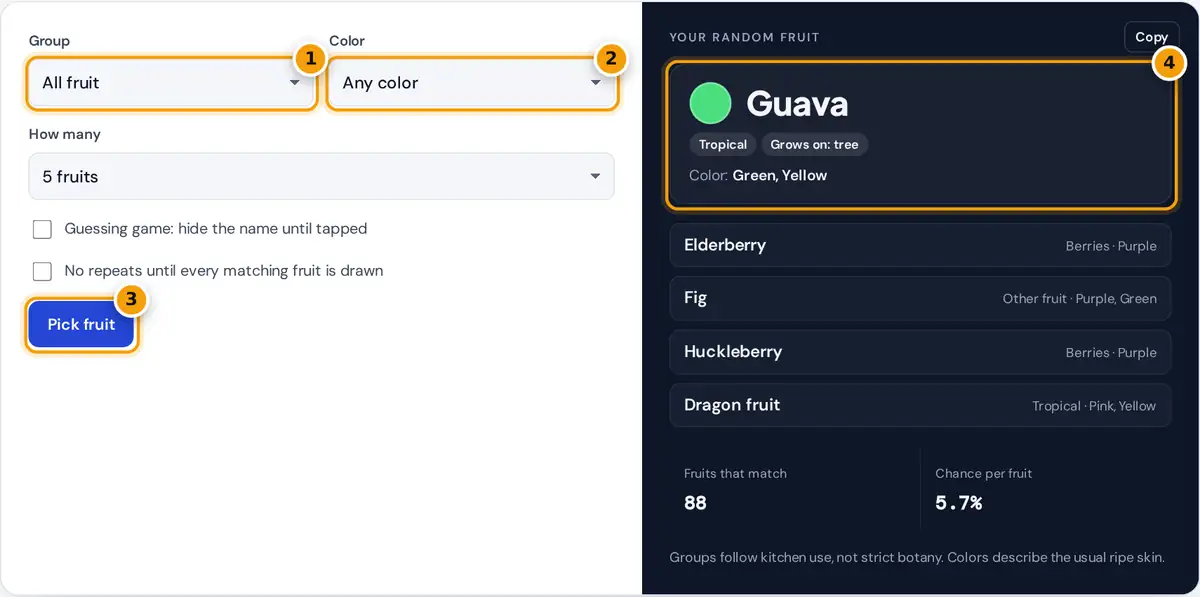
- Choose a group such as berries, citrus or tropical fruit.
- Optionally filter by color.
- Press Pick fruit for a new draw.
- Read the fruit, its group, color and how it grows.
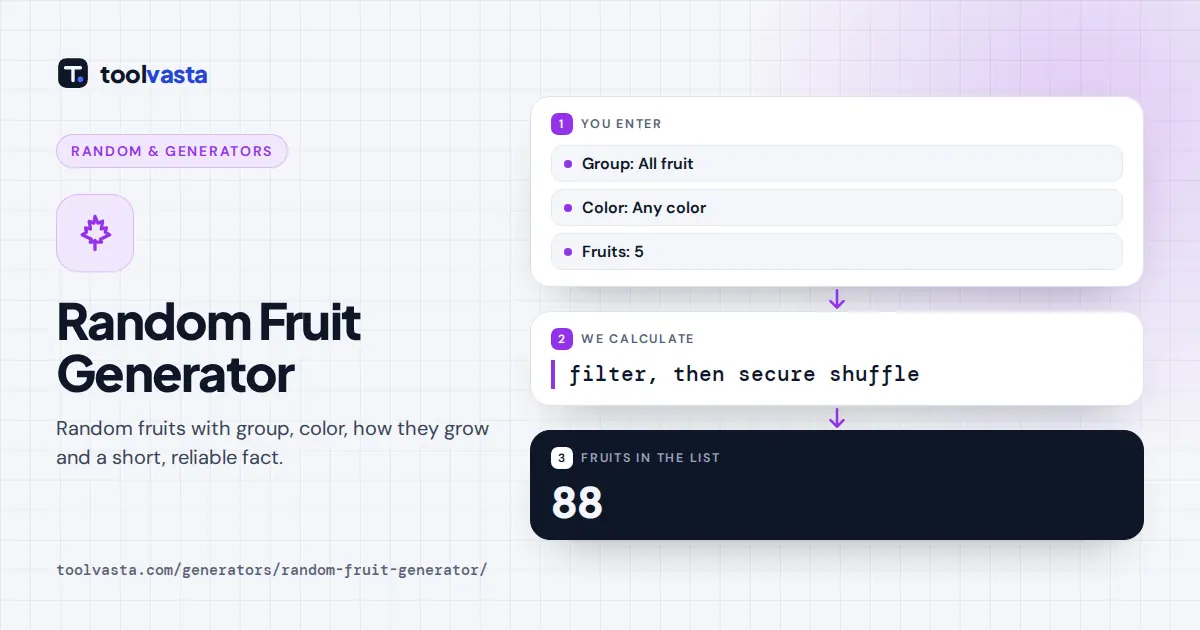
Press Pick fruit to draw random fruits from a list of 88. The first pick shows the fruit's group, its usual colors, what it grows on and, for many fruits, a short fact. The rest of the draw is listed below, and no fruit repeats within one draw.
Choose a group such as berries or tropical fruit, or a color such as red or green, to narrow the pool. Tick the guessing game box to hide the names, which turns the tool into a quick quiz for kids, or tick No repeats to work through every matching fruit before any comes back.
Fruit Groups in the Generator
Groups follow how fruit is sorted in shops and kitchens rather than strict botany, which is full of surprises. Botanically, bananas and avocados are berries, while strawberries and raspberries are not true berries at all.
| Group | Fruits | Examples |
|---|---|---|
| Berries | 16 | Strawberry, Raspberry, Blackberry, Blueberry |
| Citrus | 15 | Lemon, Lime, Key lime, Orange |
| Tropical | 26 | Mango, Lychee, Longan, Rambutan |
| Stone fruit | 8 | Peach, Nectarine, Plum, Damson |
| Apples and pears | 7 | Apple, Pear, Asian pear, Quince |
| Melons | 6 | Watermelon, Cantaloupe, Honeydew, Galia melon |
| Other fruit | 10 | Grape, Kiwifruit, Fig, Pomegranate |
| Total | 88 |
How the Random Pick Works
The generator filters the list, shuffles the matching fruits with your browser's cryptographic random source using the Fisher-Yates method, and shows the first ones. Every matching fruit has the same chance.
Worked example: drawing 5 fruits from all 88 gives each a 5 ÷ 88 = 5.7% chance. Filter to the 15 citrus fruits and draw 1, and each has a 1 ÷ 15 = 6.7% chance.
Ideas for Using a Random Fruit
- Try something new: pick a tropical fruit you have never tasted and look for it at an international grocery store.
- Kids' games: use the guessing game, a fruit alphabet challenge or a drawing game where everyone sketches the fruit that comes up.
- Smoothies and salads: draw three fruits and build a recipe around them.
- Writing and art prompts: use a random fruit as the subject of a still life or a short poem.
- Classroom lessons: discuss how each fruit grows, on a tree, a shrub, a vine, a palm or a cactus.
About the Fruit Facts
Facts are short and limited to well-established points, such as the US Supreme Court's 1893 ruling that treated the tomato as a vegetable for import taxes, or the jabuticaba growing straight from its trunk. Fruits without a fact simply show their group, colors and growth habit. If you have allergies, check labels and ask a health professional before trying an unfamiliar fruit.
How Fruits Grow
Every result shows what the fruit grows on, which makes a good talking point for lessons and games. Most fruits in the list grow on trees, from apples and cherries to mangoes and jackfruit. Berries such as blueberries and currants grow on shrubs, while grapes, kiwifruit, passion fruit and melons grow on vines.
A few are less obvious. Bananas and pineapples grow on large leafy plants rather than trees, and strawberries grow on low plants that spread with runners. Dates, coconuts and acai grow on palms, and dragon fruit and prickly pears grow on cacti. Botanically, a fruit is the part of a flowering plant that develops from the flower and carries the seeds, which is why tomatoes and avocados count.
Picking by Color
The color filter uses the usual color of the ripe skin, and fruits with more than one common color appear under each. Apples, for example, show up under red, green and yellow. Color is a fun way to plan a rainbow fruit platter for a party: draw one fruit from each color and arrange them in order.
Frequently asked questions
How many fruits are in the random fruit generator?
The list has 88 fruits, from everyday apples, bananas and oranges to less familiar ones such as jabuticaba, salak, cherimoya, kiwano and Buddha's hand, sorted into seven groups you can filter.
Can I pick a random fruit by color?
Yes. Choose red, orange, yellow, green, purple, pink or brown. Fruits with more than one common color, such as apples, appear under each of their colors.
Is a tomato a fruit?
Botanically, yes: a tomato develops from a flower and contains seeds. In cooking it is treated as a vegetable, and in 1893 the US Supreme Court ruled it a vegetable for tariff purposes.
Why is a banana called a berry?
Botanists define a berry as a fleshy fruit that develops from a single ovary. Bananas, grapes, tomatoes and avocados fit that definition, while strawberries and raspberries do not.
How does the fruit guessing game work?
Tick the guessing game box and each name is hidden. Read the group, color and growth habit, guess the fruit, then tap to reveal the answer. Emoji are hidden too.
Is the random fruit pick fair?
Yes. The generator shuffles the matching fruits with your browser's secure random source, so every fruit in the filtered list has the same chance of being picked.