How to Use the Knight Name Generator
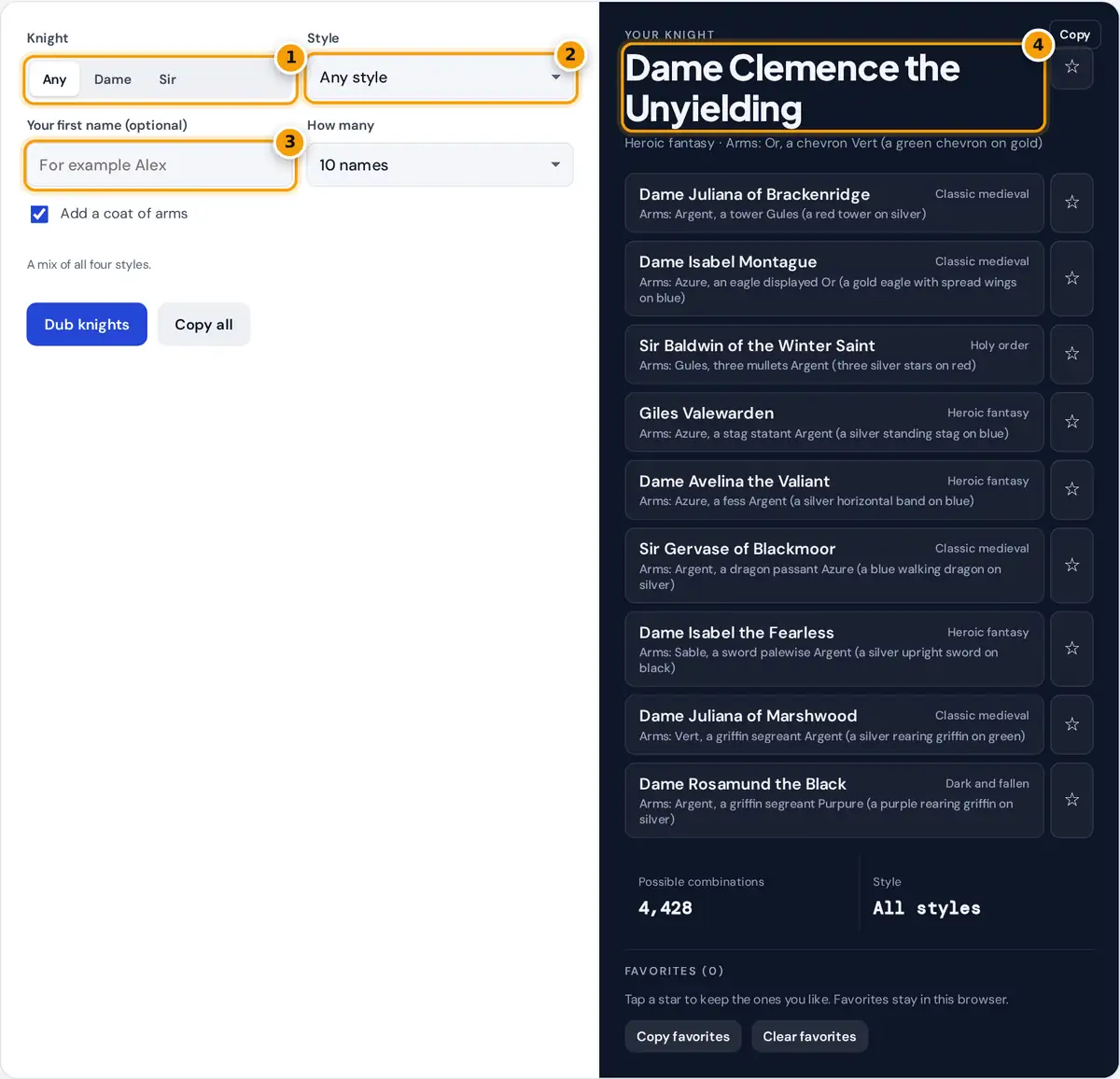
- Choose Sir, Dame or any.
- Pick a style: classic medieval, heroic, dark or holy order.
- Optionally add your first name to be knighted.
- Read your knight and coat of arms. Copy or save it.
Choose Sir for a male knight, Dame for a female knight, or Any for both. Then pick a style: Classic medieval, Heroic fantasy, Dark and fallen, or Holy order. Press Dub knights to fill the lists with new names.
Type your own first name to be knighted yourself, for example Sir Alex of Thornbury or Dame Alex the Valiant. With the coat of arms box ticked, every knight also gets a shield described in real heraldic language, called blazon, followed by a plain English version. Click a name to copy it, or tap the star to save it.
Knight Name Styles
| Style | Pattern | Example |
|---|---|---|
| Classic medieval | Sir or Dame + name + of + place, or + family name | Sir Godfrey of Harrowfield, Dame Cecily Ravenscroft |
| Heroic fantasy | Name + epithet, or name + heroic surname | Dame Matilda the Dauntless, Hugh Stormshield |
| Dark and fallen | Name + dark epithet, or a nameless knight | Sir Fulk the Oathbreaker, The Thorned Knight |
| Holy order | Name + of the + order | Dame Sybil of the Silver Chalice |
The first names are genuine medieval English names, 24 for women and 24 for men, such as Avelina, Hawise, Gervase and Fulk. Place names are invented to sound like English villages and manors.
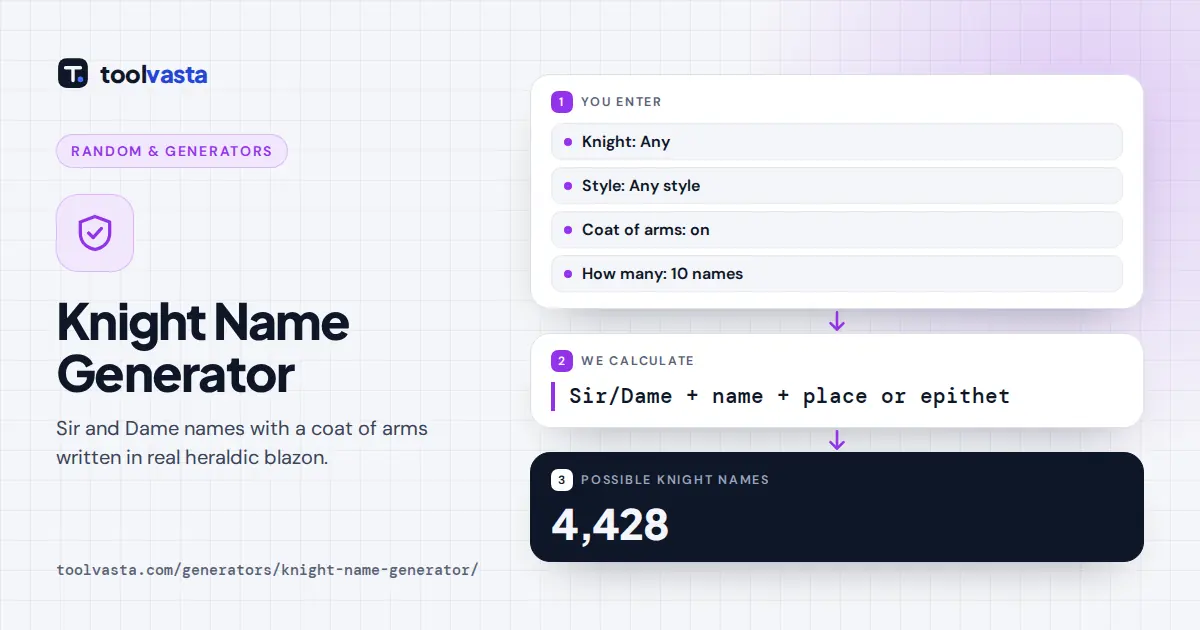
Across all four styles and both forms the generator can make 4,428 knight names. Names are drawn with your browser's secure random source, and a list never repeats.
How the Coat of Arms Works
Heraldry has its own vocabulary. The background of a shield is the field, and the picture or shape on it is the charge. Colors are called tinctures, and they fall into two groups: the metals, Or (gold) and Argent (silver), and the colors, such as Azure (blue), Gules (red), Vert (green), Sable (black) and Purpure (purple).
The generator follows the main rule of heraldry, the rule of tincture: never put a metal on a metal or a color on a color. A gold lion on blue is correct, while a red lion on blue is not, because the contrast would be poor from a distance. That is why every shield here pairs a metal with a color.
| Blazon | Plain English |
|---|---|
| Azure, a lion rampant Or | A gold rearing lion on blue |
| Argent, a chevron Gules | A red chevron on silver |
| Vert, three mullets Argent | Three silver stars on green |
| Or, an eagle displayed Sable | A black eagle with spread wings on gold |
A blazon names the field first, then the charge, then the charge's tincture. With 16 charges and every valid pairing of metal and color there are 320 possible shields.
Sir, Dame and Real Knighthood
In medieval Europe, a knight was a mounted warrior, often from a landholding family, who swore service to a lord. Knights were known by their first name and either their home manor ("of Thornbury") or their family name. Women were rarely knighted in the Middle Ages, but in the modern British honors system a woman appointed to certain orders of knighthood is styled Dame, which is why the generator uses Dame for female knights.
Tips for Naming a Knight
- Use the place. "Of Wexcombe" tells readers where the knight's loyalty and land lie, and gives you a home to visit in the story.
- Earn the epithet. A title like the Unyielding or the Oathbreaker should come from something the knight did.
- Match the arms to the character. A boar's head suits a fierce fighter, a crescent a knight of the night, a fleur-de-lis a courtly one.
- Keep orders consistent. Knights of one holy order share its name and often its colors.
Frequently asked questions
How do I make a knight name?
Start with Sir for a man or Dame for a woman, add a medieval first name, then add a home such as of Thornbury, a family name, or an epithet such as the Valiant. The generator builds all of these for you.
What is a female knight called?
In the modern British honors system, a woman who receives a knighthood-level honor is styled Dame, as in Dame Matilda. The generator uses Dame for female knights in every style.
What is the rule of tincture in heraldry?
It is the main color rule of heraldry: never place a metal on a metal or a color on a color. Gold and silver are the metals, so a gold lion belongs on a colored field such as blue or red.
What does Azure, a lion rampant Or mean?
It is a blazon, the formal description of a coat of arms. It means a blue shield with a gold lion standing on its hind legs. The field comes first, then the charge and its tincture.
How many knight names can the generator make?
It can make 4,428 knight names across four styles for Sirs and Dames, plus more with your own name. Each can be paired with one of 320 correctly blazoned coats of arms.
Are these real medieval names?
The first names are real medieval English names such as Avelina, Hawise, Gervase and Fulk. The places, epithets and orders are invented, so the combined knights are fictional characters you can use freely.