How to Use the Random Chord Generator
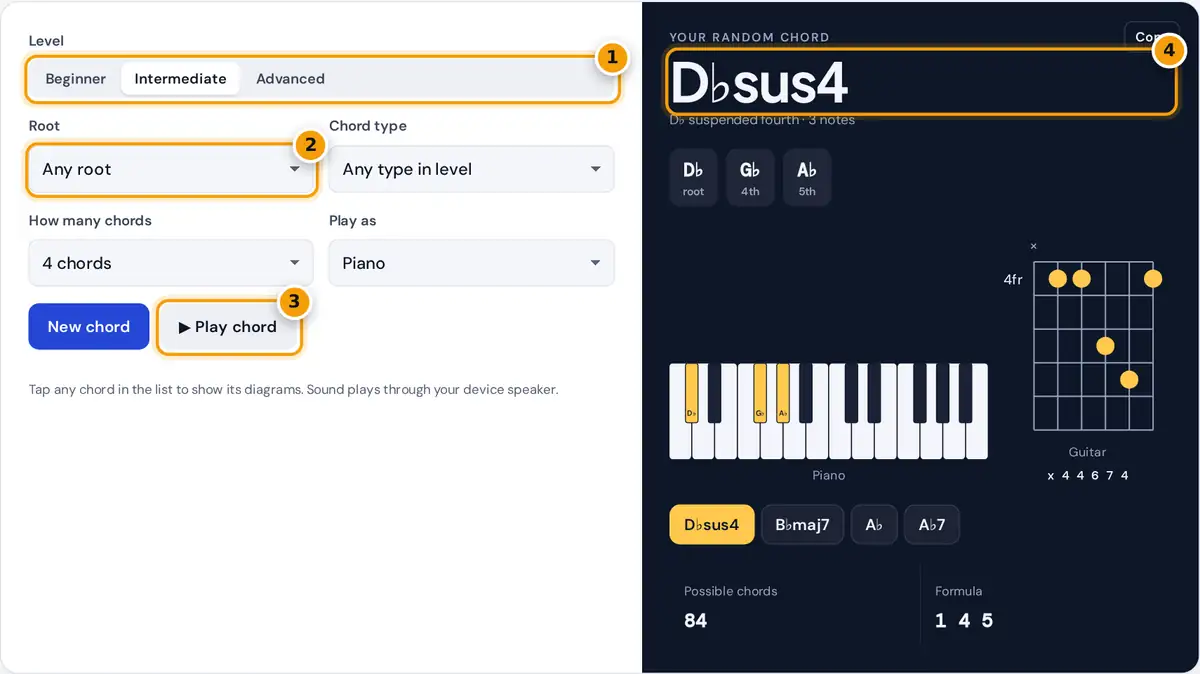
- Choose Beginner, Intermediate or Advanced chord types.
- Pick any root, natural notes only or one specific root.
- Press Play chord to hear it on piano or guitar.
- Read the chord name, its notes and both diagrams.
Choose a level and press New chord. Beginner draws major and minor chords, Intermediate adds sevenths and suspended chords, and Advanced uses all 16 chord types, including diminished, augmented, sixth and ninth chords. Each chord shows its notes with their role (root, 3rd, 5th and so on), its formula, the keys to press on a piano and a guitar chord box with the fret numbers.
Narrow the draw with the Root menu, for example natural notes only, or pick a specific Chord type to drill one shape in every key. Set How many chords to 4 or 8 for a random progression, then tap any chord in the list to see its diagrams. Press Play chord to hear it as a piano chord or a guitar strum.
How Chords Are Built
A chord stacks notes at fixed distances, in semitones, above a root. The formula uses scale degrees of the major scale: 3 is a major third (4 semitones), ♭3 a minor third (3), 5 a perfect fifth (7) and ♭7 a minor seventh (10).
Spelling matters. A third is always written on the letter two steps above the root, so the major third of E is G♯, not A♭. That is why E♭ diminished seventh is spelled E♭, G♭, B♭♭, D♭♭: the double flats keep each note on the correct letter, even though B♭♭ sounds the same as A on a piano.
| Chord type | Symbol | Formula | Example on C |
|---|---|---|---|
| Major | C | 1 3 5 | C E G |
| Minor | Cm | 1 ♭3 5 | C E♭ G |
| Dominant seventh | C7 | 1 3 5 ♭7 | C E G B♭ |
| Major seventh | Cmaj7 | 1 3 5 7 | C E G B |
| Minor seventh | Cm7 | 1 ♭3 5 ♭7 | C E♭ G B♭ |
| Suspended fourth | Csus4 | 1 4 5 | C F G |
| Diminished | Cdim | 1 ♭3 ♭5 | C E♭ G♭ |
| Augmented | Caug | 1 3 ♯5 | C E G♯ |
| Half-diminished | Cm7♭5 | 1 ♭3 ♭5 ♭7 | C E♭ G♭ B♭ |
| Dominant ninth | C9 | 1 3 5 ♭7 9 | C E G B♭ D |
How Many Chords Can It Draw?
The generator uses 12 roots: C, D♭, D, E♭, E, F, F♯, G, A♭, A, B♭ and B. The number of possible chords is the number of roots times the number of chord types.
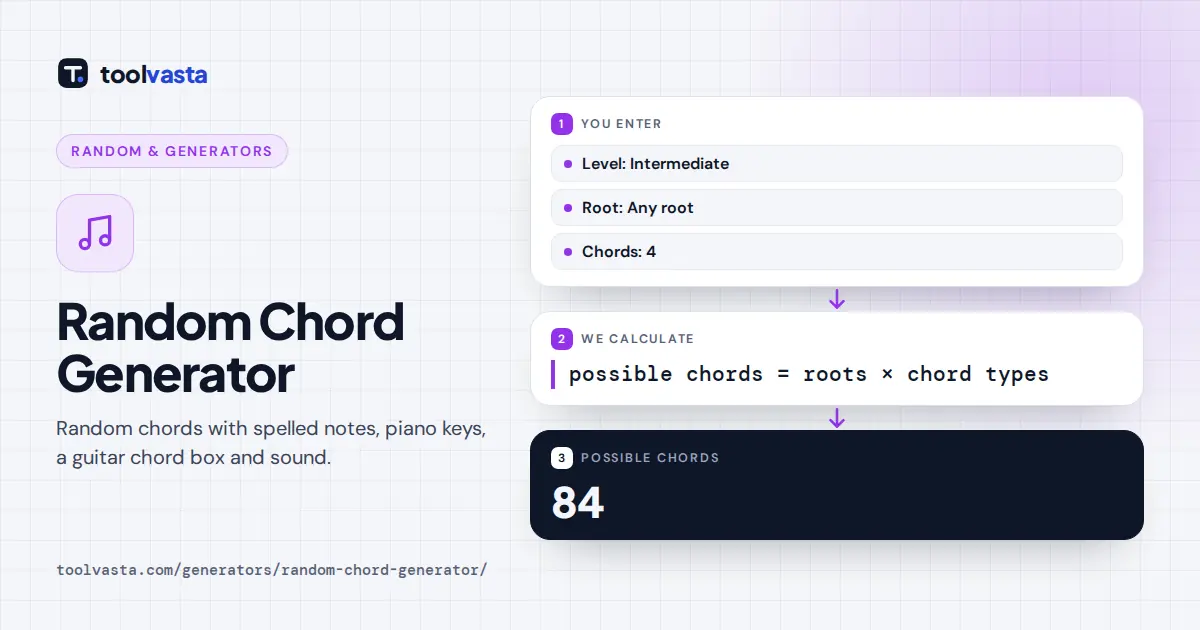
Worked example: Beginner has 12 × 2 = 24 chords, Intermediate 12 × 7 = 84, and Advanced 12 × 16 = 192. With natural roots only on Advanced you get 7 × 16 = 112.
How the Guitar Shapes Are Chosen
For standard tuning (E A D G B E), the tool searches every playable shape within a four-fret span. A shape must start on the root in the bass, use only chord tones, include every required note (the 5th may be left out of four- and five-note chords, as guitarists usually do), and need no more than four fingers, counting a barre as one. Among the shapes that pass, it prefers low positions, open strings and more ringing strings. So C comes out as the familiar x32010 and G as 320003, while chords such as B minor use a barre (x24432). An x means do not play that string and an o means play it open.
Practice Ideas
- Speed changes: draw 4 chords and switch between them in time with a slow metronome.
- Name the notes: hide the screen, say the notes of the chord, then check.
- Ear training: press Play and decide whether the chord is major, minor or diminished before you look.
- Songwriting: use a random 4-chord run as the start of a verse and change one chord to taste.
About the Sound
Play uses your browser's Web Audio feature to synthesize each note, so nothing is downloaded. Piano mode plays the chord in close position starting near middle C, and guitar mode strums the notes of the shape shown in the chord box from the lowest string up.
Frequently asked questions
How does the random chord generator work?
It picks a random root and chord type from your level using a secure random source, spells the notes correctly, and draws the chord on a piano keyboard and a guitar chord box. You can also hear it.
What chords are in each level?
Beginner has major and minor chords. Intermediate adds dominant 7, major 7, minor 7, sus2 and sus4. Advanced adds diminished, augmented, 6, minor 6, 9, add9, half-diminished, diminished 7 and 7sus4.
Why does the chord show a double flat?
Each chord tone is written on its own letter. In E♭ diminished seventh, the ♭♭7 above E♭ is written D♭♭. It sounds the same as C, but the spelling shows its role in the chord.
What do x and o mean on the guitar chord box?
An x above a string means do not play it, and an o means play it open. Dots show where to press, and a number such as 5fr marks the fret where the box starts.
Can I generate a random chord progression?
Yes. Set How many chords to 4 or 8 for a random sequence. Tap each chord to see its diagrams and press Play. For a progression in one key, pick chords that share notes.
Why can't I hear the chord?
Sound uses your browser's Web Audio feature. Check that your device is not muted, then press Play again. On some phones the silent switch also blocks web audio.