How to Use the Vocal Range Test
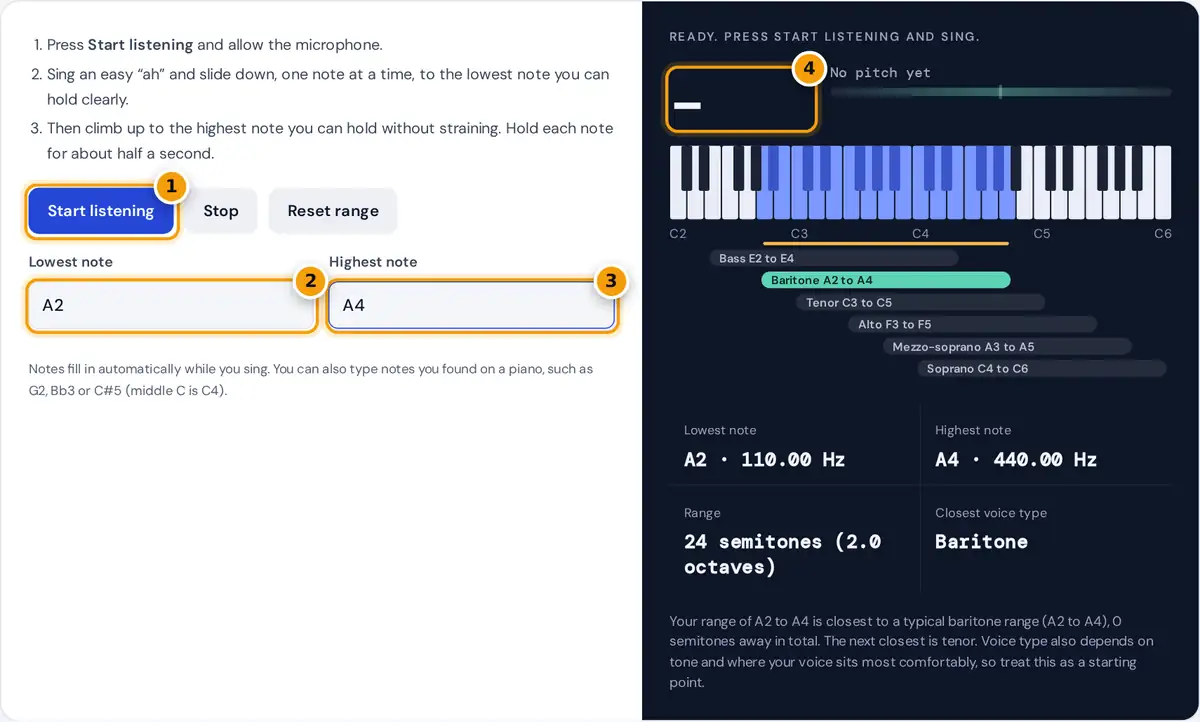
- Press Start listening and allow the microphone, then sing a relaxed ah.
- Slide down to your lowest clear note, or type one you found on a piano, such as A2.
- Climb to your highest comfortable note without straining, or type it, such as A4.
- Watch the live note while you sing, then read your range and closest voice type below.
Find a quiet room and sit 20 to 30 cm from your microphone. Press Start listening and allow microphone access when the browser asks. A relaxed “ah” on a comfortable note is the best start.
Step down one note at a time until your voice cracks, fades or turns into a growl, then climb to the highest note you can hold without straining. Each held note updates the range automatically.
The large display shows the current note, its frequency and how many cents sharp or flat you are. Already know your notes from a piano? Type them into the Lowest note and Highest note boxes.
How Pitch and Range Are Calculated
The test reads windows of 2,048 samples, about 43 milliseconds, and finds the repeating period of the wave with YIN pitch detection, published by de Cheveigné and Kawahara in 2002, to get the fundamental frequency.
frequency = 440 × 2(n − 69) ÷ 12
cents off = (n − nearest whole note) × 100
range in octaves = (highest n − lowest n) ÷ 12
That frequency becomes a note number on the scale where A4 is 440 Hz and middle C, written C4, is note 60. Each step of one is a semitone, and twelve semitones make one octave.
A note counts once you hold it steadily for about a quarter of a second, within half a semitone. Quick slides, breaths and short bursts of noise therefore cannot stretch your lowest or highest result.
Worked Example: Finding a Baritone Range
Suppose your lowest held note is A2, which is 110.00 Hz and note 45, and your highest is F4, which is 349.23 Hz and note 65. The span is 20 semitones, or about 1.7 octaves.
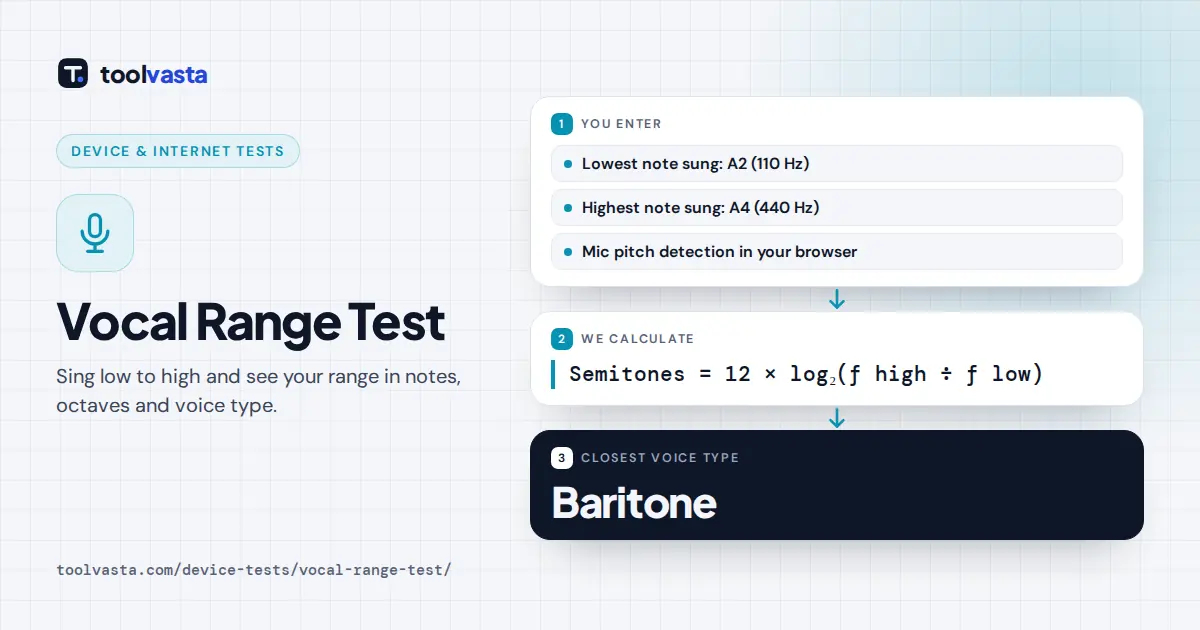
To pick the closest voice type, the tool measures how far each end sits from every typical range and adds both gaps. Baritone, A2 to A4, scores 0 plus 4, a total distance of 4.
Bass, E2 to E4, scores 5 plus 1, making 6, and tenor, C3 to C5, scores 3 plus 7, making 10. Baritone has the smallest total, so it is reported first, with bass listed next.
Voice Types and Typical Ranges
The six categories below are the two-octave ranges commonly used in choral and classical teaching. They overlap quite a lot, which is why the same singer can fit two neighboring types on a range test.
| Voice type | Typical range | Approximate frequencies |
|---|---|---|
| Bass | E2 to E4 | 82 Hz to 330 Hz |
| Baritone | A2 to A4 | 110 Hz to 440 Hz |
| Tenor | C3 to C5 | 131 Hz to 523 Hz |
| Alto (contralto) | F3 to F5 | 175 Hz to 698 Hz |
| Mezzo-soprano | A3 to A5 | 220 Hz to 880 Hz |
| Soprano | C4 to C6 | 262 Hz to 1,047 Hz |
Alto is often called contralto when the voice is especially low and dark. Soprano and mezzo-soprano are the higher female categories, while tenor, baritone and bass cover the usual male voices from top to bottom.
A countertenor is a male singer who works mainly in an alto or mezzo range, usually in falsetto. Because the test reads pitch only, a countertenor will be matched with one of those higher ranges.
Vocal Range vs Voice Type
Your vocal range is the distance between your lowest and highest notes. Your voice type describes where the voice sits comfortably and how it sounds, so singers with identical ranges can belong to different categories.
Teachers listen for tessitura, the zone where you can sing for long periods without fatigue, and timbre, the color and weight of the tone. Both matter more than one spectacular note on a good day.
They also note the passaggio, the area where chest voice hands over to head voice. Where those register changes fall is a useful clue, so treat this label as a starting point for choosing songs.
Tips for an Accurate Result
Warm up for a few minutes with humming or lip trills. A cold voice can lose several notes at both ends, and a gentle siren from low to high helps you find the true edges.
- Sing at a normal volume: a strained squeak or a whisper is not part of your working range.
- Use a plain built-in microphone or a USB microphone and turn off noise filters in headsets or call apps.
- Test again on another day and keep the result you get most often.
If a very low note suddenly shows an octave jump, sing a little louder. Quiet, breathy low notes are the hardest to detect, and headsets sometimes filter low frequencies before the browser even hears them.
Your range changes with the time of day, hydration, illness and how much you have already sung today. Morning voices often lose top notes, so a relaxed afternoon session usually gives the most representative reading.
Limits of an Online Range Test
The tool measures pitch only. A singing teacher also judges tone, weight and comfort before naming a voice type, and can spot habits that cause vocal strain long before a range test would show anything.
Notes below about 60 Hz or above about 1,400 Hz fall outside what the detector hears, and typed notes must sit between C1 and C7. The Web Audio API specification describes the browser features used.
Your sound is analyzed on your device through web audio and is never recorded or uploaded. If singing hurts or hoarseness lasts, read the NIDCD advice on voice care and stop testing for the day.
Frequently asked questions
What is a normal vocal range?
Most untrained adults can sing about one and a half to two octaves, or roughly 18 to 24 semitones. Trained singers commonly reach two octaves or more, although comfort and tone matter as much as span.
How do I know if I am a tenor or a baritone?
Find your lowest and highest comfortable notes. A baritone range sits around A2 to A4 and a tenor range around C3 to C5, though tessitura and tone color also decide the category.
What note is middle C?
Middle C is C4, about 261.63 Hz, and it is note 60 on the standard scale. A4, the usual tuning note, is 440 Hz and sits nine semitones above middle C.
Why does the test not detect my lowest notes?
Very quiet or breathy low notes are hard to measure. Sing a little louder, move closer to the microphone, and turn off headset noise filters that remove low frequencies before the browser hears them.
Is my voice recorded?
No. The sound is analyzed in your browser while you sing and is never saved or sent anywhere. Only the lowest and highest note names stay on the page until you reset or leave.
Can I increase my vocal range?
Yes. Regular training, warm-ups and healthy technique often add a few semitones at each end, while fatigue, illness and age can narrow it. Never push through pain to reach a higher note.