How to Use the Hearing Age Test
- Set your volume low first, play the 1 kHz check tone and lower the tone level if it is not soft.
- Press Start sweep. A soft tone rises from 8 kHz to 20 kHz; headphones give the best result.
- Press I can't hear it now, or Space, the moment the tone disappears. Repeat two or three times.
- Read the highest frequency you heard and the rough, informal hearing age band.
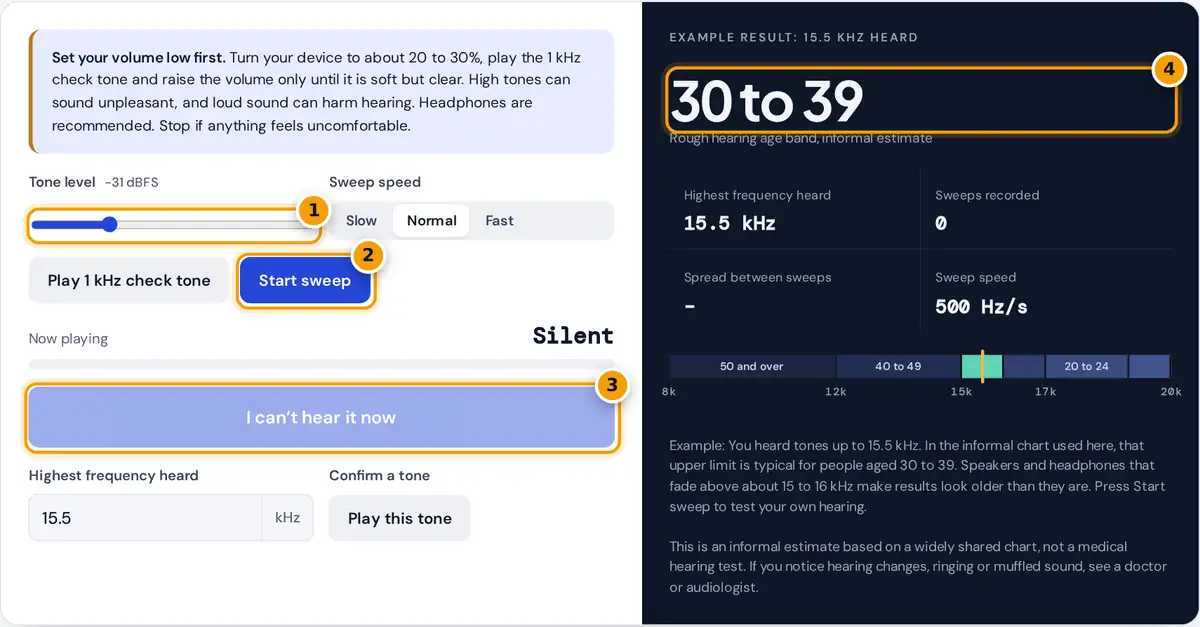
Find a quiet room and put on headphones if you can. Before anything else, turn your device volume down to about 20 to 30%, press Play 1 kHz check tone and adjust until the tone is soft but clear. You can also lower the Tone level slider. Then press Start sweep. A gentle tone rises from 8 kHz to 20 kHz, and the meter shows the frequency playing now. The moment you can no longer hear it, press I can’t hear it now, or tap Space or Enter.
The panel shows the highest frequency you heard and a rough age band. Run two or three sweeps: each one is recorded, the result becomes their average, and the spread tells you how consistent you were. You can also type a frequency and press Play this tone to confirm whether you hear a steady tone just above or below your result. The page opens with an example of 15.5 kHz.
How the Sweep and Age Band Work
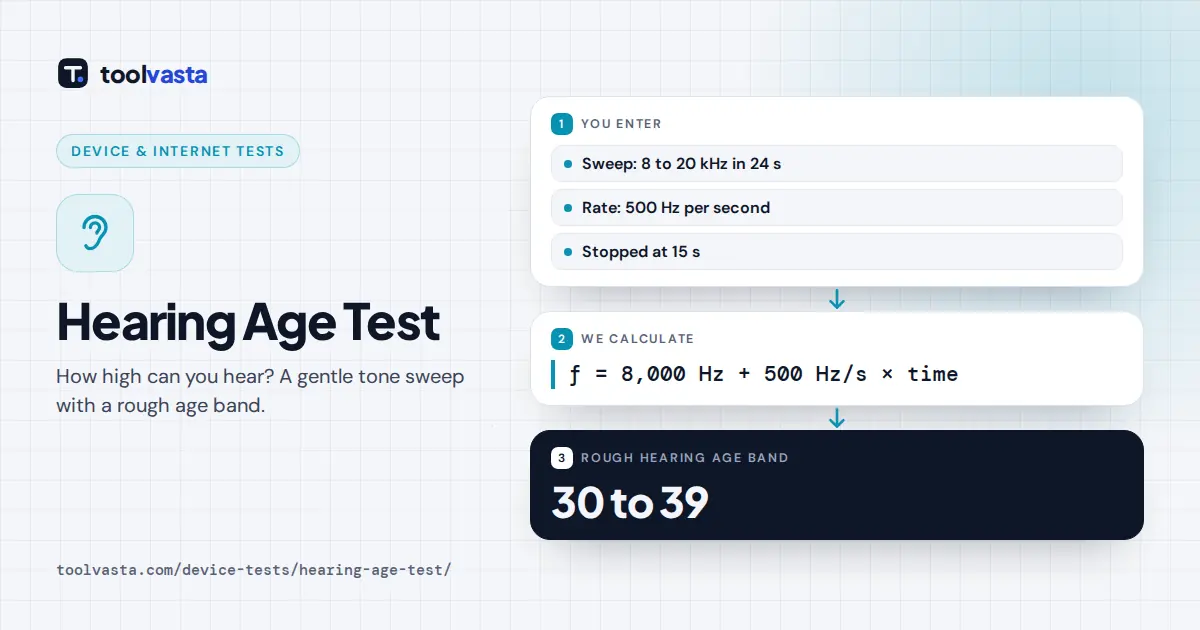
The tone is a pure sine wave made in your browser with the Web Audio API. Its pitch rises in a straight line from 8,000 Hz to 20,000 Hz over 36, 24 or 12 seconds, so at the normal speed it climbs 500 Hz every second. When you press stop, the tool reads the audio clock, subtracts the output delay your device reports and works out the frequency that was reaching your ears.
frequency at time t = 8,000 Hz + sweep rate × t
result = average of your sweeps
The age band comes from a chart that is widely shared online, not from a clinical standard. It is shown as a rough guide only:
| Highest frequency heard | Typical for ages |
|---|---|
| 19 kHz and above | Under 20 |
| 17 to 19 kHz | 20 to 24 |
| 16 to 17 kHz | 25 to 29 |
| 15 to 16 kHz | 30 to 39 |
| 12 to 15 kHz | 40 to 49 |
| Below 12 kHz | 50 and over |
Worked Example
At the normal speed the sweep lasts 24 seconds, so it rises (20,000 − 8,000) ÷ 24 = 500 Hz per second. If you press stop 15 seconds after the tone starts, the frequency is 8,000 + 500 × 15 = 15,500 Hz, or 15.5 kHz. In the chart, 15.5 kHz falls between 15 and 16 kHz, the band typical for ages 30 to 39. Your reaction time also matters: a quarter of a second at 500 Hz per second is about 125 Hz, which is why the slow speed gives a slightly more precise result.
Why High Frequencies Fade With Age
Young ears can often hear up to about 20 kHz. Over the years the hair cells at the base of the inner ear, which respond to the highest pitches, are gradually lost, so the upper limit drifts down. This age related hearing loss is called presbycusis, and the NIDCD at the National Institutes of Health describes how common it is in older adults. Loud noise speeds up the same process at any age, which is why the World Health Organization promotes safe listening.
A standard clinical hearing test checks frequencies from about 250 Hz to 8 kHz, the range that matters most for speech. That is why this test starts at 8 kHz: it looks at the extra high range that changes first, not at how well you hear conversation.
Limits of an Online Hearing Test
- Your equipment. Many laptop and phone speakers, and some headphones and wireless links, fade above about 15 to 16 kHz. If your result sits near that point, try wired headphones.
- Volume. The test is not calibrated. A louder setting lets you hear higher, but you should never turn it up to chase a better result.
- Background noise and attention. A noisy room or a late press lowers your result. Repeat the sweep two or three times.
- Not a diagnosis. If you notice muffled hearing, ringing, or trouble following conversation, book a proper hearing assessment.
Frequently asked questions
What frequency should I be able to hear at my age?
As a rough guide from a widely shared chart, people under 20 often hear 19 kHz or more, people in their thirties around 15 to 16 kHz and people over 50 often below 12 kHz. Individual results vary a lot.
Is this hearing age test accurate?
It gives an informal estimate only. Your speakers or headphones, the volume, background noise and your reaction time all affect the result. It cannot replace a hearing assessment by an audiologist or doctor.
Why can't I hear the tone even at the start?
Check that sound is on, your volume is not muted and the right output device is selected. If the 1 kHz check tone is audible but 8 kHz is not, try headphones, and consider a proper hearing check.
Is the high frequency tone safe to play?
At a low volume, yes. Set the volume with the 1 kHz check tone so it is soft, never turn it up to chase higher tones, and stop if the sound feels unpleasant or painful.
Why do headphones give a different result from speakers?
Many small speakers and some wireless headphones cannot reproduce very high frequencies, so the tone fades because of the device rather than your ears. Wired headphones usually give the most reliable result.
Can you improve your high frequency hearing?
Lost hair cells in the inner ear do not grow back, but you can protect what you have. Keep listening volumes moderate, use hearing protection around loud noise and take breaks from headphones.