How to Use the Mnemonic Generator
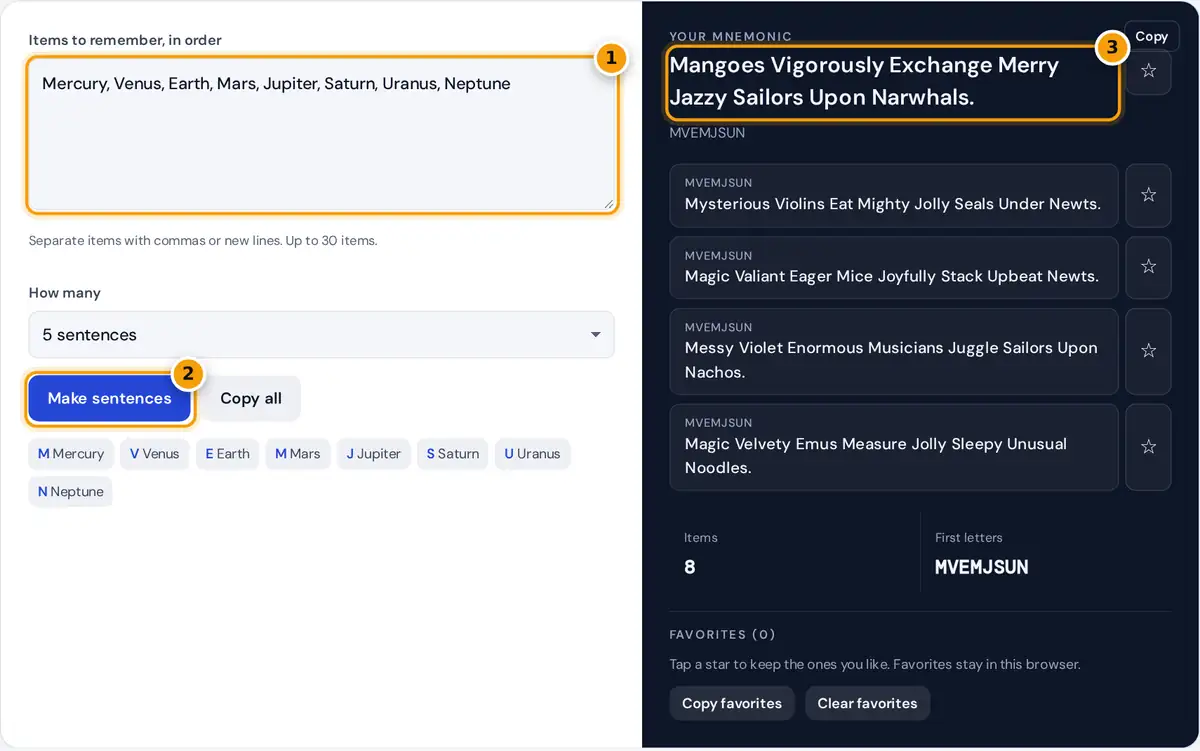
- Paste the items you need to remember, in order.
- Press Make sentences for a fresh batch.
- Pick the sentence that sticks. Copy it or star it to keep it.
Type or paste the items you need to remember, in the right order, separated by commas or new lines. Press Make sentences and the generator builds acrostic sentences: the first word starts with the first letter of your first item, the second word with the second item's letter, and so on. The key under the list shows which letter stands for which item.
Read the sentences aloud and pick the one that makes you smile, because funny and vivid sentences are the easiest to recall. Click a sentence to copy it, tap the star to save it to favorites, or press Make sentences again for a fresh batch. Favorites stay in this browser so you can compare them later.
How the Sentences Are Built
Each sentence follows a simple grammar so it reads like a real, if silly, sentence rather than a random list of words:
For each letter, the generator picks a word of the right type from a bank of 494 words, using adjectives such as Merry and Velvety, plural nouns such as Monkeys and Volcanoes, verbs such as Munch and Visit, and prepositions such as Under and With. If a letter has no word of the needed type, it tries another sentence shape. Words are not repeated within a sentence.
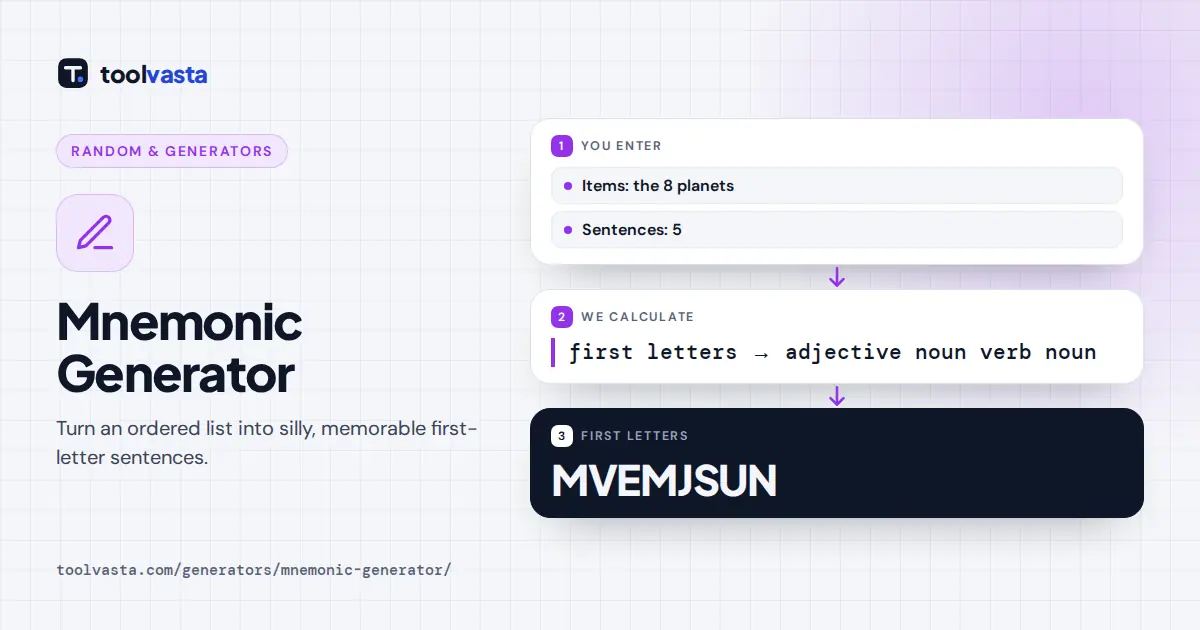
Worked example: the eight planets, Mercury, Venus, Earth, Mars, Jupiter, Saturn, Uranus and Neptune, give the letters MVEMJSUN. One possible result is "Merry Velvety Elephants Munch Juicy Sandwiches Under Noodles." Each word's first letter matches a planet, in order.
Classic Mnemonics to Compare
| To remember | Letters | Well-known mnemonic |
|---|---|---|
| Planets from the Sun | MVEMJSUN | My Very Educated Mother Just Served Us Nachos |
| Colors of the rainbow | ROYGBIV | Richard Of York Gave Battle In Vain |
| Order of operations | PEMDAS | Please Excuse My Dear Aunt Sally |
| Treble clef lines | EGBDF | Every Good Boy Does Fine |
| Taxonomy ranks | DKPCOFGS | Dear King Philip Came Over For Good Soup |
Why Acrostic Mnemonics Work
An acrostic gives your memory a cue for each item and keeps the order fixed. Remembering one sentence is easier than remembering eight unrelated words, and the first letter of each word prompts the item it stands for. Mnemonics work best for ordered lists you already understand, such as the planets, the cranial nerves, steps in a process or the notes on a staff.
Tips for a Mnemonic That Sticks
- Make it vivid. Picture the scene: merry elephants munching sandwiches is hard to forget.
- Say it out loud a few times, then write it from memory along with the items.
- Personalize it. Swap a word for the name of a friend, a pet or a favorite food that starts with the same letter.
- Watch repeated letters. If two items share a letter, such as Mercury and Mars, learn which M comes first by linking the word to the item.
- Keep lists short. For more than about 12 items, split the list into two sentences.
Using Mnemonics for Study
Mnemonics shine for exams that test lists in order: the planets, the order of operations in math, the cranial nerves in anatomy, the stages of mitosis in biology or the notes of a musical staff. Pair the sentence with real understanding of each item, because the mnemonic only gives you the cue, not the meaning.
Practice retrieval rather than rereading. Cover the list, say the sentence, and write each item from its first letter. Repeat after a day, then after a few days. This spaced practice moves the list into long-term memory, and after a while you may find you no longer need the sentence at all.
Frequently asked questions
What is a mnemonic sentence?
A mnemonic sentence, or acrostic, is a sentence whose words start with the same letters as the items you want to remember, in the same order, such as My Very Educated Mother Just Served Us Nachos for the planets.
How do I make my own mnemonic?
Paste your list, in order, into the generator and press Make sentences. Pick the funniest or most vivid sentence, then personalize a word or two so it means something to you.
Does the generator keep my list in order?
Yes. The words always follow the order of your items, because the order is usually what you need to remember. Reorder the list in the box if you want a different sequence.
What happens with items that start with the same letter?
Each item gets its own word, so two M items get two different M words. Use the letter key to link each word to its item, for example Merry for Mercury and Munch for Mars.
Can I use it for long lists?
Yes, up to 30 items. Sentences longer than about 12 words are harder to remember, so consider splitting a long list into two or three shorter mnemonics.
What is the difference between an acronym and an acrostic?
An acronym joins first letters into one word or code, such as ROYGBIV. An acrostic turns those letters into a sentence, which many people find easier to recall.