How to Use the Story Idea Generator
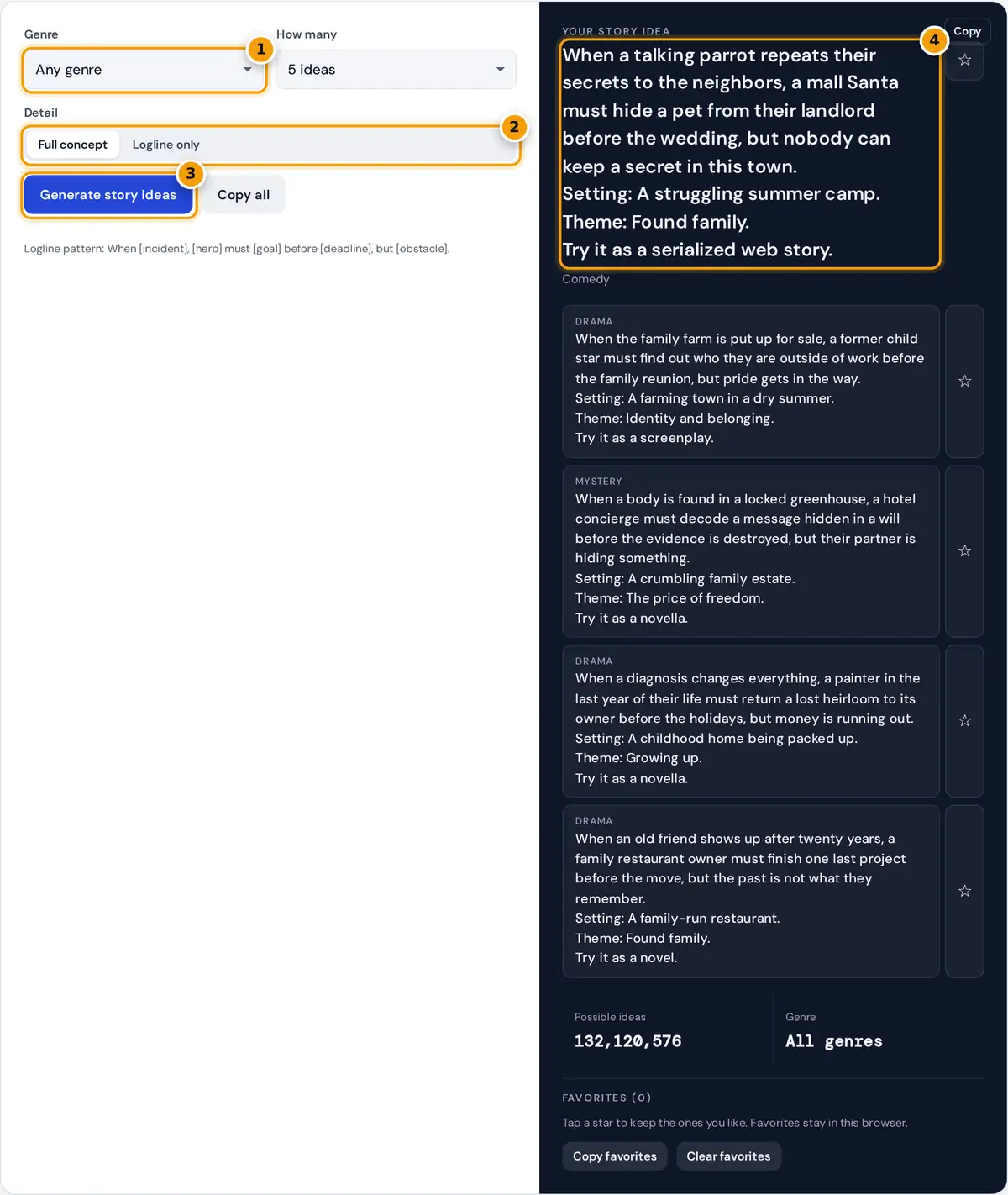
- Choose a genre, or keep Any genre for a mix of eight.
- Pick Full concept for setting, theme and format, or Logline only.
- Press Generate story ideas for a fresh batch.
- Read your top idea. Click to copy it or tap the star to save it.
Choose a genre, or keep Any genre for a mix, and press Generate story ideas. Each idea is a complete premise in one sentence, called a logline, followed by a setting, a theme and a suggested format. Switch Detail to Logline only if you just want the core premise.
Click an idea to copy it, use Copy all for the whole batch, or tap the star to save it to favorites. Favorites stay in this browser, so you can build a shortlist over several sessions and compare ideas side by side before you commit to one.
The Logline Formula
Screenwriters and novelists use loglines to test whether a story has an engine before they write it. A strong logline answers five questions: who is the hero, what starts the story, what do they want, what happens if they fail in time, and what stands in the way. Every idea here follows that structure:
Worked example: "When a guest vanishes from a snowbound inn, a hotel concierge must find the real culprit before the storm clears and the suspects leave, but every suspect has an alibi." In one sentence you know the hero, the mystery, the ticking clock and the central problem.
| Part | What it does | Example |
|---|---|---|
| Inciting incident | Breaks the hero's normal life | A guest vanishes from a snowbound inn |
| Protagonist | A specific person with a hook | A hotel concierge |
| Goal | A concrete thing to achieve | Find the real culprit |
| Deadline | Adds urgency | The storm clears and the suspects leave |
| Obstacle | Makes the goal hard | Every suspect has an alibi |
How Many Ideas Are There?
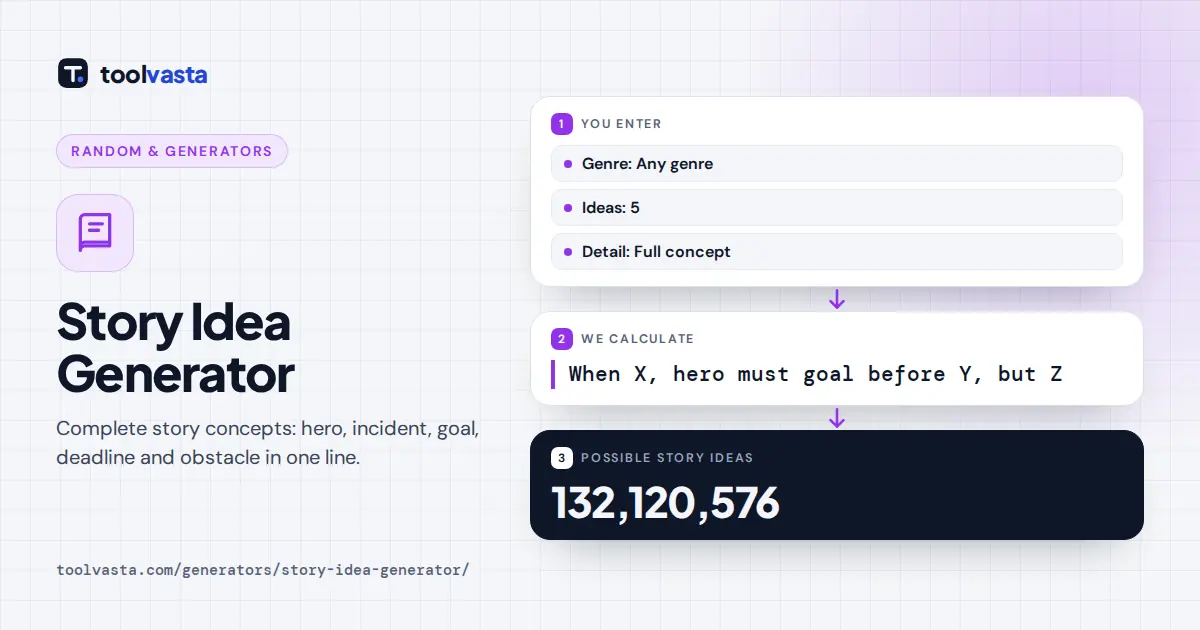
Each genre has 8 protagonists, 8 incidents, 8 goals, 8 deadlines and 8 obstacles, written to fit together. That gives 85 = 32,768 loglines per genre, or 262,144 across all eight genres. Adding one of 6 settings, 14 themes and 6 formats raises the total to 132,120,576 full concepts. Parts are picked with your browser's secure random source, and a batch never repeats an idea.
How to Develop a Story Idea
- Ask why. Why is this hero the one who must act? The answer usually becomes the character's backstory.
- Raise the stakes. Decide what the hero loses if the deadline passes, both in the world and personally.
- Connect the theme. Let the theme shape the ending. A story about forgiveness should end with someone forgiving, or failing to.
- Swap freely. Keep the parts that excite you and replace the rest. A mystery logline can become a comedy with a new obstacle.
- Outline three turning points: the incident, a midpoint surprise and a final choice. That is enough to start drafting.
Picking a Format
The suggested format is a nudge, not a rule. A short story suits a single, sharp twist and a few scenes. A novella has room for one main plot and a subplot. A novel can follow several characters. A screenplay depends on visual action and dialogue, and a graphic novel or web serial rewards strong images and cliffhangers. For a different style of prompt, with a twist and a word count, try the random prompt generator on this site.
What Each Genre Brings
The parts in each genre are written to fit that genre's promise to the reader. Fantasy ideas lean on curses, prophecies and invented places. Science fiction ideas follow one technology or discovery to its consequences. Mystery ideas always hide a culprit and give the hero a reason to investigate, while romance ideas put two people in each other's way and give them a reason to stay apart.
Horror ideas build dread around a place or a presence, adventure ideas send the hero somewhere dangerous with a clear prize, comedy ideas start from an embarrassing mistake that keeps snowballing, and drama ideas focus on family, work and the choices that change a life. Mixing genres is a classic way to find something fresh: try keeping a mystery hero and swapping in a horror obstacle.
Frequently asked questions
What is a story idea generator?
It combines story building blocks into a premise you can write. This one creates loglines with a protagonist, an inciting incident, a goal, a deadline and an obstacle, plus a setting, a theme and a format.
What is a logline?
A logline is a one-sentence summary of a story's premise. It names the hero, what starts the story, what they want, the time pressure and what stands in their way.
Which genres can I choose?
Fantasy, science fiction, mystery, romance, horror, adventure, comedy and drama. Choose Any genre to mix them, and each idea is labeled with the genre it came from.
Can I use these story ideas for a book or film?
Yes. The ideas are free to use for novels, short stories, screenplays, comics, school assignments and role-playing games. Change any part so the story becomes your own.
How many story ideas can it create?
There are 32,768 loglines in each genre and 262,144 across all eight genres. Once settings, themes and formats are added, the generator can produce 132,120,576 different full story concepts.
How is this different from a writing prompt?
A prompt gives a starting situation. A logline gives a whole story engine: the goal, the deadline and the obstacle, which tell you where the story is going and how it might end.