How to Use the Viking Name Generator
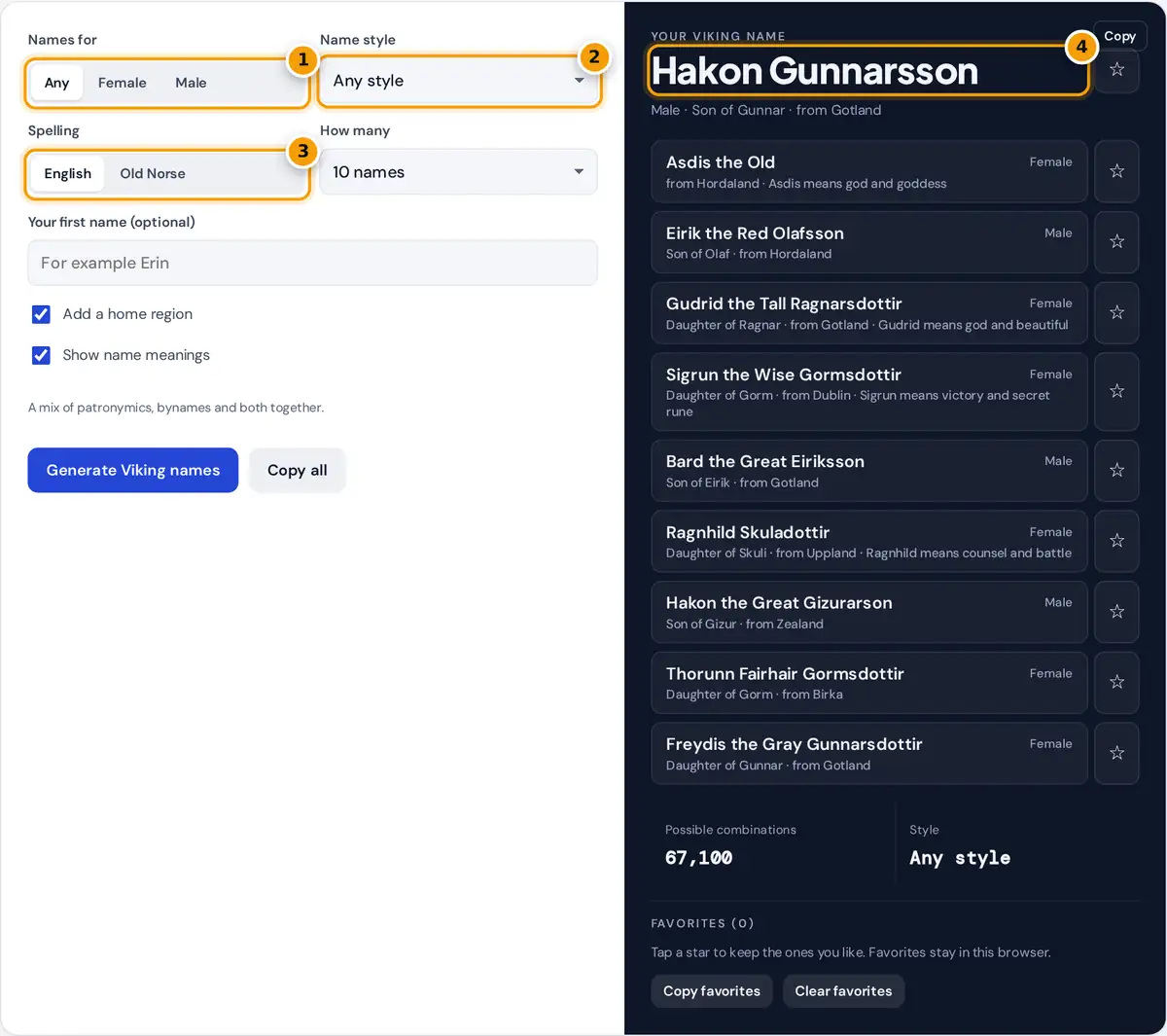
- Choose female, male or any Viking names.
- Pick a patronymic, a byname, or both together.
- Switch between English and Old Norse spelling with ð, þ and ǫ.
- Read your Viking name with father, home region and meaning. Copy or save it.
Choose Female, Male or Any, then pick a name style. Patronymic names add the father's name with -son or -dottir. Byname names add a nickname such as the Red or the Far-Traveled. The third style uses both, the way people are often introduced in the Icelandic sagas. Press Generate for a new list.
Switch the spelling between English (Bjorn Haraldsson) and Old Norse (Bjǫrn Haraldsson), which keeps the original letters such as ð, þ and ǫ. Type your own first name to give yourself a Norse surname, add a home region from the Viking world, or show what a name means. Click any name to copy it, or tap the star to save it.
How Norse Patronymics Work
Most Norse people had no family surname. Instead, they were known as the son or daughter of their father. The father's name is put in the genitive case, which usually adds -s, and then -son or -dóttir is attached. The grammar matters: some names take a different genitive ending, and the generator uses the correct form for each of its 40 fathers.
| Father | Genitive | Son | Daughter |
|---|---|---|---|
| Haraldr (Harald) | Haralds | Haraldsson | Haraldsdóttir |
| Sigurðr (Sigurd) | Sigurðar | Sigurðarson | Sigurðardóttir |
| Bjǫrn (Bjorn) | Bjarnar | Bjarnarson | Bjarnardóttir |
| Hákon (Hakon) | Hákonar | Hákonarson | Hákonardóttir |
| Snorri | Snorra | Snorrason | Snorradóttir |
That is why a simple rule like "add -sson" gets many names wrong. Bjǫrn's son is Bjarnarson, not Bjornsson, and Snorri's daughter is Snorradóttir. Iceland still uses this system today, so a brother and sister have different last names, and neither matches their father's.
Bynames and Nicknames
With few first names in use, people needed a way to tell two Thorsteins apart. Bynames did the job. Many described looks or character (the Red, the Stout, the Deep-Minded), and others recorded deeds or luck (the Far-Traveled, the Lucky). In Old Norse the byname takes the article inn for men and in for women, and the adjective changes its ending to match, so a wise man is inn spaki and a wise woman is in spaka. The generator uses 20 bynames in both forms.
How Many Names Are Possible
The generator uses 40 male and 39 female Old Norse names drawn from sagas, runestones and later Norse records. Male names cannot take their own name as a patronymic, so a man has 39 possible fathers and a woman has 40.
female byname names = 39 × 20 = 780
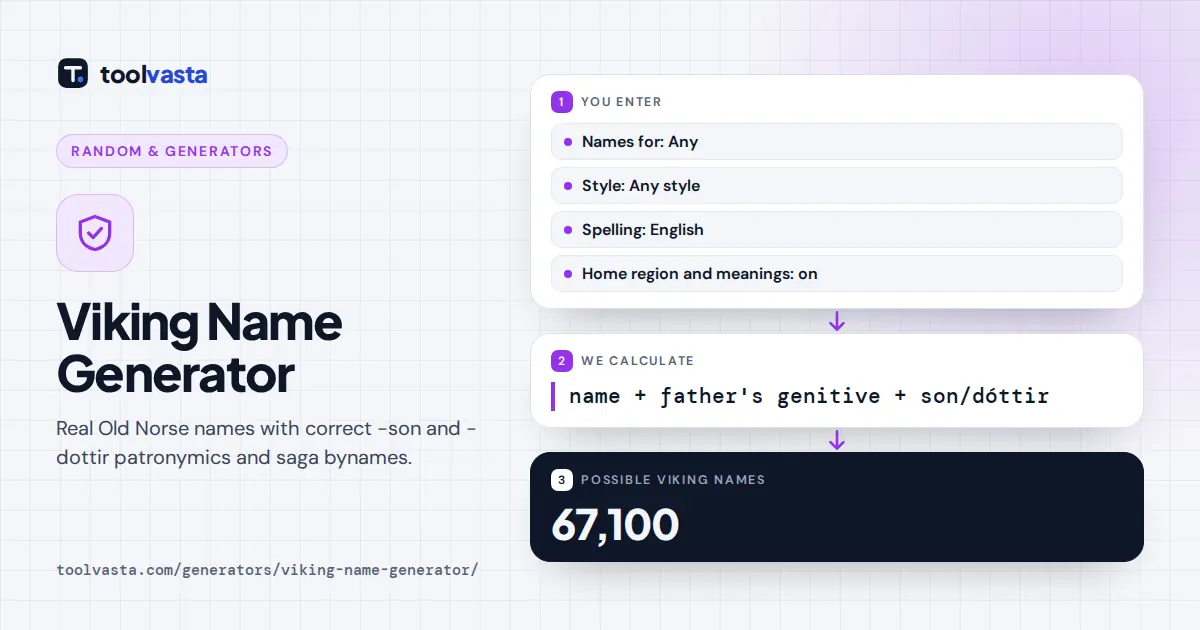
Across both genders and all three styles there are 67,100 possible Viking names in each spelling. Every name is chosen with your browser's secure random source.
What Viking Names Mean
Many Norse names join two words. Names with Þór- or Thor- honor the god Thor, as in Thorstein (Thor's stone). Ás- means a god, as in Asgeir (god and spear), and Sig- means victory, as in Sigrid. Animal names were popular and often stand alone: Bjorn is bear, Ulf is wolf, Hrafn is raven and Orm is serpent. The meanings shown by the generator are limited to names whose origin is well established. Others are left blank rather than guessed.
Tips for Choosing a Viking Name
- Pick the right spelling. English spellings are easier to read in stories and games. Old Norse spellings suit historical fiction and reenactment.
- Use a home region. A character from Orkney or Dublin hints at a life among both Norse and Gaelic neighbors.
- Earn the byname. In the sagas, a byname often tells a story. Let your character's nickname come from something they did.
- Keep the family logic. If a father is Ketil, all his children carry Ketilsson or Ketilsdóttir, and his grandchildren will not.
Frequently asked questions
How do Viking last names work?
Most Vikings used a patronymic instead of a family surname. The father's name goes into the genitive and takes -son or -dóttir, so the son of Harald is Haraldsson and his daughter is Haraldsdóttir.
Why is the son of Bjorn called Bjarnarson?
Old Norse names change form in the genitive. Bjǫrn becomes Bjarnar, so his son is Bjarnarson and his daughter Bjarnardóttir. The generator stores the correct genitive for every father instead of simply adding -s.
What are good female Viking names?
Popular Old Norse names for women include Astrid, Sigrid, Gudrun, Ingrid, Helga, Thora and Freydis. Pair one with a patronymic or a byname, for example Astrid Sigurdardottir or Aud the Deep-Minded.
What is a Viking byname?
A byname is a nickname that set someone apart, such as the Red, Fairhair or the Far-Traveled. In Old Norse it takes the article inn for men and in for women, as in Leifr inn heppni.
Are these real Viking names?
Yes. The first names are genuine Old Norse names found in sagas, runestones and later Norse records. The combinations are random, so a generated person is fictional even though each part is historically accurate.
Can I get my own Viking name?
Yes. Type your first name and the generator adds a Norse patronymic, a byname or both, such as Erin Thorsteinsdottir or Erin the Far-Traveled. Without your name there are 67,100 possible combinations.