How to Use the Random Prompt Generator
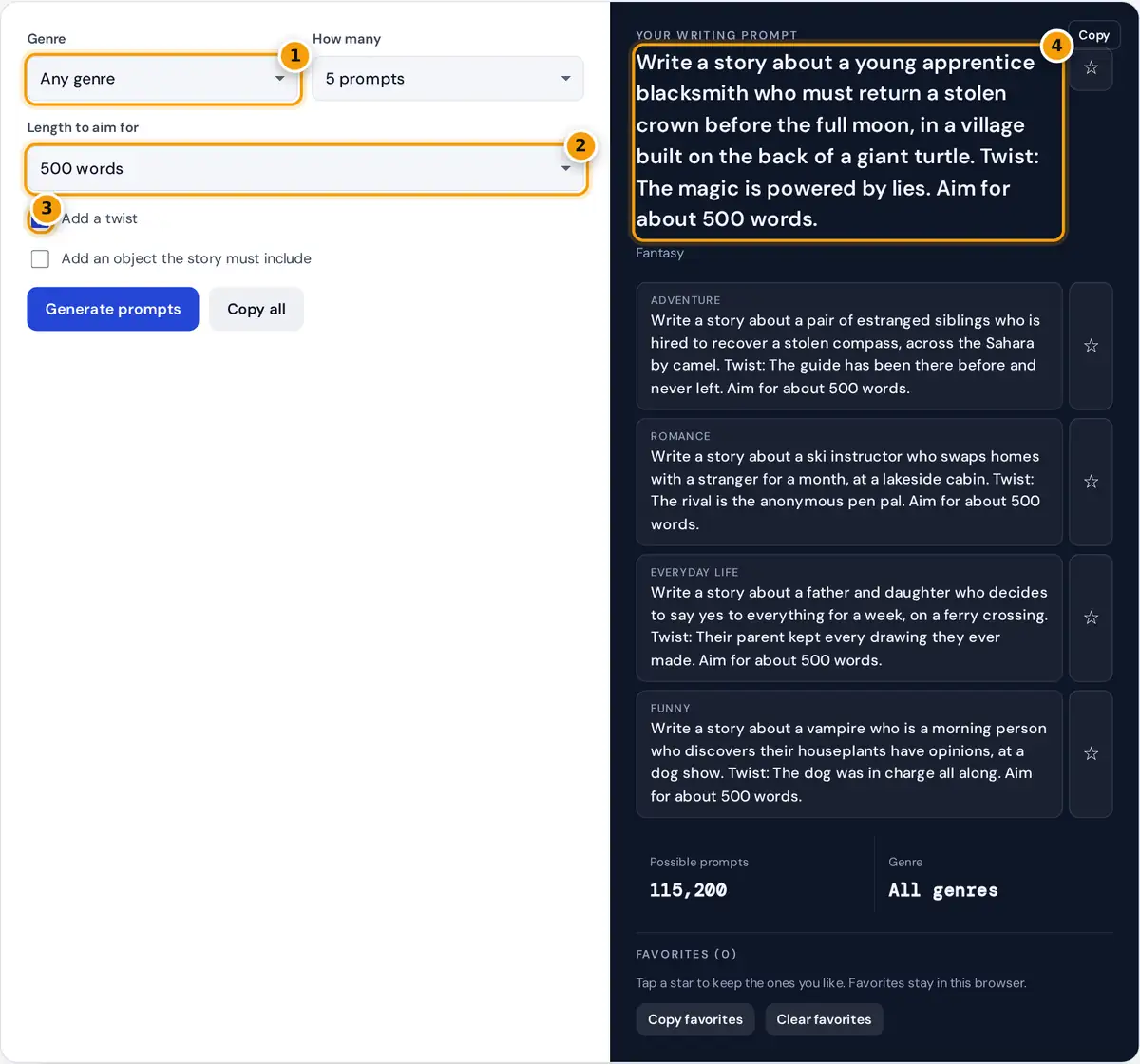
- Choose a genre such as mystery, fantasy or romance.
- Pick a word count to aim for.
- Keep the twist on for a plot turn to build toward.
- Read your prompt, then copy it or star it for later.
Choose a genre, or keep Any genre for a surprise, and press Generate. Each prompt names a character, a situation and a setting, for example: "Write a story about a lighthouse keeper who receives a puzzle box from an anonymous sender, in a snowbound hotel." Leave Add a twist ticked for a turn in the plot to steer toward, and tick the object box if you want one specific item that must appear in the story.
Pick a length to aim for, from a 100 word drabble to a 2,500 word short story. Click a prompt to copy it, use Copy all for the full list, or tap the star to save it. Favorites stay in this browser, so you can build a bank of ideas for later writing sessions.
The Anatomy of a Good Prompt
Every prompt combines four parts, each written for its genre. The character gives you a point of view with a built-in quirk. The situation is the inciting incident that breaks their normal life. The setting adds atmosphere and limits, and the twist gives you a destination, so you know what your ending is building toward.
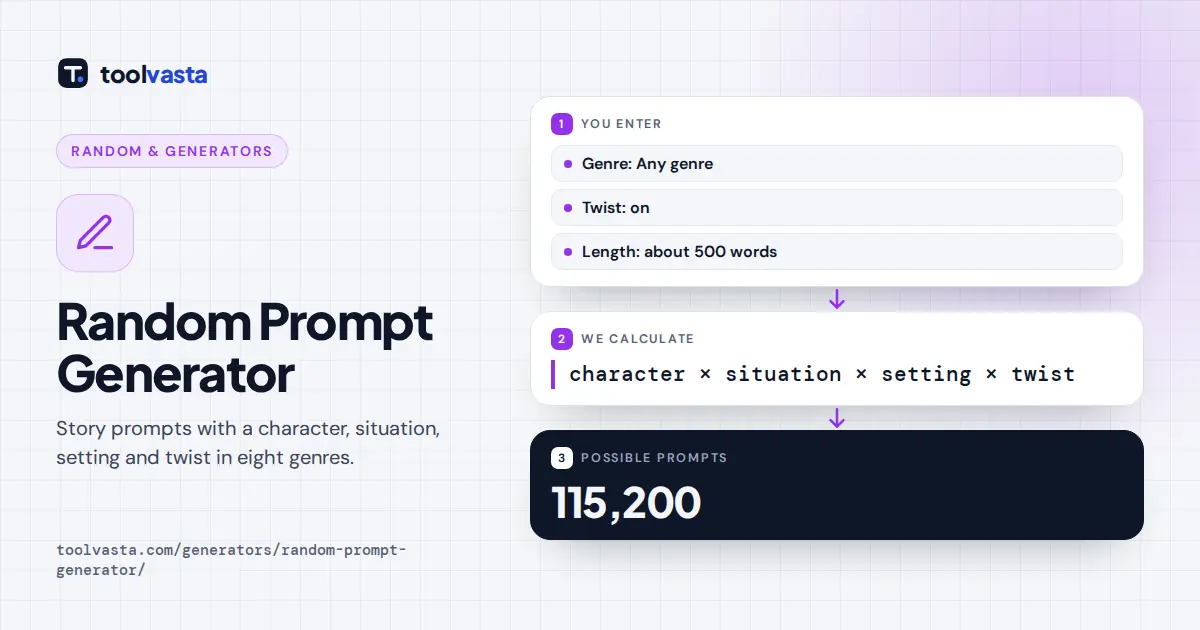
Across all eight genres there are 115,200 prompts with twists. Adding a must-include object multiplies that by 20, for 2,304,000 combinations. Each part is picked with your browser's secure random source, and a list never repeats a prompt.
| Genre | Example character | Example twist |
|---|---|---|
| Fantasy | A young apprentice blacksmith | The villain turns out to be their future self |
| Science fiction | A ship's engineer on her last shift | The aliens are humans from the far future |
| Mystery | A retired detective who runs a bakery | The victim staged the whole thing |
| Romance | A wedding planner who hates weddings | They met years ago and both forgot |
| Horror | A night shift nurse | The monster is trying to warn them |
| Adventure | A treasure hunter with a fear of heights | The treasure is a person |
| Everyday life | A grandmother learning to swim | The letter was written by someone they never met |
| Funny | A cat who believes it runs the household | The nemesis is just as lost as they are |
How to Write from a Prompt
- Set a timer. Give yourself 15 or 20 minutes and write without stopping. A prompt works best when you do not overthink it.
- Change anything. A prompt is a starting point, not a rule. If the setting does not work, swap it and keep the character.
- Start late. Open the story at the moment the situation happens, not with the character waking up.
- Hide the twist. Plant two or three small clues early so the twist feels surprising and fair.
- Write to the length. A 100 word drabble needs one image and one turn. A 2,500 word story has room for a subplot.
Who Uses Writing Prompts
Novelists use prompts to warm up before a writing session or to break through writer's block. Teachers use them for creative writing lessons and journal time, and writing groups use them for timed challenges where everyone writes from the same prompt and compares results. Game masters use them as plot hooks for tabletop campaigns, and screenwriters use them to practice structure. Students preparing for exams with a creative writing section can practice by generating one prompt and writing to a strict time limit.
Making the Most of Each Genre
Mystery prompts reward planning: decide who did it before you write the first line. Horror prompts work best when you hold back and let the reader imagine the worst. Romance prompts need two characters with a reason to stay apart, and science fiction prompts get stronger when you follow one idea to its consequences. Funny prompts thrive on a straight-faced narrator, and everyday life prompts are about small moments that change a person. If you want a challenge, generate a prompt in a genre you never write and see what you discover.
Frequently asked questions
How do I use a random writing prompt?
Read the prompt, set a timer for 15 to 20 minutes and start writing without editing. Use the character, situation and setting as given, or change any part that does not spark an idea.
What genres does the prompt generator cover?
It covers eight genres: fantasy, science fiction, mystery, romance, horror, adventure, everyday life and funny. Choose Any genre to mix them, and each prompt shows the genre it came from.
What is the twist option?
The twist adds a surprising turn to the prompt, such as the mentor being a ghost or the detective being a suspect. It gives you an ending to build toward. Untick it for an open-ended prompt.
What is a drabble?
A drabble is a complete story of exactly 100 words. Choose the 100 word target for a quick daily exercise that teaches you to cut every word that does not earn its place.
Can teachers use these prompts in class?
Yes. The prompts avoid graphic content, so they work for creative writing lessons, journals and timed challenges. Generate a list, copy it, and give each student or group a different prompt.
How many prompts can the generator create?
There are 115,200 prompts with twists across eight genres, or 14,400 per genre. Adding a must-include object raises the total to 2,304,000 different combinations to write from.