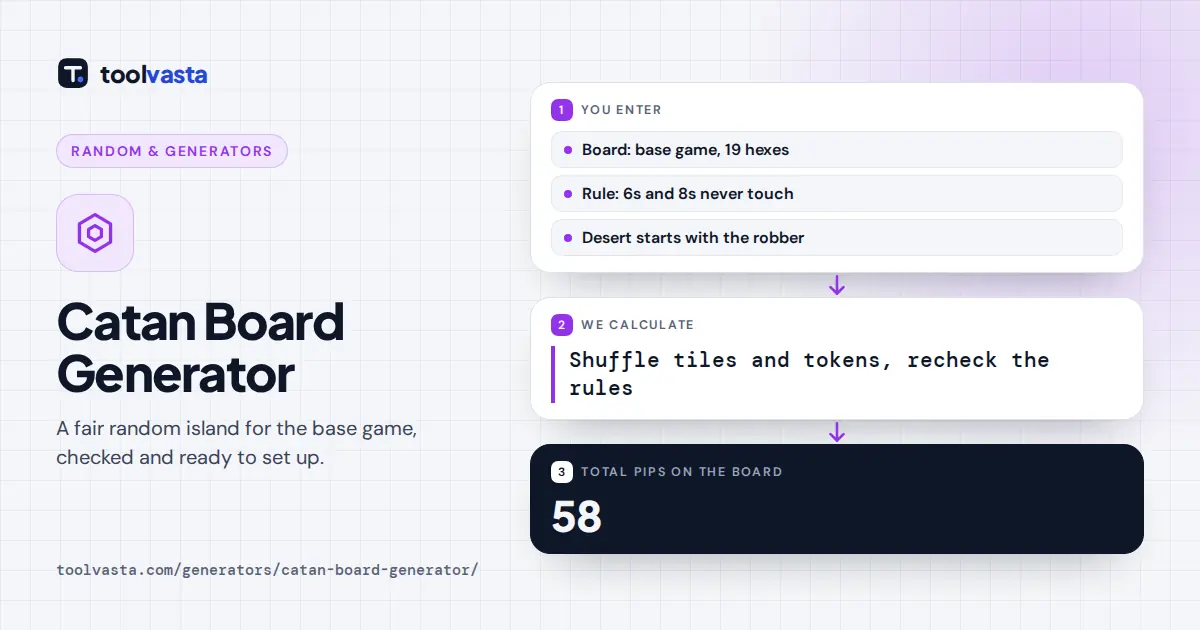
How to Use the Catan Board Generator
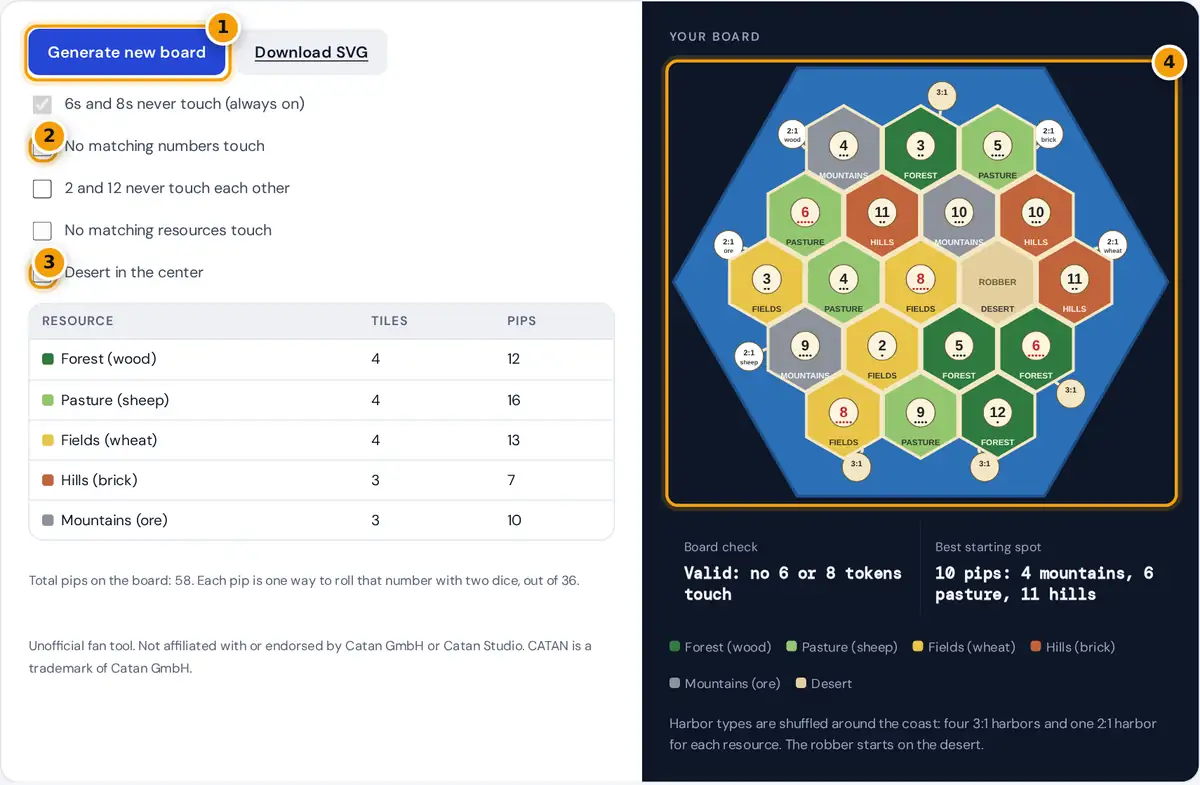
- Press Generate new board for a fresh random layout.
- Tick extra fairness rules, such as no matching numbers or resources touching.
- Tick desert in the center if your group prefers that setup.
- Lay out your tiles to match the board, check the pip table and download the SVG.
Press Generate new board for a random layout of the standard 19-tile base game island. The generator shuffles the terrain tiles, places the 18 number tokens and the desert, and then shuffles the harbor types.
It always checks that no red number, 6 or 8, sits next to another red number. Set out your physical tiles to match the picture, or download the SVG file to print or share online.
Tick the optional rules for a fairer board: no matching numbers side by side, no 2 next to 12, no matching resources side by side, or the desert fixed in the center of the island.
- The checks on the left confirm every rule on the current board.
- The pip table shows how much production each resource gets.
- The best starting spot is highlighted with its pip total.
What Is on a Standard Base-Game Board
A standard Catan board has 19 terrain hexes surrounded by a frame of sea pieces. Each terrain type produces one resource, except the desert, which produces nothing and is where the robber starts the game.
| Terrain | Produces | Tiles |
|---|---|---|
| Forest | Wood (lumber) | 4 |
| Pasture | Sheep (wool) | 4 |
| Fields | Wheat (grain) | 4 |
| Hills | Brick | 3 |
| Mountains | Ore | 3 |
| Desert | Nothing (robber starts here) | 1 |
The 18 number tokens are one each of 2 and 12, and two each of 3, 4, 5, 6, 8, 9, 10 and 11. There is no 7, since a 7 moves the robber instead.
Nine harbors surround the island: four general 3:1 harbors and one 2:1 harbor for each of the five resources. The generator randomly shuffles which harbor type sits at each of the nine coastal harbor spots.
Dice Odds and Pips
Each token shows dots, called pips, equal to the number of ways two dice can roll that number out of 36 combinations. More pips means the number is rolled more often during a typical game.
chance of rolling n on one turn = pips ÷ 36
| Number | 2 or 12 | 3 or 11 | 4 or 10 | 5 or 9 | 6 or 8 |
|---|---|---|---|---|---|
| Pips | 1 | 2 | 3 | 4 | 5 |
| Chance per roll | 2.8% | 5.6% | 8.3% | 11.1% | 13.9% |
The 6 and 8 each have five pips, a 13.9% chance per roll, while the 2 and 12 have only one pip each, just 2.8%. These dice odds come straight from the basic probability theory.
The whole board always has 58 pips, whatever the layout. That is why the red 6 and 8 tokens matter so much: side by side they give one spot 10 pips from just two tiles.
What Makes a Balanced Catan Board
The rule that 6s and 8s must not touch is part of the standard setup advice for variable boards, and this generator always enforces it. It stops any single corner from dominating production early on.
Avoiding identical numbers next to each other spreads production further, so one spot cannot become much stronger than the rest. Keeping the 2 and 12 apart prevents a weak corner of almost useless low numbers.
Resource clustering matters too. When all the brick or all the ore sits together, one player can control it and block others. The resource rule keeps matching terrain tiles apart for a genuinely fair setup.
- Check the resource pips: a resource with very few pips will be scarce and valuable all game.
- Generate again if you prefer an even spread of production.
- Fix the desert in the center for a symmetrical, beginner-friendly board.
Choosing a Strong Starting Spot
Settlements sit on corners where up to three tiles meet, and a corner collects resources whenever any of its numbers is rolled. Adding the pips on those three tiles gives a quick measure of strength.
The best starting spot shown by the generator is the corner with the highest total pips. Strong openings usually combine high pips with a mix of resources, rather than three tiles of the same terrain.
Wood and brick help you build roads and settlements early, while ore and wheat drive cities and development cards later. A harbor next to a resource you produce heavily can turn surplus into trade value.
Limits of This Generator
The generator covers the 3 to 4 player base game with 19 terrain tiles. It does not create the 30-hex board of the 5 to 6 player extension, or layouts for Seafarers and other expansions.
Harbor positions are evenly spaced around the coast with shuffled types, so match them to your own board frame. Counting the layouts is a combinatorics problem with a truly huge answer, so boards rarely repeat.
This is an unofficial fan-made tool. It is not affiliated with, sponsored by or endorsed by Catan GmbH or Catan Studio, and CATAN is a trademark of Catan GmbH. Official rules are the final word.
Frequently asked questions
Can 6 and 8 be next to each other in Catan?
The standard setup advice for a variable board is to keep the red 6 and 8 tokens apart. This generator always enforces that rule and rechecks it on every new board it creates.
How many pips are on a Catan board?
The 18 number tokens have 58 pips in total. Each pip is one of the 36 possible two-dice rolls that produce that number, so a 6 or an 8 has five pips each.
What tiles are in the Catan base game?
There are 19 terrain tiles: 4 forest, 4 pasture, 4 fields, 3 hills, 3 mountains and 1 desert, with 18 number tokens and 9 harbors placed around the outside of the island.
What makes a Catan board balanced?
A balanced board keeps 6s and 8s apart, avoids matching numbers and matching resources side by side, and gives every resource a fair share of pips so no player starts with a big advantage.
Does the generator support 5 to 6 players?
Not yet. It creates the standard 19-tile board for 3 to 4 players. The 5 to 6 player extension uses a larger board with 30 terrain hexes and extra harbors, which this tool does not draw.
Is this an official Catan tool?
No. It is an unofficial fan tool and is not affiliated with or endorsed by Catan GmbH or Catan Studio. Use it alongside the official rules that come with your copy of the game.