How to Use the Sudoku Generator
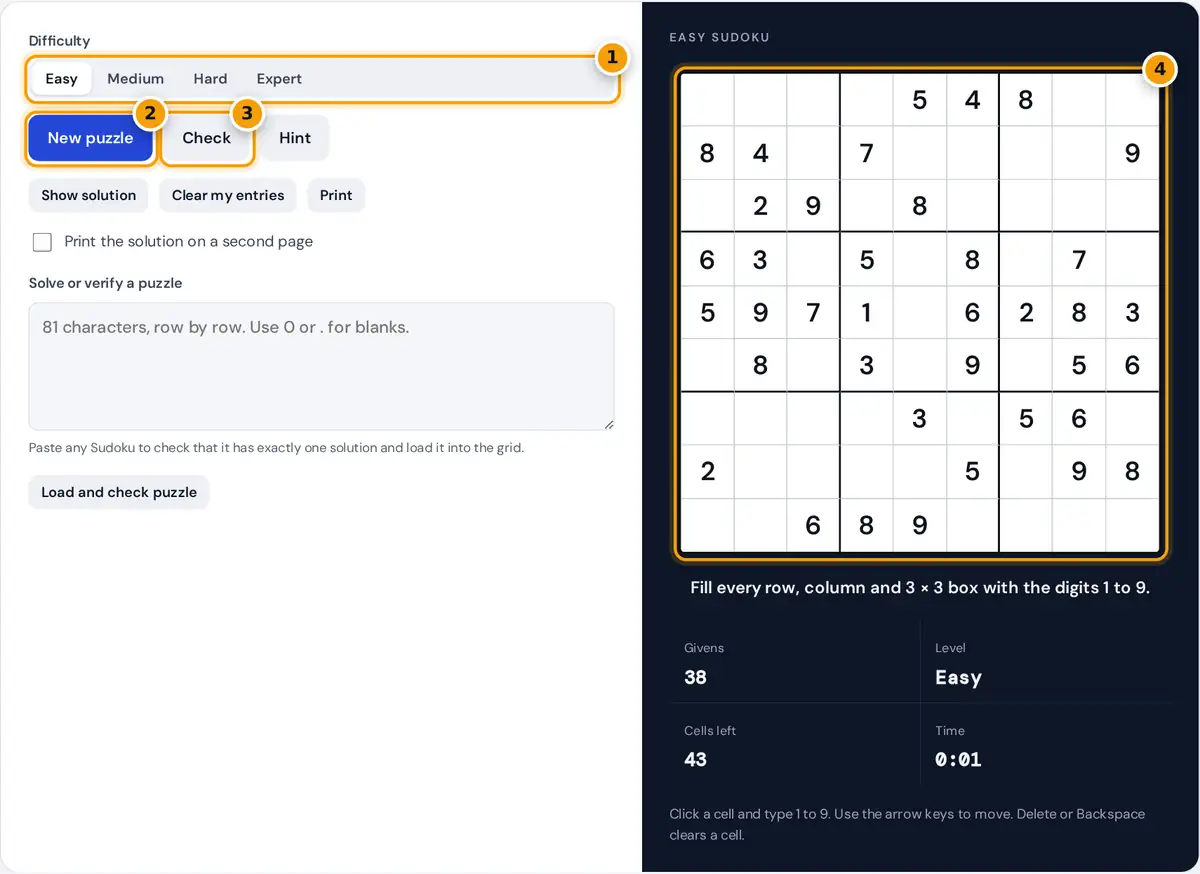
- Choose easy, medium, hard or expert.
- Press New puzzle for a fresh grid.
- Press Check to highlight mistakes, or Hint for one cell.
- Fill the grid, then print or reveal the solution.
Choose a level, Easy, Medium, Hard or Expert, and a new puzzle appears instantly. Click a cell and type a digit from 1 to 9, and move around with the arrow keys. The row, column and box of the selected cell are shaded, and matching digits are highlighted, which makes it easier to spot where a number can go.
Press Check to highlight mistakes and see how many cells are left, or Hint to fill in one correct cell. Show solution reveals the full answer. Press Print for a clean, large-print copy of the puzzle, and tick the box to add the solution on a second page. To solve or verify a puzzle from a book or newspaper, paste its 81 cells into the box and press Load and check puzzle.
Sudoku Rules
A Sudoku grid has 9 rows, 9 columns and 9 boxes of 3 × 3 cells. Some cells start filled in; these are the givens. Your goal is to fill every empty cell so that each row, each column and each box contains the digits 1 to 9 exactly once. A proper Sudoku has exactly one solution, so it can always be solved by logic without guessing.
How the Puzzles Are Generated
The generator first builds a complete, valid grid by placing digits in random order with a backtracking search. It then removes digits in symmetric pairs, so the pattern of givens usually looks the same when the grid is rotated half a turn. After each removal, a solver counts the solutions. If there is more than one, the digits go back. This continues until the puzzle reaches the target number of givens for your level.
| Level | Target givens | Empty cells |
|---|---|---|
| Easy | 38 | 43 |
| Medium | 32 | 49 |
| Hard | 28 | 53 |
| Expert | 24 | 57 |
Expert puzzles are close to the limit of how few givens a random grid can keep while staying unique, so the generator tries several grids within a moment and keeps the closest result. In the rare case it cannot reach 24 givens, the level label says closest found. Fewer givens usually means a harder puzzle, but true difficulty also depends on which solving techniques are needed, so two puzzles at the same level can feel different.
Solving and Verifying Your Own Puzzle
Type or paste a puzzle row by row, using 0 or a dot for empty cells. Spaces and line breaks are ignored. For example, a well-known puzzle starts 530070000 600195000 and so on. The tool checks that no two givens clash, then searches for solutions. It tells you whether the puzzle has a unique solution, no solution, or more than one. Mathematicians have shown that a proper Sudoku needs at least 17 givens, so a grid with fewer will always have several solutions.
Solving Tips
- Scan for singles. Look at each digit in turn and find boxes where it can only go in one cell.
- Check every row and column. When a row has only one or two empty cells, the missing digits are easy to place.
- Use pencil marks on paper. On a printed puzzle, write small candidate digits in the corners of cells.
- Look for pairs. If two cells in a row can only hold the same two digits, those digits can be removed from the rest of the row.
- Never guess on a proper puzzle. There is always a logical next step. If you are stuck, use Hint and see why that digit fits.
Printing Puzzles
The print layout shows only the puzzle, with large cells and thick box lines, and nothing else from the page. It suits classrooms, waiting rooms, care homes and travel. Generate a few puzzles at different levels and print each one for a ready-made puzzle booklet.
Frequently asked questions
Does every puzzle have exactly one solution?
Yes. After each pair of digits is removed, a solver counts the solutions, and the removal is undone if more than one appears. Every generated puzzle has a single, unique solution.
How are the difficulty levels decided?
Levels are based on the number of givens: 38 for Easy, 32 for Medium, 28 for Hard and 24 for Expert. Fewer givens usually means a harder puzzle, though solving techniques also matter.
Can I check my answers as I play?
Yes. Press Check to highlight wrong digits in red and see how many cells are left. Hint fills one correct cell, and Show solution reveals the whole answer.
Can I print a Sudoku?
Yes. Press Print to get a clean, large puzzle on its own page. Tick the solution box to add the answer on a second page, which is handy for teachers and puzzle booklets.
Can this tool solve a Sudoku from a newspaper?
Yes. Paste the 81 cells, using 0 or a dot for blanks, and press Load and check puzzle. The tool says whether it has a unique solution and loads it so you can play, use hints or show the answer.
What is the minimum number of clues in a Sudoku?
A proper Sudoku with a unique solution needs at least 17 givens. This was shown by a large computer search in 2012. Grids with 16 or fewer givens always have more than one solution.