How to Use the Online Tone Generator
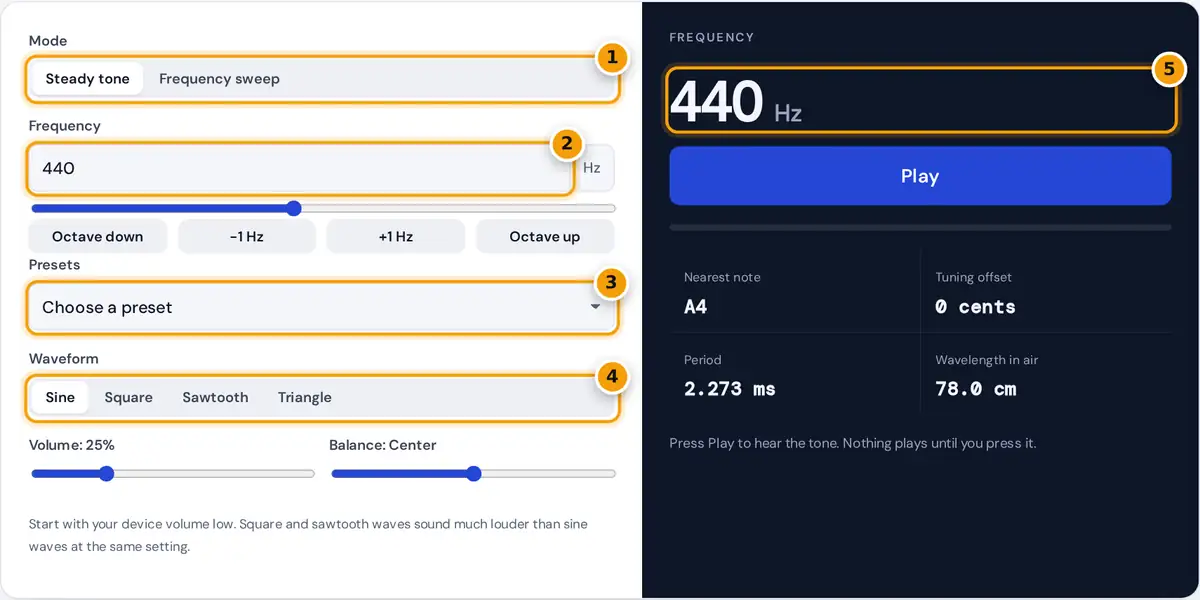
- Choose a steady tone or a frequency sweep.
- Type a frequency in Hz, or drag the slider and use the octave buttons.
- Pick a preset, such as 440 Hz tuning pitch or a 15 kHz hearing check.
- Choose a waveform: sine, square, sawtooth or triangle.
- Check the frequency and nearest note, then press Play with your volume low.
Type a frequency in hertz or drag the slider, choose a waveform and then press Play. Sound starts only when you press the button, so nothing ever plays by surprise when the page first opens.
You can change frequency, waveform, volume and left or right balance while the tone plays. Octave buttons halve or double the frequency, and the 1 Hz buttons nudge it up or down in fine steps.
Presets cover common test tones such as 440 Hz, middle C, 1,000 Hz and mains hum. Beside the frequency you will see the nearest note, the tuning offset in cents, the period and the wavelength.
Using the Frequency Sweep
Choose Frequency sweep to glide smoothly from one frequency to another over a set number of seconds. Enter the start and end frequencies in hertz, the duration, and press Play to hear the complete glide.
A sweep from 20 Hz to 20,000 Hz quickly shows where speakers or headphones stop producing sound. It also reveals where a room, desk or a car door panel starts to rattle at certain pitches.
The sweep is exponential, so it spends equal time in every octave, which matches how we hear pitch. A linear sweep would rush through the bass and spend most of its time on high treble.
Frequency, Notes and Wavelength Formulas
The generator converts frequency into a note number counted in semitones from A4, the 440 Hz tuning reference. It rounds to the nearest semitone to name the note and shows the leftover remainder in cents.
frequency of a note = 440 × 2^(n ÷ 12), where n = semitones from A4
period = 1 ÷ f
wavelength in air = 343 m/s ÷ f (at about 20 °C)
For 1,000 Hz, the formula gives 14.21 semitones above A4. Rounding gives 14, which is B5, and the remaining 0.21 semitones is +21 cents. The period is 1 millisecond and the wavelength is 34.3 cm.
Middle C is 9 semitones below A4, so 440 × 2^(−9 ÷ 12) = 261.63 Hz. Each octave doubles the frequency, so A5 is 880 Hz, and sound travels at about 343 m/s in air at room temperature.
Reference Frequencies
These landmark frequencies help you quickly choose a sensible test tone. Low values feel more like vibration than pitch, while the highest ones sit at the very edge of what young ears can still detect.
| Frequency | What it is |
|---|---|
| 20 Hz | Approximate lower limit of human hearing |
| 27.5 Hz | A0, the lowest key on a standard 88-key piano |
| 50 Hz and 60 Hz | Mains electricity frequency (60 Hz in Canada and the US), heard as hum |
| 261.63 Hz | Middle C (C4) |
| 440 Hz | A4, the standard tuning pitch |
| 1,000 Hz | Common reference tone for audio equipment |
| 4,186 Hz | C8, the highest key on a standard piano |
| 20,000 Hz | Approximate upper limit of hearing in young people |
A4 at 440 Hz is the standard tuning pitch for most modern music, and 1,000 Hz is the usual test tone for most audio gear. Mains electrical hum sits at 60 Hz in North America.
The upper limit of hearing falls with age, so many adults cannot hear tones above 15,000 Hz. If a high tone seems silent, check that your speakers can reproduce it before blaming your own ears.
Sine, Square, Sawtooth and Triangle Waves
A sine wave is a pure tone with a single frequency and no harmonics or overtones at all. It is the best choice for testing equipment, tuning instruments and comparing your hearing at different pitches.
- Square: odd harmonics give a hollow, buzzy sound like old video games.
- Sawtooth: all harmonics give a bright, brassy synthesizer sound.
- Triangle: odd harmonics that fade quickly sound soft, close to a flute.
A square wave contains only odd harmonics at fairly strong levels, which is why it sounds hollow. A triangle also has only odd harmonics, but they fade quickly, making it sound much gentler and rounder.
Square and sawtooth waves sound much louder than a sine wave at the same volume setting, because their extra harmonics add energy. Always lower the volume before switching from a sine wave to another shape.
Volume and Hearing Safety
Always start with your device at a low volume and raise it slowly. Pure tones can be surprisingly piercing, especially at high frequencies or with square waves played through headphones held close to the ear.
Long exposure to loud sound causes hearing damage that does not heal, since inner ear hair cells cannot regrow. The NIDCD guide to noise-induced hearing loss explains safe listening and how damage builds up gradually.
This tool is not a medical hearing test. Results depend on your speakers, volume and room, so if you notice hearing changes, ringing or muffled sound, book a proper hearing assessment with a qualified audiologist.
Limits of a Browser Tone Generator
Tones are created with the Web Audio API locally on your own device. Nothing is recorded, stored or uploaded anywhere, and the online tone generator accepts any frequency from 1 Hz up to 22,000 Hz.
The highest frequency that can actually play is half your audio device's sample rate, usually 22,050 Hz or 24,000 Hz. Very high settings may therefore be cut off or distorted by the audio hardware itself.
Very low tones below about 40 Hz often cannot be reproduced by phone or laptop speakers, so use headphones or a subwoofer. The tone pauses if you switch tabs, so it never plays on unnoticed.
Frequently asked questions
What is a tone generator used for?
Common uses are tuning instruments, testing speakers and headphones, finding rattles in a room or car, checking left and right channels, and exploring which frequencies you can hear on your device.
Is 440 Hz the note A?
Yes. 440 Hz is A4, the A above middle C, and it is the standard tuning pitch for most modern music. Each octave doubles it, so A5 is 880 Hz.
Why can I not hear very high or very low tones?
Human hearing covers roughly 20 to 20,000 Hz and the upper limit drops with age. Small speakers also struggle to reproduce frequencies below about 40 Hz, so try headphones.
Why does the tone not start automatically?
Browsers block sound until you interact with the page, and an unexpected tone would be unpleasant. The generator only plays after you press Play, and it pauses when you switch tabs.
Is this a hearing test?
No. It can show which tones you hear on your current device, but results depend on your speakers and volume. For a real hearing assessment, see an audiologist or hearing clinic.
What does a frequency sweep do?
A sweep glides smoothly from one frequency to another over a set time. Sweeping from 20 Hz to 20,000 Hz shows where speakers stop producing sound and where objects in a room start to rattle.