How to Use the Last Name Generator
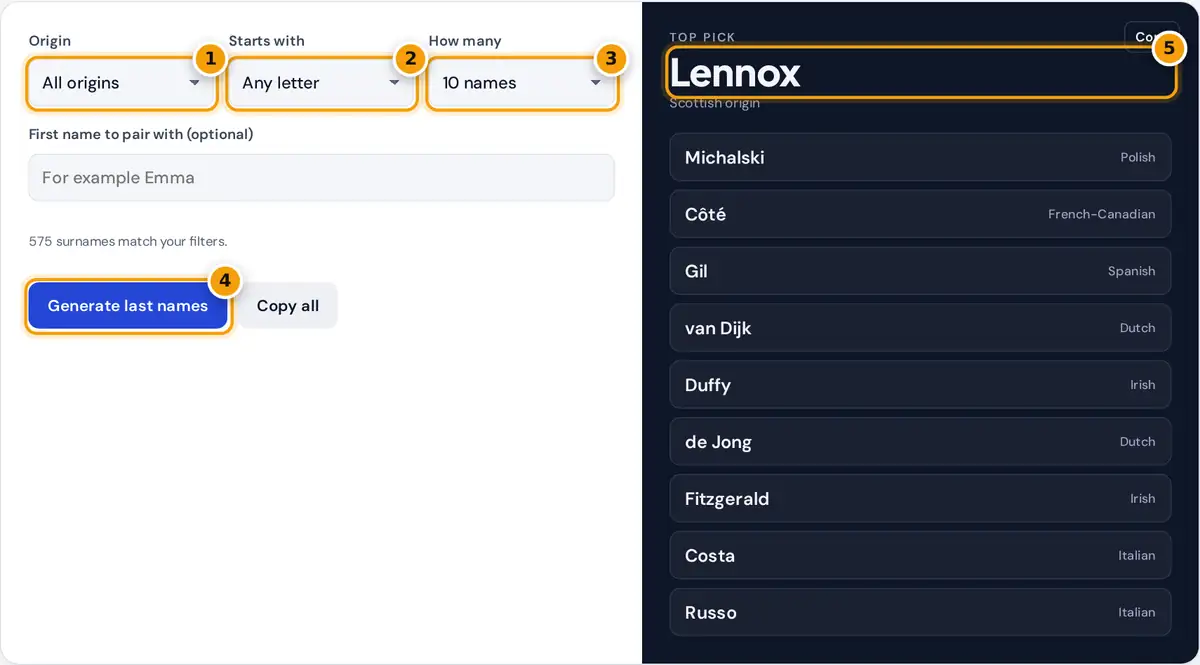
- Choose an origin, such as Irish, French-Canadian or Korean, or keep all origins.
- Pick a starting letter if the surname must begin with one.
- Choose how many last names to generate: 5, 10 or 25.
- Press Generate last names for a fresh random list.
- Read your top pick and its origin, then copy one name or the whole list.
Pick an origin, or keep All origins for a global mix, and optionally choose a Starts with letter. Then select 5, 10 or 25 names and press Generate last names for new random last names.
Each surname carries an origin label, and a counter shows how many names match your filters. The first result appears as the top pick, so you always have one suggestion ready before scanning the list.
Type a first name to see full name combinations, which helps when naming a character or testing how a surname sounds. Click any surname to copy it instantly, or use Copy all for every result.
Where the Surnames Come From
This last names generator holds 575 real surnames, 25 for each of 23 origins. They are among the most common or recognizable names in each tradition, so they sound authentic in stories and sample data.
| Origin | Examples |
|---|---|
| English | Smith, Taylor, Clarke, Wright |
| Scottish | Campbell, MacDonald, Stewart, Robertson |
| Irish | Murphy, Kelly, O'Sullivan, Walsh |
| Welsh | Jones, Davies, Evans, Thomas |
| French | Martin, Bernard, Dubois, Durand |
| French-Canadian | Tremblay, Gagnon, Roy, Côté |
| German | Müller, Schmidt, Schneider, Fischer |
| Italian | Rossi, Russo, Ferrari, Esposito |
| Spanish | García, Rodríguez, González, Fernández |
| Portuguese | Silva, Santos, Ferreira, Pereira |
| Dutch | de Jong, Jansen, de Vries, van den Berg |
| Scandinavian | Hansen, Johansen, Olsen, Larsen |
| Polish | Nowak, Kowalski, Wiśniewski, Wójcik |
| Ukrainian | Shevchenko, Kovalenko, Bondarenko, Tkachenko |
| Greek | Papadopoulos, Papadakis, Georgiou, Nikolaidis |
| Jewish (Hebrew and Yiddish) | Cohen, Levi, Katz, Friedman |
| Arabic | Haddad, Khoury, Mansour, Nasser |
| Indian | Sharma, Patel, Singh, Kumar |
| Chinese | Wang, Li, Zhang, Liu |
| Japanese | Sato, Suzuki, Takahashi, Tanaka |
| Korean | Kim, Lee, Park, Choi |
| Vietnamese | Nguyen, Tran, Le, Pham |
| Nigerian | Adeyemi, Okafor, Okonkwo, Adebayo |
The mix runs from English, Scottish and Irish names to French-Canadian, Ukrainian, Indian, Korean and Nigerian ones. That range reflects the many family name traditions you will find in Canada and other multicultural countries today.
No name appears under more than one origin, even where a surname is shared between cultures. The origin label therefore shows where the generator files a name, not every place that family name is used.
Spelling, Accents and Name Order
Spellings follow the most common form in each language, with accents kept where they belong, as in Côté, García and Müller. Removing accents changes how a name looks, so keep them if your project allows.
Names from languages with other writing systems, such as Chinese, Japanese, Korean, Greek, Ukrainian and Arabic, appear in a common romanized spelling using the English alphabet. Other spellings exist for nearly every one of them.
The Korean surname Lee is also written Yi or Rhee, and Nguyen is Nguyễn in Vietnamese. In Chinese, Japanese, Korean and Vietnamese naming, the family name traditionally comes first, so name order matters for characters.
How the Random Pick Works
Results are drawn without repeats from the names that match your filters, using the secure random source built into your browser. Every matching surname is equally likely, and nothing you type is ever sent anywhere.
With 10 names from the full list of 575, each surname has a 10 in 575 probability of appearing, about 1.7%. Filter to the 25 Irish names, show 5, and each has a 20% chance.
The randomness comes from the browser's cryptographic generator described in the W3C Web Cryptography specification, rather than a simpler, predictable pseudo-random function, so lists are not biased toward any origin or letter of the alphabet.
How Surnames Were Formed
Most family names grew from a small handful of everyday sources: a person's job, a parent's name, a home place or a nickname. Knowing a surname's meaning helps you pick one that suits a character.
- Occupational names: Smith, Baker, Fletcher (arrow maker), Müller (miller), Schneider (tailor).
- Patronymic names: Johansen and Andersen mean son of Johan and son of Anders.
- Place names: Hill, Wood, Berg (mountain) and van Dijk (from the dike).
- Nicknames: Klein (small), Braun (brown) and Rossi (red, often for red hair).
Many Irish names begin with O', meaning grandson of, while Mac means son of in Irish and Scottish names. Spanish names ending in -ez, such as Fernández, carry the same patronymic sense of family descent.
Occupational surnames are especially common in English and German, which helps explain why Smith, Müller and Schmidt rank so high. The Italian Ferrari also means smith, showing how one trade produced similar names across Europe.
The Most Common Last Names
Wang and Li are often cited as the most common surnames in the world because of China's large population, with Zhang close behind. All three of them appear in the Chinese section of this generator.
In the United States, Smith tops the list of surnames counted in the 2010 census surname data, followed closely by Johnson and Williams. Smith is also among the most common surnames found in Canada today.
Tremblay is very closely tied to Quebec and leads the French-Canadian list here. Many popular names cluster in one region, so an origin filter gives far more believable results than a single global ranking would.
Good Uses for a Random Surname
Writers use a random last name generator to find character names for novels, scripts, fantasy campaigns and role-playing games. Real surnames make supporting characters feel more grounded, even in invented worlds with their own maps.
Developers and trainers use the list for placeholder names in mockups, demos and test data. Because every name is real and common, the samples look natural without pointing to any one specific person you know.
The tool also helps when brainstorming a pen name or checking how a first name sounds with different surnames. For deeper research into a particular culture, treat the generated name as a starting point only.
Frequently asked questions
How many last names are in the generator?
It contains 575 real surnames, 25 from each of 23 origins, including English, Irish, French-Canadian, Italian, Indian, Chinese, Korean and Nigerian names. You can filter by origin and first letter.
Are these real last names?
Yes. Every surname in the list is a real, commonly used family name in its tradition. They are not invented, so they work well for realistic characters, sample customers and test data.
Can I get last names that start with a certain letter?
Yes. Choose a letter in the Starts with menu. The counter shows how many surnames match, and you can combine the letter with any origin to narrow the list further.
What is the most common last name in the world?
Wang and Li are often cited as the most common surnames worldwide because of China's large population, with Zhang close behind. In Canada and the United States, Smith is among the most common.
Can I use a generated surname for a character?
Yes. Surnames are not owned by anyone, so you can use them freely. Avoid pairing a famous first name with its well-known surname if you want an original character.
Can I generate fantasy last names?
This generator uses real surnames rather than invented ones. For a fantasy setting, real names from one origin, such as Welsh or Scandinavian, give a consistent feel that readers find believable.