How to Use the Random Year Generator
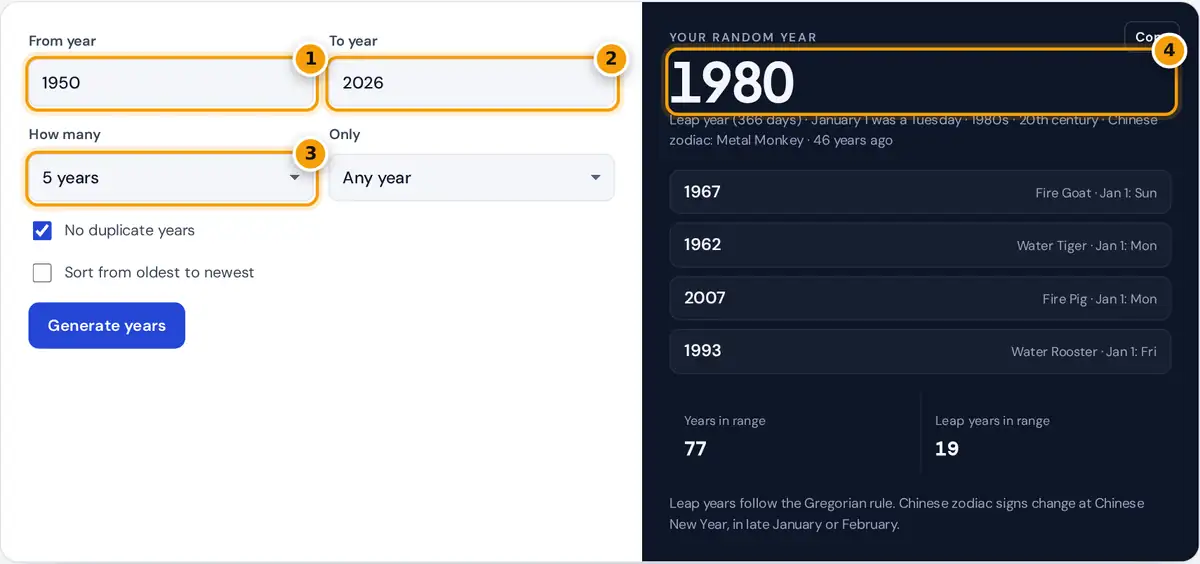
- Enter the earliest year.
- Enter the latest year. Both ends are included.
- Choose how many years to generate.
- Read the year with its leap status, weekday, century and zodiac.
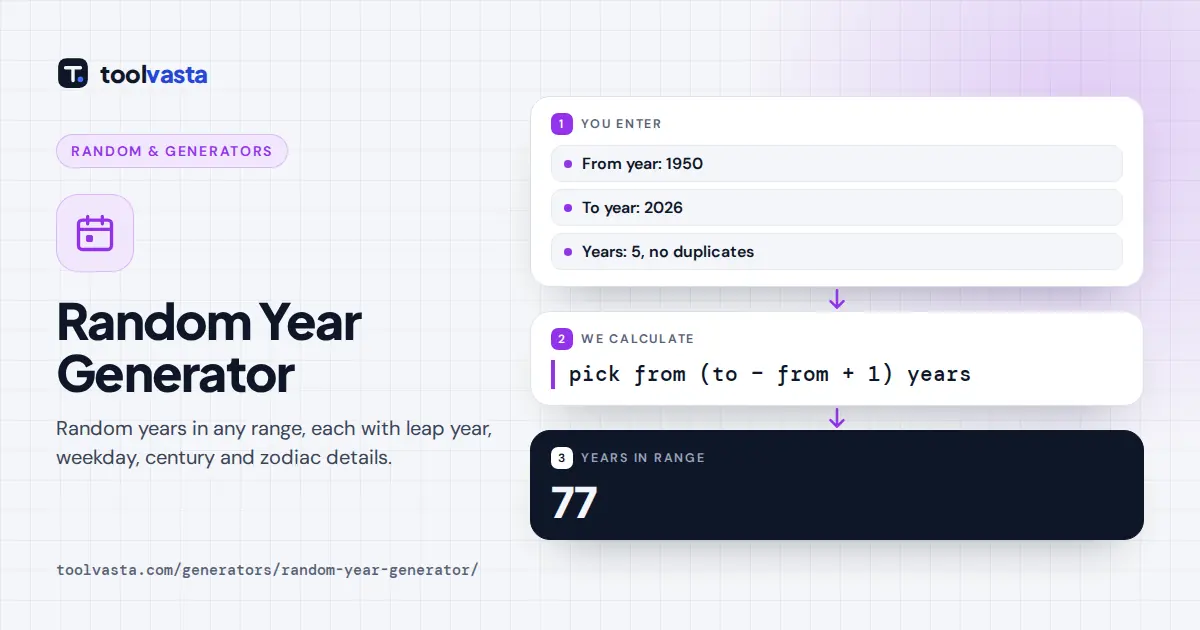
Enter a From year and a To year, choose how many years you want and press Generate years. Both ends of the range are included, so 1950 to 2026 covers 77 years. The first year appears large with its details underneath, and the rest are listed below with their leap status, Chinese zodiac sign and the weekday of January 1.
Keep No duplicate years ticked for a list of different years, or untick it to allow repeats, as if each year were drawn from a hat and put back. Tick Sort to list the years in order, and use the Only filter to draw just leap years or just common years. The copy button copies the years one per line, ready to paste into a spreadsheet.
The Leap Year Rule
The generator uses the Gregorian calendar, the calendar used in most of the world today. A year is a leap year with 366 days when it meets this rule:
So 2024 is a leap year, 1900 is not (divisible by 100 but not by 400), and 2000 is (divisible by 400). From 1950 to 2026 there are 19 leap years: 1952, 1956 and every fourth year up to 2024. Years before 1582 are shown in the proleptic Gregorian calendar, which extends today's rules backward, so dates may differ from historical Julian records.
Worked Example
Set both years to 2000. The result is 2000: a leap year because it is divisible by 400, January 1 fell on a Saturday, it belongs to the 2000s decade and the 20th century (the 21st century began on January 1, 2001), and its Chinese zodiac sign is the Metal Dragon. Set both to 1900 and you get a common year of 365 days that began on a Monday.
| Year | Leap year? | January 1 | Century | Chinese zodiac |
|---|---|---|---|---|
| 1900 | No | Monday | 19th | Metal Rat |
| 1969 | No | Wednesday | 20th | Earth Rooster |
| 2000 | Yes | Saturday | 20th | Metal Dragon |
| 2024 | Yes | Monday | 21st | Wood Dragon |
How the Chinese Zodiac Is Worked Out
The Chinese zodiac repeats every 12 years in the order Rat, Ox, Tiger, Rabbit, Dragon, Snake, Horse, Goat, Monkey, Rooster, Dog and Pig. Each sign is paired with one of five elements, Metal, Water, Wood, Fire and Earth, which change every two years, giving a 60-year cycle. Because Chinese New Year falls between January 21 and February 20, someone born in January or early February belongs to the previous year's sign.
Ways to Use a Random Year
- Trivia and history games: draw a year and ask players to name an event, a song or an invention from it.
- Test data: generate realistic birth years or model years for forms and spreadsheets.
- Writing prompts: set a story in a random year and research what daily life was like.
- Teaching: practice leap year rules and centuries with real examples.
Decades and Centuries
Each result shows the decade and the century a year belongs to. Decades are counted the everyday way, so 1987 is in the 1980s. Centuries follow the formal count, which starts at year 1 because there was no year zero, so the 20th century ran from 1901 to 2000 and the 21st began in 2001.
For example, (1950 − 1) ÷ 100 = 19.49, which rounds down to 19, plus 1 gives the 20th century. The same formula puts 2000 in the 20th century and 2001 in the 21st.
How the Weekday Is Found
The weekday of January 1 comes from your browser's built-in calendar, which uses the Gregorian calendar for every year. A common year of 365 days moves January 1 forward by one weekday, and a leap year moves it by two. That is why 2024 began on a Monday and 2025 on a Wednesday.
Frequently asked questions
How do I generate a random year between two years?
Type the earliest year in From year and the latest in To year, choose how many years you want and press Generate. Both years you enter can be picked.
Is 2000 a leap year?
Yes. 2000 is divisible by 400, so it is a leap year even though it is divisible by 100. The year 1900 is not a leap year because it is divisible by 100 but not by 400.
Can the random years repeat?
Only if you want them to. With No duplicate years ticked, every year in the list is different. Untick it to allow repeats, like drawing a year and putting it back each time.
Can I generate only leap years?
Yes. Set Only to Leap years and the generator draws only from leap years in your range. The stats show how many leap years the range contains.
Why does my Chinese zodiac sign differ from the result?
The zodiac year starts at Chinese New Year, between January 21 and February 20. If you were born in January or early February, your sign is usually the previous year's.
When did the 21st century start?
The 21st century started on January 1, 2001, because there was no year zero. The year 2000 was the last year of the 20th century.