How to use the random flag generator
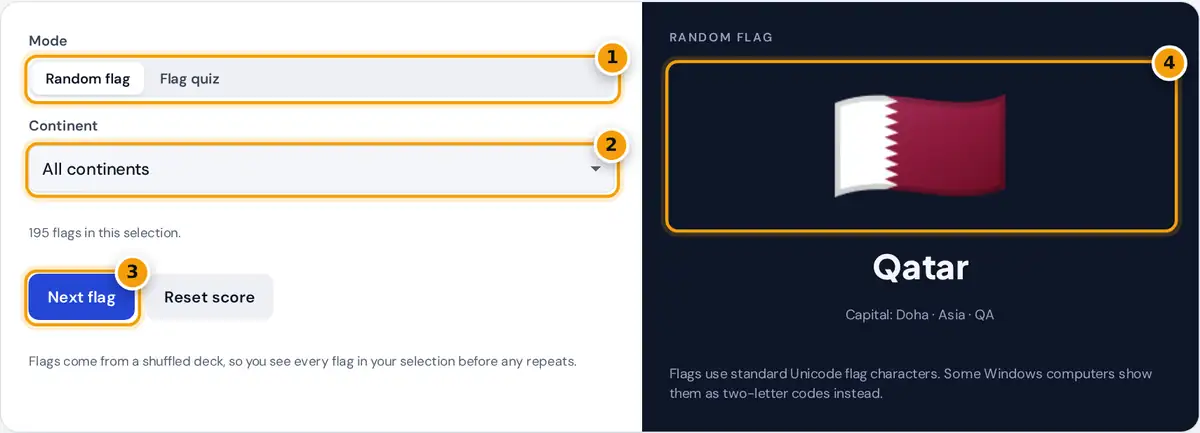
- Choose Random flag to browse, or Flag quiz to guess from multiple choices.
- Pick a continent to practice, or keep All continents for all 195 flags.
- Press Next flag for another flag. You see every flag once before any repeats.
- Read the flag with its country, capital and continent.
In Random flag mode, press Next flag to see a new country flag with the country's name, capital, continent and ISO code. Switch to Flag quiz to hide the name and choose the right country from four options. The score, percentage and best streak update after each answer, and the correct answer is highlighted so you learn from mistakes.
Use the continent filter to practice one region at a time. In quiz mode, the three wrong options come from the same continent as the correct answer, which makes the quiz harder and more useful, since neighboring countries often have similar flags.
Which flags are included
The generator covers 195 countries: the 193 member states of the United Nations plus Vatican City and Palestine, the two UN observer states. Flags are drawn from a shuffled deck, so you see every flag in your selection once before the deck is reshuffled.
chance of guessing right at random in the quiz = 1 ÷ 4 = 25%
For example, Europe has 44 flags, so 44 presses of Next flag shows each European flag exactly once. If you guessed blindly in quiz mode, you would expect about 25% correct, so a score well above that shows real progress.
How the flags are displayed
The page shows flags with Unicode regional indicator symbols. Each country's two-letter ISO 3166-1 code, such as CA for Canada, is written with two special letters that phones and most browsers display as the national flag. Because the flags are characters rather than images, the page loads instantly and the flags stay crisp at any size. On some Windows computers the system font does not include flag designs, so you will see the two letters instead. The country name and code are always shown, so the generator still works there.
Flags that are easy to mix up
| Flags | How to tell them apart |
|---|---|
| Chad and Romania | Both are vertical blue, yellow and red stripes. Chad's blue is darker. |
| Indonesia and Monaco | Both are red over white. They differ only in proportions. |
| Ireland and Côte d'Ivoire | Ireland is green, white and orange from the flagpole. Côte d'Ivoire is orange, white and green. |
| Netherlands and Luxembourg | Both are red, white and blue stripes. Luxembourg uses a lighter blue and a longer flag. |
| Australia and New Zealand | Both show the Union Jack and the Southern Cross. New Zealand's stars are red with white borders, and Australia adds a large seven-pointed star. |
Tips for learning world flags
- Learn one continent at a time, starting with the region you know best.
- Group flags by pattern: horizontal stripes, vertical stripes, crosses, stars and emblems.
- Pay attention to colors that carry meaning across regions, such as the pan-African red, gold and green or the Nordic cross.
- Practice in short daily sessions. Ten minutes of quizzing beats an hour of reading once a week.
Frequently asked questions
How many flags are in the random flag generator?
There are 195 country flags: the 193 United Nations member states plus Vatican City and Palestine.
How does the flag quiz work?
Each round shows a flag and four country names from the same continent. Choose one to see the correct answer, and your score, percentage and best streak update automatically.
Why do I see letters instead of a flag?
Flags are shown with Unicode flag characters. Some Windows computers do not include flag images in their system font, so they display the two-letter country code instead.
Can I practice flags from just one continent?
Yes. Choose a continent in the filter and both the random flags and the quiz options come from that region.
Will the same flag repeat?
Not until you have seen every flag in your selection. The flags are dealt from a shuffled deck that reshuffles when it runs out.